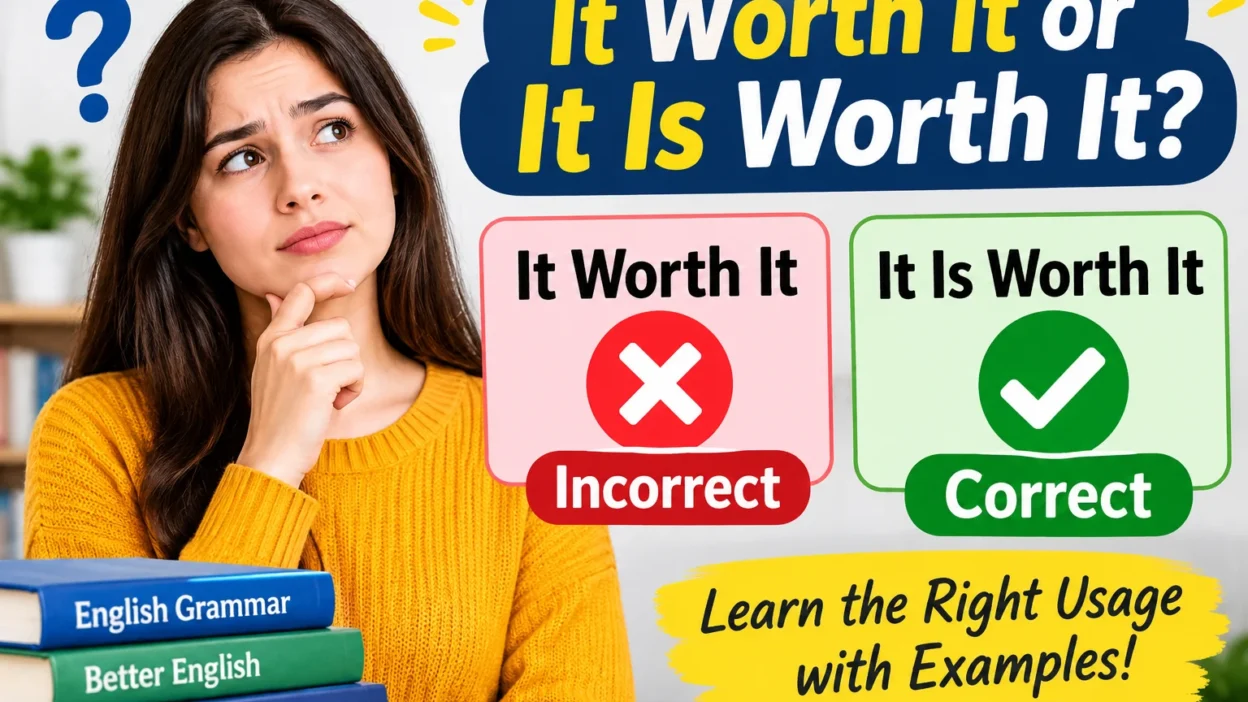
The phrases “it worth it” and “it is worth it” may look similar, but only one is grammatically correct in standard English. If you are wondering if to say “it worth it” or “it is worth it,” the correct expression is “it is worth it.” You need the verb “is” to make the sentence grammatically complete.
English learners sometimes leave out the verb “is” because the shorter expression sounds understandable in casual conversation, text messages, or informal writing. However, understanding the correct sentence structure helps you communicate more clearly and confidently. If you are talking about buying something, spending money, learning a skill, or making an important decision, knowing how to use “worth it” correctly can improve your everyday English.
Quick Answer
“It is worth it” is the grammatically correct expression. The phrase “it worth it” is incorrect in standard English because it is missing the linking verb “is.” You can also use contractions such as “it’s worth it” in everyday conversations and informal writing.
Why Do People Confuse “It Worth It” and “It Is Worth It”?
People confuse these expressions because both communicate a similar idea: something has value or deserves the time, money, or effort required.
The confusion often happens for three reasons:
- Informal communication: People sometimes shorten sentences when texting or speaking quickly.
- Missing linking verbs: English learners may forget that adjectives such as “worth” need a suitable verb in this sentence structure.
- Similar expressions: Phrases such as “worth the money” and “worth trying” can make learners think the verb “is” is optional.
However, standard English requires a linking verb in this construction.
For example:
- Incorrect: It worth the money.
- Correct: It is worth the money.
First Word: Understanding “It Worth It”
“It worth it” is grammatically incorrect in standard English.
The problem is that the sentence does not contain a linking verb between the subject “it” and the expression “worth it.”
In this construction, “worth” functions as an adjective. It describes if something has enough value to justify its cost, time, or effort.
Why Is “It Worth It” Incorrect?
English sentences generally need a verb to connect the subject with an adjective.
Consider these examples:
- Incorrect: It beautiful.
- Correct: It is beautiful.
- Incorrect: It expensive.
- Correct: It is expensive.
- Incorrect: It worth it.
- Correct: It is worth it.
Without “is,” the sentence is incomplete in standard English.
Can You Use “It Worth It” in Text Messages?
You might see “it worth it” in casual messages, social media comments, or informal online conversations.
People may understand the intended meaning, but that does not make the expression grammatically correct.
For professional emails, academic assignments, articles, and formal conversations, use “it is worth it” or “it’s worth it.”
Second Word: Understanding “It Is Worth It”
“It is worth it” is the correct and complete expression in standard English.
It means that something provides enough value, enjoyment, benefit, or satisfaction to justify the money, time, or effort spent on it.
How Is “It Is Worth It” Used?
The expression usually follows this structure:
Subject + is + worth + it
Examples:
- This course is worth it.
- The new phone is worth it.
- Learning English is worth it.
- The long journey is worth it.
The expression can describe different kinds of value, including financial, personal, educational, and emotional value.
What Does “Worth It” Mean?
“Worth it” means that something is valuable enough to justify the cost, effort, time, or inconvenience involved.
For example:
- The expensive laptop is worth it because it works efficiently.
- Studying every day is worth it because it improves your English.
- The long wait was worth it because the experience was amazing.
Is “It’s Worth It” Also Correct?
Yes! “It’s worth it” is the contracted form of “it is worth it.”
Both expressions are grammatically correct.
- It is worth it. (Full form)
- It’s worth it. (Contracted form)
The full form is useful when you want to emphasize the statement. The contracted form sounds natural in everyday conversation.
It Worth It vs It Is Worth It: Comparison Table
| Feature | It Worth It | It Is Worth It |
|---|---|---|
| Grammar | Incorrect | Correct |
| Linking verb | Missing | Includes “is” |
| Standard English | Not accepted | Accepted |
| Formal writing | Avoid | Appropriate |
| Meaning | Intended but incomplete | Something has value |
| Example | It worth buying. | It is worth buying. |
When to Use Each Expression
Understanding when to use these expressions is simple because only one is grammatically correct in standard English.
When to Use “It Is Worth It”
Use “it is worth it” when you want to explain that something deserves the time, money, energy, or effort required.
Examples:
- The training program is worth it.
- This book is worth reading.
- The extra expense is worth it.
- Learning a second language is worth it.
You can use this expression in conversations, professional writing, academic assignments, and everyday communication.
When to Avoid “It Worth It”
Avoid using “it worth it” as a complete standard English sentence.
Instead, add the appropriate linking verb.
Examples:
- Incorrect: It worth the price.
- Correct: It is worth the price.
- Incorrect: It worth watching.
- Correct: It is worth watching.
- Incorrect: It worth my time.
- Correct: It is worth my time.
15 Examples of “It Is Worth It” in Sentences
Here are practical examples showing how to use “it is worth it” naturally in everyday English.
- Buying a good-quality laptop is worth it because it lasts longer.
- Learning English is worth it if you want better career opportunities.
- This restaurant is expensive, but it is worth it.
- The long journey was tiring, but it was worth it.
- Is it worth it to buy a new smartphone?
- Exercising regularly is worth it for your overall fitness.
- The online course is worth it because it teaches practical skills.
- Working hard for your dreams is always worth it.
- This movie is worth watching with your family.
- The extra money is worth it for better quality.
- I think the vacation is worth it because we need a break.
- The difficult exam preparation was worth it when I passed.
- Is this expensive camera really worth it?
- Spending time with your loved ones is worth it.
- The effort you put into learning a new skill will be worth it.
Examples Using the Contraction “It’s Worth It”
You can also use the shorter form in everyday conversations.
- It’s worth it to learn another language.
- It’s definitely worth it.
- The price is high, but it’s worth it.
- Trust me, it’s worth it.
Common Mistakes to Avoid
English learners sometimes make mistakes when using “worth it.” Here are some common problems and their corrections.
| Incorrect Expression | Correct Expression |
|---|---|
| It worth it. | It is worth it. |
| It worth the money. | It is worth the money. |
| It worth to try. | It is worth trying. |
| This worth it. | This is worth it. |
| Is worth it? | Is it worth it? |
| It worth watching. | It is worth watching. |
Mistake 1: Leaving Out the Verb
Incorrect: It worth buying.
Correct: It is worth buying.
Mistake 2: Using “To” Before a Gerund
Incorrect: It is worth to watch.
Correct: It is worth watching.
After “worth,” use a noun or a gerund (the -ing form of a verb) in this construction.
Mistake 3: Forgetting the Subject in a Question
Incorrect: Is worth it?
Correct: Is it worth it?
Remember to include the subject “it” in the question.
Memory Trick: How to Remember the Correct Expression
A simple way to remember the correct expression is to think of “worth” as an adjective that needs a linking verb in this sentence structure.
Remember: It + Is + Worth + It.
For example:
- It is worth learning.
- It is worth buying.
- It is worth trying.
You can also remember that “it’s” means “it is.”
Whenever you are unsure, ask yourself if your sentence needs the linking verb “is.” This small trick can help you avoid the mistake.
American vs British English
There is no grammatical difference between American and British English when using “it is worth it.”
Both varieties use the same correct expression.
| American English | British English |
|---|---|
| It is worth it. | It is worth it. |
| It’s worth buying. | It’s worth buying. |
| Is it worth the money? | Is it worth the money? |
| It isn’t worth it. | It isn’t worth it. |
The pronunciation and accent may differ, but the grammar remains the same.
You can confidently use “it is worth it” in both American and British English.
Similar Words and Expressions
Several expressions have meanings similar to “it is worth it.” Learning them can help you expand your vocabulary.
1. Worthwhile
“Worthwhile” means useful, valuable, or deserving of the time and effort involved.
Example: Learning a new language is a worthwhile experience.
2. Valuable
“Valuable” describes something that has significant importance or usefulness.
Example: Her advice was valuable to my career.
3. Worth the Money
This expression means that something provides enough quality or benefit to justify its price.
Example: This laptop is worth the money.
4. Worth Trying
This means that something deserves an attempt because it might produce a good result.
Example: This new learning method is worth trying.
5. Worth the Effort
This expression means that the benefits justify the work required.
Example: Completing the project was difficult, but it was worth the effort.
6. Worthwhile Investment
This describes something that is likely to provide useful benefits in the future.
Example: Learning professional skills is a worthwhile investment.
Final Verdict: It Worth It or It Is Worth It?
The correct expression is “it is worth it.” The phrase “it worth it” is grammatically incorrect in standard English because it leaves out the linking verb “is.”
You can also use “it’s worth it,” which is the contracted form of “it is worth it.”
Remember these examples:
- Incorrect: It worth it.
- Correct: It is worth it.
- Also correct: It’s worth it.
If you are speaking, texting, or writing professionally, using the correct expression will make your English clearer and more natural.
FAQs:
1. Is It Worth It or Is It Is Worth It?
“Is it worth it?” is the correct question form. “Is it is worth it?” is incorrect because it repeats the verb “is.”
Example: Is it worth it to buy this phone?
2. Is “It Worth It” Grammatically Correct?
No. “It worth it” is grammatically incorrect in standard English because it is missing the linking verb “is.”
The correct expression is “it is worth it.”
3. Can I Say “It’s Worth It” Instead of “It Is Worth It”?
Yes. “It’s worth it” is the contracted form of “it is worth it.” Both expressions are grammatically correct and have the same meaning.
4. What Does “It Is Worth It” Mean?
“It is worth it” means that something provides enough value or benefit to justify the money, time, or effort spent on it.
Example: The course is expensive, but it is worth it.
5. Is “Worth It” Formal or Informal?
“Worth it” is natural in both formal and informal English. You can use it in everyday conversations, emails, articles, and professional discussions.
6. Is It Correct to Say “It Is Worth to Try”?
No. In this construction, use a gerund (verb ending in -ing) after “worth.”
Correct: It is worth trying.
Incorrect: It is worth to try.
7. Can I Use “Worth It” Without “Is”?
Yes, in certain grammatical structures, but not as a complete sentence with “it” as the subject.
For example:
- Is it worth it?
- I think it is worth it.
- If worth it, consider buying it.
The final example uses an elliptical structure where words are omitted but understood from context.
Remember This
- It is worth it: Correct.
- It’s worth it: Correct.
- It worth it: Incorrect in standard English.
- Is it worth it?: Correct question form.
- It is worth trying: Correct construction.
- It is worth to try: Incorrect construction.
The most important rule is to include the linking verb “is” when using “it” as the subject in a statement.
Conclusion
Choosing between “it worth it” and “it is worth it” is easy once you understand the role of linking verbs in English grammar. “It is worth it” is the grammatically correct expression because “is” connects the subject “it” with the adjective “worth.” On the other hand, “it worth it” is incomplete and should be avoided in standard English writing and speaking.
You can also use “it’s worth it” as a shorter, natural alternative in everyday communication. Remember to use “worth” with nouns or -ing forms when explaining if something deserves your time, money, or effort. With regular practice and attention to sentence structure, you can use these expressions confidently and avoid common English grammar mistakes.