
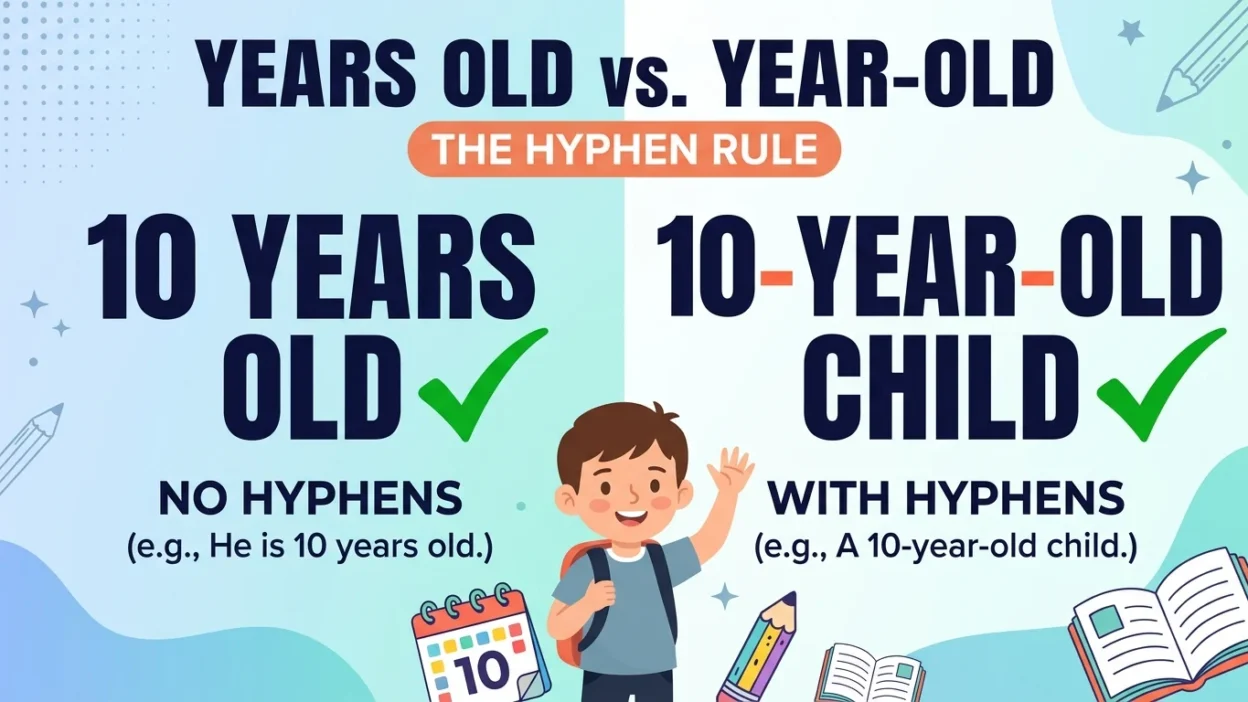
When writing about someone’s age, it is easy to get confused about if to use a hyphen in expressions such as 10 years old, 10-year-old, or a 10-year-old child. Although these expressions look similar, they follow different grammar rules. Knowing when to use a hyphen helps you write clear, natural, and grammatically correct English.
The main rule is simple: Use hyphens when an age expression comes before a noun as a compound adjective. Do not use hyphens when the age comes after a verb such as “is,” “was,” or “looks.” For example, write “She is 10 years old,” but write “She is a 10-year-old girl.” The difference depends on how the age expression functions in the sentence, not simply on the number of years.
Quick Answer: What Is the Years Old Hyphen Rule?
Use years old without hyphens when describing someone’s age after a verb. For example, “My son is 10 years old.” Use year-old with hyphens when the expression comes before a noun and describes it. For example, “My 10-year-old son loves football.” Use singular “year,” not “years,” in the hyphenated expression.
Why Do People Confuse the Years Old Hyphen Rule?
People often confuse these expressions because they communicate the same age but have different grammatical structures.
Consider these examples:
- She is 12 years old.
- She is a 12-year-old student.
Both sentences describe a 12-year-old person. However, the first expression describes age independently, while the second acts as an adjective describing the noun “student.”
There are three common reasons for this confusion:
- Similar meanings: Both expressions communicate someone’s age.
- Different grammatical functions: One is an age description, while the other is a compound adjective.
- Singular and plural differences: The standalone expression uses “years,” but the compound adjective uses “year-old.”
Understanding these differences makes the rule much easier to remember.
First Word: Years Old
Years old is an age expression used after a linking verb or another appropriate verb. It tells the reader how old someone or something is.
It does not need hyphens because it is not functioning as a compound adjective directly before a noun.
Meaning of Years Old
The expression “years old” means the number of years a person, animal, building, or object has existed.
For example:
- My daughter is five years old.
- This house is 100 years old.
- The puppy is two years old.
- My grandfather is 75 years old.
In these sentences, the age expression comes after the subject and verb.
When to Use Years Old
Use “years old” when:
- You describe someone’s age after a verb.
- You answer a question about age.
- You write an age at the end of a sentence.
- You describe how long something has existed.
Examples:
- How old are you? I am 20 years old.
- My brother was 15 years old when he started college.
- The building is almost 200 years old.
- Their youngest child is three years old.
Remember that “years old” normally uses the plural form when the number is greater than one.
Second Word: Year-Old
Year-old is a compound adjective used to describe the age of a person, animal, object, or thing before a noun.
It uses hyphens to connect the words into one descriptive expression.
Meaning of Year-Old
The expression “year-old” describes how many years someone or something has existed.
For example:
- A 10-year-old boy
- A 25-year-old woman
- A 50-year-old building
- A three-year-old dog
Notice that “year” stays singular, even when the number is greater than one.
When to Use Year-Old
Use “year-old” when the complete age expression comes immediately before a noun.
Examples:
- She is a 10-year-old girl.
- We adopted a two-year-old dog.
- He bought a 20-year-old car.
- They live in a 100-year-old house.
The hyphens connect the number, the word “year,” and “old” into a single compound modifier.
Years Old vs Year-Old: Comparison Table
| Feature | Years old | Year-old |
|---|---|---|
| Hyphen | No | Yes |
| Grammar role | Age expression | Compound adjective |
| Position | Usually after a verb | Before a noun |
| Form | Plural “years” | Singular “year” |
| Example | She is 10 years old. | A 10-year-old girl. |
The key difference is grammatical function. Use “years old” to state an age and “year-old” to describe a noun.
When to Use Each: Years Old or Year-Old?
Choosing the correct form becomes easier when you identify where the age expression appears in your sentence.
1. Use Years Old After a Linking Verb
When the age follows verbs such as “is,” “are,” “was,” or “were,” do not use hyphens.
Examples:
- My sister is 18 years old.
- The building was 80 years old.
- The children are six years old.
2. Use Year-Old Before a Noun
When an age expression describes a noun, connect the words with hyphens.
Examples:
- An 18-year-old student
- An 80-year-old building
- Six-year-old children
3. Use Year-Old Without a Following Noun When Appropriate
The compound adjective can also appear after a noun when the sentence uses a structure such as “a child who is 10 years old” shortened to “a child who is 10-year-old” only in certain established constructions. In standard everyday English, the natural form is “a child who is 10 years old.”
However, you can use the compound adjective as a noun:
- The 10-year-old won the competition.
- A 16-year-old applied for the scholarship.
- The two-year-old started walking.
Here, “10-year-old” and similar forms refer to people rather than directly modifying a following noun.
15 Examples of Years Old and Year-Old in Sentences
Here are practical examples showing how to use both forms correctly.
Examples Using Years Old
- My younger brother is 12 years old.
- The baby is only six months old.
- This school is 75 years old.
- My grandmother is 90 years old.
- The dog is three years old.
- Their oldest son is 21 years old.
- The company is 15 years old.
- I was 10 years old when I learned to swim.
Examples Using Year-Old
- My 12-year-old brother plays basketball.
- She adopted a three-year-old dog.
- They purchased a 75-year-old house.
- The 90-year-old woman lives independently.
- He has a 21-year-old son.
- A 15-year-old company can still be considered relatively young.
- The 10-year-old boy learned to swim.
Common Mistakes With the Years Old Hyphen Rule
Even experienced English writers sometimes make mistakes when describing age. Here are the most common ones and how to correct them.
Mistake 1: Using Hyphens After a Verb
Incorrect: She is 10-years-old.
Correct: She is 10 years old.
Why? The age expression follows the linking verb “is,” so it does not need hyphens.
Mistake 2: Using Years Instead of Year in a Compound Adjective
Incorrect: He is a 15-years-old student.
Correct: He is a 15-year-old student.
Why? Compound age adjectives always use the singular form “year.”
Mistake 3: Forgetting the Hyphens Before a Noun
Incorrect: I met a 20 year old man.
Correct: I met a 20-year-old man.
Why? The age expression works as a compound adjective before “man.”
Mistake 4: Using a Hyphen in Every Age Expression
Incorrect: My father is 60-year-old.
Correct: My father is 60 years old.
Why? When stating someone’s age after a linking verb, use “years old” without hyphens.
Mistake 5: Writing the Number in the Wrong Form
Incorrect: She has a 5-years-old daughter.
Correct: She has a five-year-old daughter.
Why? Use the singular “year” in the compound adjective.
Memory Trick: How to Remember the Years Old Hyphen Rule
Here is an easy way to remember the difference:
Before a noun = Hyphens. After a verb = No hyphens.
Think of these two examples:
- Before a noun: A 10-year-old student.
- After a verb: The student is 10 years old.
You can also remember this simple formula:
- Number + year-old + noun: Hyphenated.
- Subject + verb + number + years old: No hyphens.
This simple trick works for most everyday age expressions.
American vs British English: Is the Hyphen Rule Different?
The basic hyphen rule is the same in both American and British English.
Both varieties generally use:
- American English: She is a 10-year-old girl.
- British English: She is a 10-year-old girl.
- American English: She is 10 years old.
- British English: She is 10 years old.
There may be differences in house style, punctuation preferences, and number formatting, but the basic distinction between “years old” and “year-old” remains consistent.
Similar Words and Age Expressions
Several other age-related expressions follow similar grammatical patterns.
1. Month-Old
Use “month-old” as a compound adjective before a noun.
- A six-month-old baby.
- The baby is six months old.
2. Day-Old
Use “day-old” before a noun to describe something that is one or more days old.
- A two-day-old kitten.
- The kitten is two days old.
3. Week-Old
Use “week-old” before a noun.
- A three-week-old puppy.
- The puppy is three weeks old.
4. Decade-Old
Use “decade-old” as a compound adjective.
- A decade-old computer.
- The computer is a decade old.
5. Centuries-Old
Use “centuries-old” to describe something that has existed for many centuries.
- A centuries-old tradition.
- The tradition is centuries old.
These examples show that the same general principle applies to many age and time expressions.
Final Verdict: Years Old or Year-Old?
Both years old and year-old are correct, but they are used in different grammatical situations.
- Use years old without hyphens when stating someone’s age: “My son is 10 years old.”
- Use year-old with hyphens when describing a noun: “My 10-year-old son is very intelligent.”
Remember that the compound adjective always uses the singular word “year,” regardless of the number.
FAQs:
1. Should I write 10 years old or 10-year-old?
Both are correct, depending on the sentence. Write “10 years old” when stating someone’s age, as in “She is 10 years old.” Write “10-year-old” when describing a noun, as in “She is a 10-year-old girl.”
2. Does years old need a hyphen?
No. The expression “years old” does not need a hyphen when it follows a verb and states someone’s age.
Correct: My brother is 15 years old.
Incorrect: My brother is 15-years-old.
3. Is it 5 year old or 5-year-old?
Use “5-year-old” when the expression describes a noun or refers to a person.
Correct: A 5-year-old child.
If you are stating someone’s age, write “5 years old.”
4. Why is year singular in 10-year-old?
In a compound adjective, the measurement unit normally stays singular. Therefore, the correct form is “10-year-old,” not “10-years-old.”
5. Is 18 years old hyphenated?
No. Write “18 years old” without hyphens when describing someone’s age after a verb.
Example: My cousin is 18 years old.
However, write “an 18-year-old student” when the expression comes before a noun.
6. Is a 2-year-old correct?
Yes. “A 2-year-old” is correct when referring to a two-year-old person or animal. The noun is understood from the context.
Example: The two-year-old started speaking.
7. Should I write 100 years old or 100-year-old?
Both forms are correct in different contexts.
- The building is 100 years old.
- It is a 100-year-old building.
The first states the building’s age, while the second describes the building.
Remember This
The years old hyphen rule is easy once you understand the grammatical difference:
- 10 years old: No hyphen.
- 10-year-old child: Use hyphens.
- A 10-year-old: Use hyphens when referring to a person.
- 10-years-old: Incorrect in standard age expressions.
Always use singular “year” in a hyphenated age expression and plural “years” in the standalone age expression when the number is greater than one.
Conclusion
Understanding the difference between “years old” and “year-old” helps you avoid common grammar and punctuation mistakes. Although both expressions describe age, their placement in a sentence determines which form you should use. Remember that “years old” is used to state age, while “year-old” works as a compound adjective.
If you are writing an email, school assignment, blog post, or everyday message, following this simple rule will make your English clearer and more natural. When in doubt, check if the age expression describes a noun or simply tells the reader how old someone or something is.