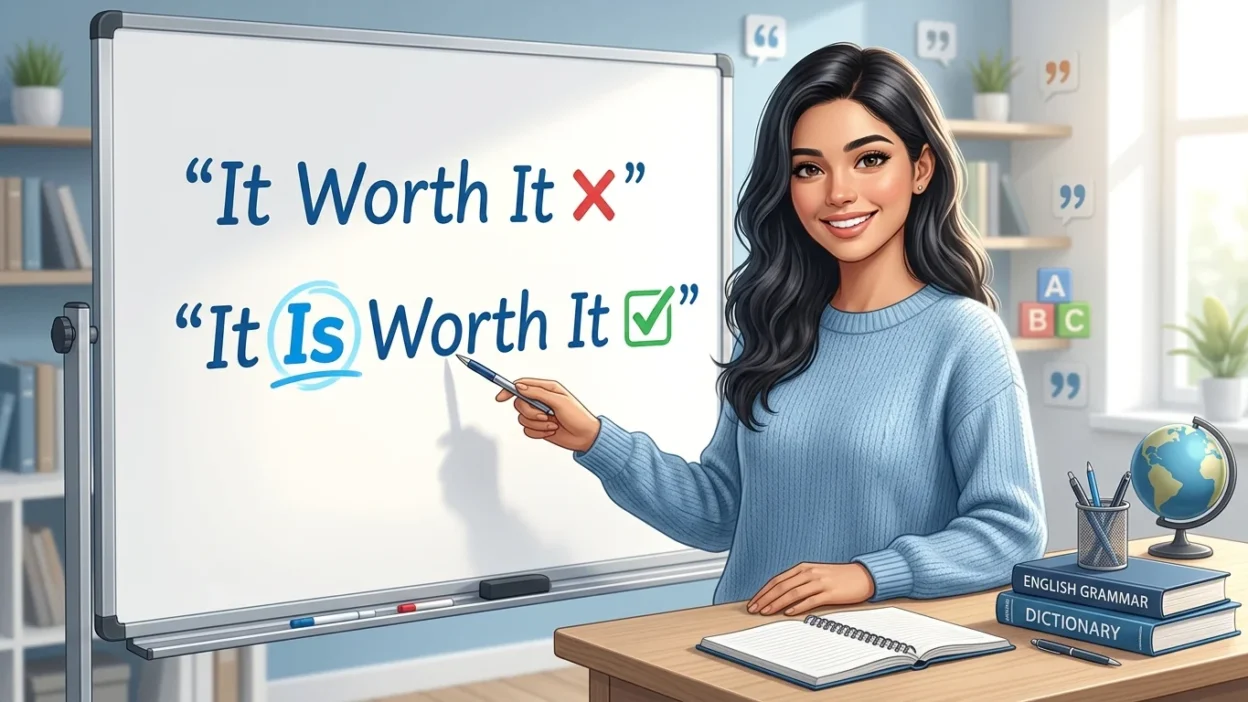
If you are wondering if to say “it worth it” or “it is worth it,” the correct standard English phrase is “it is worth it.” The shorter form “it’s worth it” is also correct because “it’s” means “it is.” The phrase “it worth it” is grammatically incorrect when used as a complete sentence because it is missing the verb “is.”
This confusion often happens because English speakers frequently shorten “it is” to “it’s” in everyday conversation. As a result, learners may hear “it’s worth it” and mistakenly think that “it worth it” is acceptable. Understanding the role of the verb is makes this expression much easier to use correctly in speaking and writing.
Quick Answer
The correct phrase is “it is worth it.” You can also say “it’s worth it,” which is the contraction of “it is worth it.” “It worth it” is incorrect because the sentence needs the linking verb is. For example: “The course is expensive, but it is worth it.”
Why Do People Confuse “It Worth It” and “It Is Worth It”?
The main reason is that “it’s worth it” sounds very natural in spoken English. When people speak quickly, the words “it” and “is” blend together.
For example:
- It is worth it. → Full form
- It’s worth it. → Contracted form
- It worth it. → Incorrect
Another reason is that worth can look like a verb, but in the expression “worth it,” it functions as an adjective or preposition-like complement describing value.
The sentence needs a form of the verb to be:
First Word: “It”
It is a pronoun. In “it is worth it,” the first it usually refers to a thing, activity, experience, cost, effort, or situation already mentioned.
Examples:
- I bought the new laptop. It is worth it.
- The trip was long, but it was worth it.
- Learning English takes time, but it is worth it.
Notice that the first it identifies what you are talking about.
Second Word: “Is”
Is is the third-person singular present form of the verb be.
In this expression, is connects the subject it with the description worth it.
The basic structure is:
It + is + worth + it
For example:
Without is, the sentence becomes incomplete:
You need the verb to make the sentence grammatically complete.
It Worth It vs It Is Worth It: Comparison Table
| Phrase | Correct? | Explanation | Example |
|---|---|---|---|
| It is worth it | ✅ Yes | Complete standard expression | It is worth it. |
| It’s worth it | ✅ Yes | Contraction of “it is” | It’s worth it. |
| It worth it | ❌ No | Missing the verb “is” | It worth it. |
| Is it worth it? | ✅ Yes | Correct question form | Is it worth it? |
| It was worth it | ✅ Yes | Correct past-tense form | The trip was worth it. |
| It will be worth it | ✅ Yes | Correct future form | It will be worth it. |
When Should You Use “It Is Worth It”?
Use “it is worth it” when you want to say that something provides enough value or benefit to justify its cost, time, effort, or difficulty.
Examples:
- The course costs $100, but it is worth it.
- Studying every day is difficult, but it is worth it.
- The restaurant is expensive, but it is worth it.
The phrase can describe both financial and non-financial value.
Use “It’s Worth It” in Everyday Conversation
“It’s worth it” is the natural contracted version and is extremely common in informal speech and writing.
For example:
Here, it’s simply means it is.
Use “It Is Worth It” for Emphasis or Formal Writing
The full form can sound slightly more deliberate or emphatic.
The full form is also useful when you want to avoid ambiguity or when writing more formally.
10+ Examples of “It Is Worth It”
Here are practical examples showing how the expression works in different situations.
- The phone is expensive, but it is worth it.
- Learning another language takes time, but it is worth it.
- The journey was exhausting, but it was worth it.
- This book is difficult to read, but it is worth it.
- The training is challenging, but it is worth it.
- The hotel costs more, but it is worth it for the location.
- Is the course worth it?
- I think the extra money is worth it.
- The long wait was worth it because the food was excellent.
- Working hard now will be worth it later.
- It’s worth it if you really enjoy the experience.
- The extra effort is definitely worth it.
Common Mistakes
Mistake 1: Saying “It Worth It”
Incorrect:
Correct:
Or:
Mistake 2: Forgetting “Is” in a Question
Incorrect:
Correct:
English questions with the verb be normally place the verb before the subject.
Mistake 3: Confusing “Its” and “It’s”
It’s means it is or it has.
Its shows possession.
Examples:
- It’s worth it. = It is worth it.
- The dog wagged its tail. = The tail belongs to the dog.
Mistake 4: Thinking “Worth” Is the Main Verb
In “It is worth it,” the verb is is. The word worth describes the value of something.
That is why “it worth it” cannot normally stand as a complete sentence.
Memory Trick
Remember this simple formula:
It + IS + worth it
Think:
If you want the shorter version:
Just remember that “it’s” contains the missing “is.”
A useful question is:
If your question contains is, your answer can be:
American vs British English
There is no standard American-versus-British difference that makes “it worth it” correct in one variety and incorrect in the other.
Both American and British English use:
- It is worth it.
- It’s worth it.
- Is it worth it?
The contraction “it’s” is particularly natural in everyday conversation in both varieties.
The important distinction is grammatical rather than regional.
Similar Words and Expressions
Several expressions can communicate a similar idea to “it is worth it.”
It Is Valuable
This focuses on the value of something.
It Is Worthwhile
Worthwhile means worth the time, effort, or cost involved.
It Pays Off
This means that effort or investment eventually produces a useful result.
It Is a Good Investment
This expression is often used for money, time, or effort.
It Is Worth the Effort
This specifically emphasizes the effort required.
It Is Worth the Money
This specifically focuses on financial value.
Final Verdict
The standard correct expression is “it is worth it.”
You can also use the natural contraction:
However, “it worth it” is not grammatically correct as a complete sentence because it is missing the verb is.
The same rule applies when asking a question:
Not:
FAQs:
Is “it worth it” grammatically correct?
No. “It worth it” is not grammatically correct as a complete standard-English sentence. The correct form is “it is worth it” or the contracted “it’s worth it.”
Is “it’s worth it” correct?
Yes. “It’s worth it” is correct because “it’s” is a contraction of “it is.”
Should I say “it is worth it” or “it’s worth it”?
Both are correct. “It’s worth it” is very natural in everyday conversation, while “it is worth it” can provide more emphasis or suit more formal writing.
What does “it is worth it” mean?
It means that something provides enough benefit or value to justify the money, time, effort, difficulty, or inconvenience involved.
Is “is it worth it?” correct?
Yes. “Is it worth it?” is the correct question when asking if something provides enough value to justify its cost or effort.
Can I say “it was worth it”?
Yes. “It was worth it” is correct when talking about something in the past.
What is the difference between “its” and “it’s”?
It’s is a contraction meaning “it is” or “it has.” Its is a possessive word.
Can “worth it” be used without “is”?
Yes, but the sentence needs another appropriate verb or structure.
For example:
The important point is that a complete sentence needs the appropriate verb.
Remember This
- It is worth it. ✅
- It’s worth it. ✅
- It worth it. ❌
- Is it worth it? ✅
- It was worth it. ✅
- It will be worth it. ✅
The easiest rule is: never leave out the verb “is” when the structure is “it is worth it.”
Conclusion
When choosing between “it worth it” and “it is worth it,” always use “it is worth it” in standard English. The shorter form “it’s worth it” is equally correct and is especially common in everyday communication. The word is is essential because it functions as the verb connecting it with the description worth it.
Once you remember that “it’s” means “it is,” this grammar point becomes simple. If you are talking about money, time, effort, travel, education, or an experience, you can confidently say “it is worth it” or “it’s worth it.”

John Leo is a skilled writer and communication enthusiast who specializes in crafting charming, witty, and thoughtful replies. Through ReplyCorner, he helps readers improve conversations with creative responses for everyday social interactions.