When talking about if something is valuable, useful, or deserving of the time, money, or effort involved, many English learners wonder if to say “is it worth it” or “does it worth it.” Although both may sound possible at first, only one is grammatically correct in standard English.
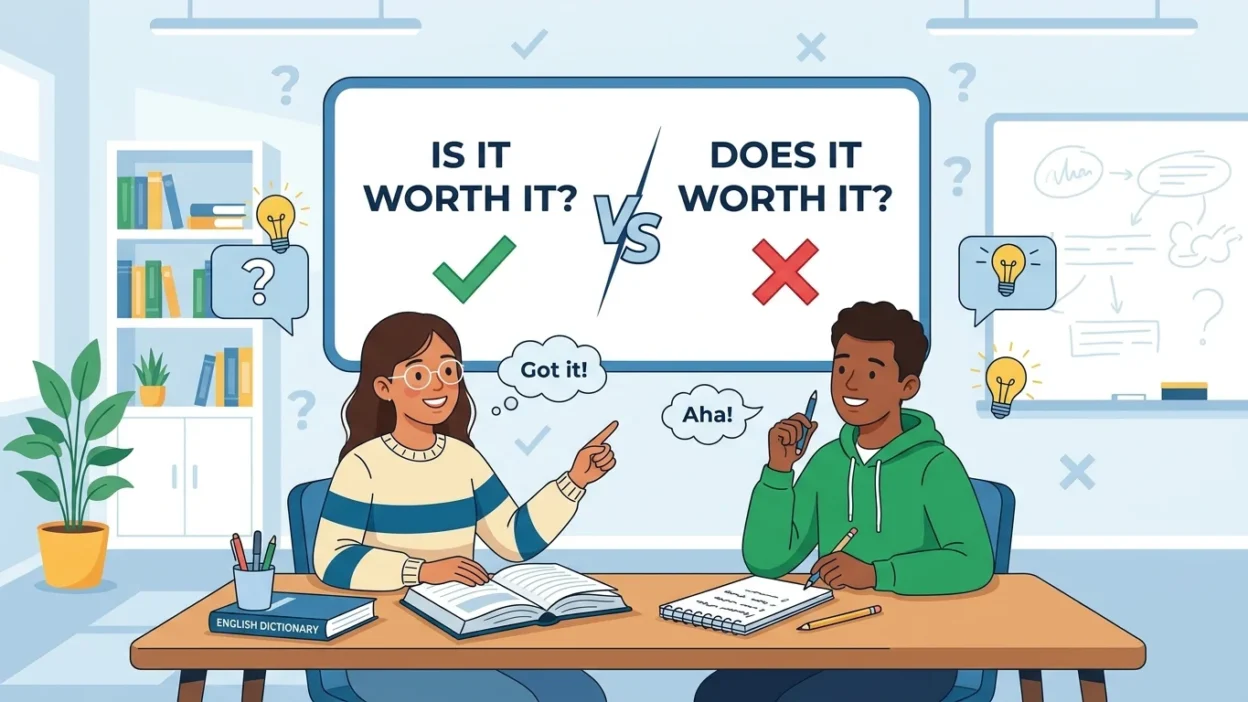
The correct expression is “Is it worth it?” We use worth after the verb be when asking if something is valuable or worthwhile. “Does it worth it?” is incorrect because worth does not work as a normal verb in this structure. Understanding this small difference will help you form natural questions and avoid a common grammar mistake.
Quick Answer
“Is it worth it?” is correct. “Does it worth it?” is incorrect in standard English. Use is because worth functions as an adjective in this expression. For example: “Is the price worth it?” or “Is it worth it to wait?”
Why Do People Confuse “Is It Worth It” and “Does It Worth It”?
The confusion usually comes from the use of do/does in English questions.
For example:
- Does it work?
- Does it help?
- Does it matter?
- Does it cost much?
In these examples, work, help, matter, and cost function as verbs.
However, in “Is it worth it?”, the word worth is not being used as an ordinary main verb. The sentence uses the linking verb is.
Compare:
- Is it worth it? ✓
- Does it worth it? ✗
The First Word: “Is”
Is is a form of the verb be. We use it to connect the subject with information describing it.
In “Is it worth it?”:
- Is = linking verb
- it = subject
- worth it = description of the value or benefit
Examples:
- Is it worth it?
- Is the trip worth it?
- Is this book worth reading?
- Is the price worth paying?
The same pattern appears in statements:
Turn the statement into a question:
The Second Word: “Does”
Does is an auxiliary verb used to form questions with ordinary verbs in the simple present tense.
Examples:
- Does she work here?
- Does he know you?
- Does this help?
- Does it matter?
After does, the main verb normally appears in its base form:
The problem with “Does it worth it?” is that worth is not functioning as the ordinary base-form verb needed in this construction.
Instead, standard English uses:
“Is It Worth It” vs “Does It Worth It”: Comparison Table
| Expression | Correct? | Explanation |
|---|---|---|
| Is it worth it? | ✓ Correct | Uses is with the expression worth it |
| Does it worth it? | ✗ Incorrect | Worth does not work as the main verb here |
| It is worth it. | ✓ Correct | Standard statement |
| It isn’t worth it. | ✓ Correct | Standard negative statement |
| Is this worth the money? | ✓ Correct | Asks about value |
| Does this worth the money? | ✗ Incorrect | Incorrect question structure |
When Should You Use “Is It Worth It”?
Use “Is it worth it?” when asking if something deserves the time, money, effort, risk, or inconvenience involved.
Examples
- Is it worth it to buy a new laptop?
- Is it worth it to wait another hour?
- Is this expensive restaurant worth it?
- Is the course worth it?
- Is it worth it for you?
- Is the extra cost worth it?
- Is this book worth reading?
- Is the trip worth the money?
- Is it worth it to repair the old car?
- Is all this effort worth it?
- Is the upgrade worth paying for?
- Is it worth it in the long run?
Notice that is comes before the subject in each direct question.
Can You Ever Use “Does” With “Worth”?
Yes, but not in “Does it worth it?”
The important point is that worth can appear in different grammatical structures.
For example:
- How much does it cost?
- What does it cost?
Here, cost is the verb.
With worth, standard expressions include:
- How much is it worth?
- Is it worth the price?
- Is it worth buying?
- Is it worth the effort?
Do not replace is with does simply because you are forming a question.
Common Mistakes
Mistake 1: “Does it worth it?”
Incorrect:
Correct:
Mistake 2: “Do it worth it?”
Incorrect:
Correct:
Mistake 3: “Is it worth?”
Sometimes learners leave out the final it when they mean that something is worthwhile.
Usually, when referring to a situation generally, say:
However, worth can also be followed by a noun or gerund:
Memory Trick
Remember this simple rule:
Worth → think “is,” not “does.”
If you mean “Is this valuable or worthwhile?”, use:
Think of the statement first:
Then switch the order to make a question:
“Is it worth it?” is standard and natural in both American and British English.
There is no need to change the basic grammar depending on if you are speaking American or British English.
For example:
- American English: Is it worth it?
- British English: Is it worth it?
Both varieties use the same structure.
You may hear differences in vocabulary or pronunciation between American and British speakers, but “Does it worth it?” is not the standard alternative in either variety.
Similar Words and Expressions
Several expressions have a meaning similar to “Is it worth it?”
Is it worthwhile?
This asks if the benefits justify the effort or cost.
Is it worth the money?
This specifically asks if the product provides enough value for its price.
Is it worth the effort?
This focuses on if the result justifies the work required.
Is it worth doing?
This asks if performing an action is worthwhile.
Does it make sense?
This is not exactly the same as “Is it worth it?”, but it can be used when asking if an action is reasonable.
Final Verdict
The correct phrase is “Is it worth it?”
“Does it worth it?” is not grammatically correct in standard English.
Use is because the expression follows the structure:
When turned into a question:
If you are talking about money, time, effort, or benefits, you can also say “Is it worth the money?”, “Is it worth the effort?”, or “Is it worth doing?”
FAQs:
Is “Is it worth it?” grammatically correct?
Yes. “Is it worth it?” is the standard grammatical expression for asking if something deserves the time, money, effort, or inconvenience involved.
Is “Does it worth it?” correct?
No. “Does it worth it?” is incorrect in standard English. The correct form is “Is it worth it?”
Why do we use “is” instead of “does”?
Because worth is used in the expression “be worth” to describe value. The statement “It is worth it” becomes “Is it worth it?” when converted into a question.
Can I say “Is it worth the money?”
Yes. This is completely correct.
It asks id the jacket provides enough value for its price.
Can I say “Is it worth doing?”
Yes. Worth + -ing is a common structure.
Is “worth it” informal?
“Worth it” is very common in everyday English and can be used in both casual and many neutral contexts. More formal writing may use expressions such as “worthwhile” or “justified by the benefits.”
What is the easiest way to remember the correct phrase?
Remember the sentence:
For a question, switch it and is:
Remember This
- Is it worth it? ✓
- Does it worth it? ✗
- It is worth it. ✓
- Is it worth the money? ✓
- Is it worth doing? ✓
The key pattern is be + worth. When you ask a question, use the appropriate form of be, such as is.
Conclusion
“Is it worth it?” is the correct expression, while “Does it worth it?” is incorrect in standard English. The difference comes from the grammatical structure of worth. In this expression, we use worth after the verb be, as in “It is worth it.”
Once you remember the basic pattern “It is worth it → Is it worth it?”, the distinction becomes easy. If you are talking about money, time, effort, or a particular experience, “Is it worth it?” is the natural question to use.

Levi Jack is a creative writer and conversation expert passionate about helping people communicate confidently. At ReplyCorner, he shares charming, witty, and engaging reply ideas that make everyday conversations more enjoyable and memorable.