
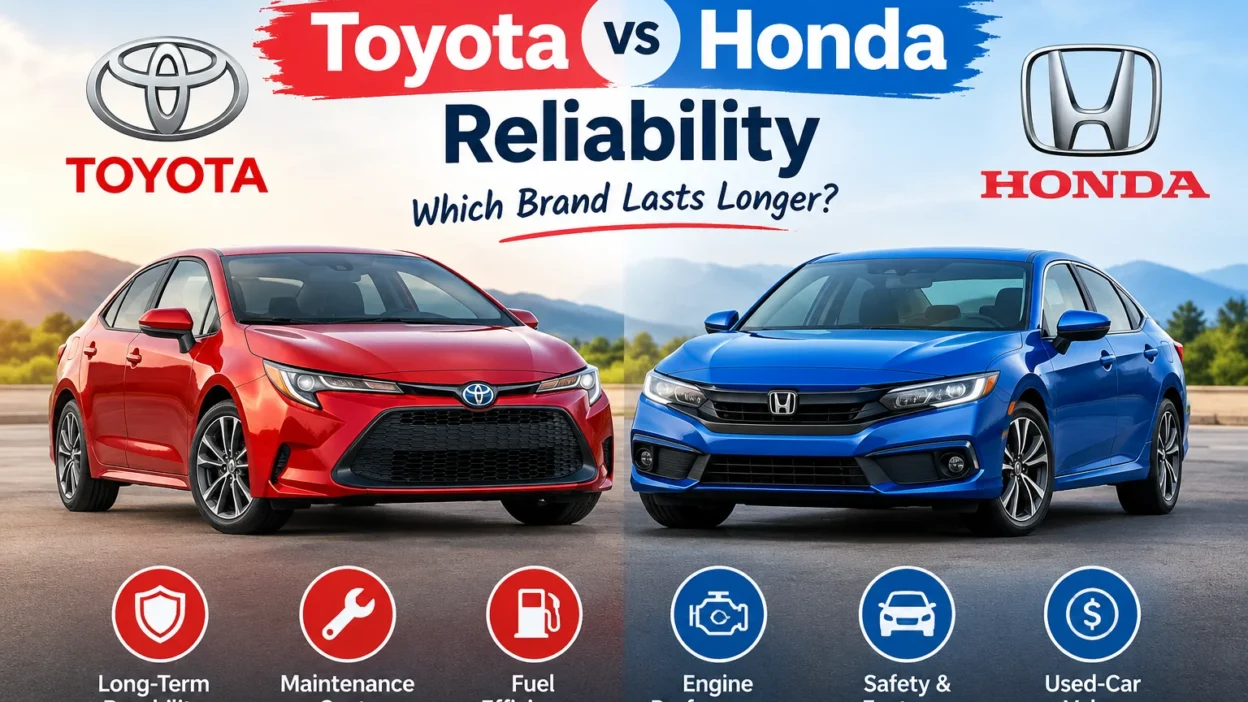
When comparing Toyota vs Honda reliability, both brands have strong reputations for building dependable cars that can last for many years. However, Toyota often has a slight advantage in long-term reliability and ownership costs, while Honda is also an excellent choice for drivers who want dependable performance, practical features, and comfortable everyday driving. The better option depends on the specific model, engine, transmission, maintenance history, and how you use your vehicle.
Toyota and Honda offer a wide range of cars, SUVs, and hybrid vehicles. Popular models such as the Toyota Corolla, Toyota Camry, Honda Civic, and Honda Accord are known for their practicality and long-term appeal. Still, no brand guarantees a trouble-free vehicle, and a well-maintained Honda can be more reliable than a poorly maintained Toyota.
Understanding the differences between these brands can help you choose a vehicle that fits your budget and provides dependable transportation for years to come.
Quick Answer
Toyota generally has a slight edge in long-term reliability, but Honda is a close competitor. Both brands make durable, fuel-efficient vehicles with strong reputations. Toyota may be the better choice if your priority is long-term ownership, while Honda is equally worth considering for its dependable engines, practical designs, and enjoyable driving experience. Always compare specific models and model years.
Why Do People Confuse Toyota and Honda Reliability?
People often compare Toyota and Honda because both Japanese automakers focus on dependable engineering, fuel efficiency, and practical vehicles. Their cars are popular with commuters, families, and used-car buyers who want to avoid expensive repairs.
The confusion comes from several factors:
- Similar reputations: Both brands are widely associated with dependable vehicles.
- Long vehicle lifespans: Cars from either brand can reach 200,000 miles or more with proper maintenance, although results vary.
- Overlapping models: The Toyota Corolla competes with the Honda Civic, while the Toyota Camry competes with the Honda Accord.
- Different reliability rankings: Results can change depending on the survey, model year, vehicle category, and type of problem measured.
- Maintenance matters: Driving habits, servicing, climate, and previous repairs can affect reliability as much as brand reputation.
The important point is that reliability is not simply a competition between two brand names. The exact vehicle and its maintenance history matter.
Toyota Reliability: What Makes Toyota a Strong Choice?
Toyota is known for producing vehicles designed for dependable everyday use. Many Toyota models have a reputation for durable engines, practical engineering, and relatively predictable maintenance needs.
1. Long-Term Durability
Many Toyota vehicles can remain on the road for well over a decade when owners follow the recommended maintenance schedule. Models such as the Corolla and Camry are popular choices for people who plan to keep their cars for a long time.
However, reaching high mileage depends on the particular engine, driving conditions, service history, and replacement of worn components.
2. Maintenance and Repair Costs
Toyota vehicles often have widely available replacement parts and a large network of repair shops. This can make routine maintenance convenient, particularly for popular models.
Repair costs still vary. A Toyota hybrid, luxury vehicle, or model with a complicated repair may cost more to maintain than a simpler Toyota.
3. Hybrid Reliability
Toyota has extensive experience with hybrid vehicles. Models such as the Prius, Corolla Hybrid, and Camry Hybrid are worth considering if you want to reduce fuel consumption without switching to a fully electric vehicle.
Hybrid batteries and other high-voltage components can eventually require attention, so buyers should check warranty coverage and the condition of the hybrid system when purchasing a used car.
4. Best Toyota Models to Consider
Toyota Corolla
A practical compact car for commuting, daily errands, and budget-conscious ownership.
Toyota Camry
A midsize sedan worth considering for comfortable family transportation and long-distance driving.
Toyota RAV4
A practical SUV option for drivers who need more cargo space and a higher seating position.
Honda Reliability: What Makes Honda a Strong Choice?
Honda also has a strong reputation for reliability. Its vehicles often combine efficient engines, practical interiors, responsive handling, and useful everyday features.
1. Dependable Engines
Honda has produced many engines known for durability when properly serviced. Popular models such as the Civic and Accord are frequently considered by buyers looking for a used car that can provide years of transportation.
Engine reliability depends on the specific design and model year, so it is important to investigate known issues before buying.
2. Practical Ownership
Honda offers many vehicles with comfortable cabins, flexible seating, and useful storage. These qualities make the brand attractive to commuters, small families, and drivers who want a car that feels easy to live with.
Maintenance costs are often competitive with Toyota, but labor rates, parts availability, and the type of repair can change the total cost.
3. Fuel Efficiency and Driving Experience
Honda’s compact and midsize cars can offer a good balance of fuel economy and responsive driving. For some drivers, a Civic or Accord may feel more engaging than a comparable Toyota.
Fuel consumption varies with the engine, transmission, vehicle age, traffic, and driving habits. Compare the specific versions you are considering rather than assuming every Honda is more economical.
4. Best Honda Models to Consider
Honda Civic
A compact car that suits commuters and buyers who value efficiency and responsive handling.
Honda Accord
A midsize sedan offering everyday practicality, passenger comfort, and a spacious cabin.
Honda CR-V
A versatile SUV for families and drivers who need passenger room and cargo flexibility.
Toyota vs Honda Reliability: Comparison Table
| Category | Toyota | Honda |
|---|---|---|
| Overall reliability | Excellent reputation | Excellent reputation |
| Long-term durability | Often has a slight edge overall | Very competitive |
| Engine dependability | Strong, model-dependent | Strong, model-dependent |
| Routine maintenance | Often affordable | Often affordable |
| Fuel efficiency | Excellent in many models | Excellent in many models |
| Hybrid experience | Extensive hybrid lineup and experience | Competitive hybrid options |
| Driving feel | Often comfort-focused | Often responsive and engaging |
| Used-car value | Strong demand for many models | Strong demand for many models |
| Repair costs | Depends on model and repair | Depends on model and repair |
| Best buying strategy | Check model year and service history | Check model year and service history |
Which brand wins? Toyota has a strong case for buyers prioritizing long-term dependability, but there is no universal winner for every vehicle category or model year. Honda can be just as good a choice when the individual vehicle has a strong reliability record and has been properly maintained.
When Should You Choose Toyota or Honda?
The best choice depends on your priorities, budget, and driving needs. Here are some practical situations to help you decide.
Choose Toyota If…
- You want a car to keep for many years.
- You prioritize a strong reputation for long-term dependability.
- You are interested in Toyota’s established hybrid technology.
- You want a popular model with widely available service options.
- You plan to buy a used Corolla, Camry, or another Toyota with a documented service history.
Choose Honda If…
- You want a reliable car with responsive handling.
- You prefer the interior layout or driving feel of a Civic or Accord.
- You find a Honda in better condition than a comparable Toyota.
- You want a practical family vehicle with flexible interior space.
- You find a specific Honda model that offers better features or value for your budget.
What If You Are Buying a Used Car?
For a used vehicle, condition is often more important than the badge on the hood.
Before buying, check the following:
- Review the service records and maintenance schedule.
- Ask about previous accidents, major repairs, and ownership history.
- Arrange an independent mechanical inspection.
- Check for warning lights, fluid leaks, unusual engine noises, and transmission problems.
- Verify that recalls have been addressed.
- Compare the asking price with similar vehicles of the same model year and mileage.
For example, a well-maintained Honda Civic with 100,000 miles may be a better purchase than a neglected Toyota Corolla with 70,000 miles. Mileage alone does not tell you the complete story.
12 Examples of Toyota vs Honda Reliability in Real-Life Situations
These examples illustrate how buyers can apply the comparison. They are practical scenarios, not guarantees about every vehicle.
1. Daily commuting: A Toyota Corolla and Honda Civic can both provide dependable everyday transportation when properly maintained.
2. Long-distance driving: A Toyota Camry or Honda Accord may be suitable for frequent highway travel. Inspect the specific vehicle before deciding.
3. Buying your first car: Either brand can be a sensible choice. Prioritize safety, condition, insurance costs, and maintenance expenses.
4. Keeping a car for 10 years: Both brands offer models that may serve you well over a decade. Regular servicing is essential.
5. Choosing a hybrid: Compare the Toyota Prius with the Honda Civic Hybrid or other comparable hybrid models, including battery warranty coverage.
6. Buying a family SUV: The Toyota RAV4 and Honda CR-V are practical options. Check their specific model-year reliability records.
7. Driving in heavy traffic: Both brands offer efficient cars. Actual fuel consumption depends on traffic, engine type, and driving style.
8. Buying an older used car: A vehicle with complete maintenance records may be a better choice than a newer car with an uncertain history.
9. Reducing repair expenses: Compare local parts prices, labor charges, and common problems for the exact model you want.
10. Choosing between two similar cars: If a Corolla and Civic have similar prices, inspect both and compare their service records before deciding.
11. Buying in a hot climate: Check the cooling system, air conditioning, battery condition, and maintenance history. Heat can affect many vehicle components.
12. Planning to resell: Both brands have models that attract used-car buyers. Resale value depends on local demand, condition, mileage, and market prices.
Common Mistakes When Comparing Toyota and Honda Reliability
Even experienced car buyers can make mistakes when comparing the two brands.
Mistake 1: Assuming Toyota Never Breaks Down
Toyota vehicles can develop engine, transmission, electrical, suspension, and other problems. A good reputation does not eliminate the need for maintenance.
Mistake 2: Assuming Honda Is Less Reliable
Honda has a strong reliability record, and many of its vehicles provide long service lives. It is inaccurate to dismiss the entire brand based on problems reported for one model.
Mistake 3: Comparing Different Vehicle Categories
Comparing a small economy car with a larger SUV may produce misleading conclusions. Vehicle size, weight, powertrain, and complexity affect maintenance and repair needs.
Mistake 4: Ignoring Model-Year Differences
A redesigned vehicle may use different engines, transmissions, electronics, or hybrid systems than an earlier version. Reliability can change significantly between generations.
Mistake 5: Focusing Only on Mileage
Mileage is useful, but it does not reveal how the vehicle was driven or maintained. A high-mileage car with excellent records may be a better purchase than a low-mileage car that was neglected.
Mistake 6: Treating Every Reliability Ranking as Universal
Different studies measure different things, including reported problems, repair frequency, owner satisfaction, and long-term durability. Check what each study actually measures before using its ranking.
Memory Trick: How to Remember the Difference
Use this simple reminder:
- Toyota: Think of long-term dependability and established hybrid experience.
- Honda: Think of dependability, practicality, and responsive driving.
This is only a general memory aid, not a rule that applies to every vehicle. Both brands compete strongly in reliability, efficiency, and everyday usefulness.
American vs British English: Toyota and Honda Reliability
There is no meaningful American-versus-British English difference in the brand names Toyota and Honda. However, some automotive terms differ between the two varieties of English.
| American English | British English |
|---|---|
| Gas | Petrol |
| Trunk | Boot |
| Hood | Bonnet |
| Tire | Tyre |
| Transmission | Gearbox, in many contexts |
| Windshield | Windscreen |
For example:
- American English: “The Toyota has excellent gas mileage.”
- British English: “The Toyota has excellent petrol economy.”
Both versions communicate the same basic idea. In international writing, choose terminology that suits your intended audience.
Similar Words and Related Reliability Terms
Understanding common automotive terms can make Toyota vs Honda comparisons easier.
- Reliability: How consistently a vehicle performs without unexpected problems.
- Durability: How well a vehicle withstands use and wear over time.
- Longevity: How long a vehicle remains usable.
- Dependability: How confidently you can rely on a vehicle for everyday transportation.
- Maintainability: How easily and conveniently a vehicle can be serviced or repaired.
- Repairability: How readily a vehicle can be repaired when something goes wrong.
- Fuel efficiency: How effectively a vehicle uses fuel to travel a given distance.
- Ownership cost: The total cost of owning a vehicle, including fuel, servicing, repairs, insurance, taxes, and depreciation.
- Resale value: The amount a vehicle may sell for in the used-car market.
- Used-car condition: The vehicle’s current mechanical, structural, and cosmetic state.
A vehicle can be durable but expensive to repair, or economical to maintain but less suitable for a particular driver’s needs. Looking at these factors together gives you a more complete picture than a reliability label alone.
Final Verdict: Is Toyota or Honda More Reliable?
Toyota is the slight overall favorite for buyers who prioritize long-term reliability, but Honda is a close competitor. Both brands offer dependable vehicles, and the difference often depends on the model, year, engine, transmission, and maintenance history.
Choose Toyota if you prefer its specific models, established hybrid experience, or reputation for long-term ownership. Choose Honda if you prefer its driving experience, interior design, or find a better-maintained vehicle at a competitive price.
If you are buying a used car, do not make your decision based on the brand alone. Compare the exact model years, review reliability information for the specific vehicles, and arrange a professional inspection before purchasing.
FAQs:
1. Is Toyota more reliable than Honda?
Toyota often has a slight advantage in general reliability comparisons, but Honda is also highly regarded. Rankings vary by study, model year, and vehicle category, so neither brand wins every comparison.
2. Which lasts longer, Toyota or Honda?
Both Toyota and Honda vehicles can last 200,000 miles or more with appropriate maintenance and favorable driving conditions. Neither brand guarantees a particular lifespan, and individual vehicle condition matters greatly.
3. Is Honda cheaper to maintain than Toyota?
Not necessarily. Both brands can have reasonable routine maintenance costs, but expenses depend on the vehicle, replacement parts, labor rates, and required repairs. Compare local service prices for the models you are considering.
4. Which is better for buying a used car, Toyota or Honda?
Either can be a good used-car purchase. Look for complete service records, a clean vehicle history, a strong model-specific reliability record, and a satisfactory independent inspection. A well-maintained Honda may be a better buy than a neglected Toyota.
5. Are Toyota engines more reliable than Honda engines?
Both manufacturers have produced durable engines. Reliability varies by engine design, model year, maintenance, and operating conditions. Research the specific engine rather than assuming every Toyota engine is better than every Honda engine.
6. Which brand makes more reliable hybrid cars?
Toyota has extensive experience with hybrid vehicles and a well-established hybrid lineup. Honda also offers competitive hybrid models. Compare the particular powertrains, warranty terms, service history, and long-term ownership requirements.
7. Is Toyota or Honda better for long-term ownership?
Toyota may have a slight overall advantage in long-term reliability reputation, but both brands can be excellent choices. The best vehicle is the one that suits your needs, has a strong record for its model year, and receives proper maintenance.
8. Which is better, Toyota Corolla or Honda Civic?
The Corolla and Civic are both strong compact-car choices. Compare their specific model years, safety features, fuel economy, driving experience, repair history, and purchase prices. A test drive and mechanical inspection can help you choose the better vehicle for your needs.
Remember This
- Toyota has a slight general reputation advantage in long-term reliability.
- Honda remains a strong competitor with many dependable models.
- Both brands can deliver long service lives with proper maintenance.
- Model year, engine, transmission, and service history matter.
- The best used car is not necessarily the one with the most famous brand name.
Conclusion
Toyota vs Honda reliability is a close comparison because both automakers have built strong reputations for producing dependable cars. Toyota may be the better starting point if long-term reliability is your main priority, while Honda is equally worth considering if you value its practical designs and driving experience. Neither brand is automatically the best in every category.
Before making a purchase, compare specific models and model years, check their known issues, calculate maintenance costs, and review the vehicle’s history. With careful research and regular servicing, a Toyota or Honda can be a dependable choice for everyday driving and long-term ownership.

John Leo is a skilled writer and communication enthusiast who specializes in crafting charming, witty, and thoughtful replies. Through ReplyCorner, he helps readers improve conversations with creative responses for everyday social interactions.