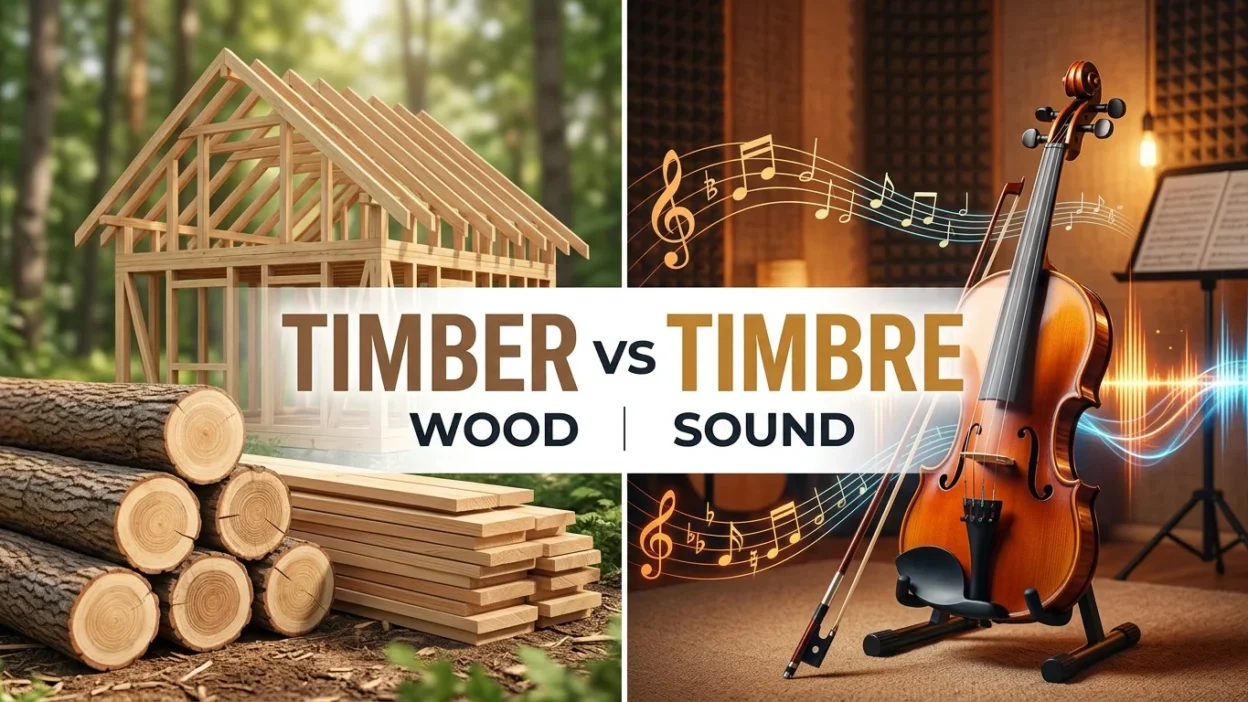
If you have ever seen timber and timbre written close together, you may have wondered if they are two spellings of the same word. They are not. Although they look and sound somewhat similar, timber and timbre have completely different meanings. Timber usually refers to wood used for building or other purposes, while timbre refers to the distinctive quality or character of a sound.
Understanding the difference between these words is useful for students, writers, musicians, and English learners because confusing them can change the meaning of a sentence completely. In this guide, you will learn what timber vs timbre means, how each word is pronounced and used, and how to remember the difference. Clear examples and a comparison table will make the distinction easy to understand.
Quick Answer
Timber means wood, especially wood prepared for construction, furniture, or other uses. Timbre means the distinctive quality of a sound that helps you recognize different voices or instruments. For example, a wooden house may use timber, while a violin has a unique timbre.
Why Do People Confuse Timber and Timbre?
People often confuse timber and timbre because their spellings are very similar and their pronunciations can be similar in some varieties of English.
However, their meanings are completely different:
- Timber → wood or trees intended for use as wood.
- Timbre → the particular quality or tone of a sound.
The easiest way to separate them is to connect timber with wood and timbre with sound.
What Does Timber Mean?
Timber is a noun that generally refers to wood, especially wood that has been prepared or is suitable for building, construction, furniture, or other practical purposes.
It can also refer to trees grown or harvested for their wood.
Examples of Timber
- The builders used timber to construct the roof.
- The forest contains valuable timber.
- We bought some timber for the new shelves.
- The house has a strong timber frame.
In some contexts, timber can also be used as a warning when a tree is falling:
This means that a falling tree may be dangerous.
What Does Timbre Mean?
Timbre is a noun used mainly when talking about sound and music. It describes the distinctive quality or character of a sound.
Two instruments can play the same musical note at the same volume but still sound different because they have different timbres.
For example, a piano and a violin can play the same note, but you can normally tell which instrument is playing. Their different sound qualities are their timbres.
Examples of Timbre
- The singer has a warm timbre.
- The flute has a bright, airy timbre.
- The two instruments have very different timbres.
- Her distinctive timbre makes her voice easy to recognize.
Timber vs Timbre: Comparison Table
| Feature | Timber | Timbre |
|---|---|---|
| Meaning | Wood or trees used as wood | Quality or character of a sound |
| Main subject | Wood, trees, construction | Music, voices, sounds |
| Part of speech | Usually noun | Noun |
| Common context | Building, forestry, furniture | Music, singing, acoustics |
| Example | The roof is made of timber. | The singer has a unique timbre. |
| Memory word | Wood | Sound |
When Should You Use Timber?
Use timber when you are talking about wood, trees, construction materials, or wooden structures.
Common situations
Construction:
“The workers delivered the timber to the building site.”
Forestry:
“The company manages forests for timber production.”
Furniture:
“This table is made from high-quality timber.”
Architecture:
“The building has a traditional timber frame.”
When Should You Use Timbre?
Use timbre when you are describing the quality, character, or texture of a sound.
Common situations
Music:
“The composer carefully considered the timbre of each instrument.”
Singing:
“She has a rich and powerful timbre.”
Speech:
“His deep timbre made his voice distinctive.”
Instruments:
“The timbre of the cello is warm and expressive.”
Timber vs Timbre: 12 Examples
1. Construction
Correct: The workers carried the timber into the building.
Here, timber means wood used as a construction material.
2. Musical instrument
Correct: The violin has a beautiful timbre.
Here, timbre describes the quality of the violin’s sound.
3. Forests
Correct: The forest produces valuable timber.
The word refers to wood obtained from trees.
4. Singing
Correct: Her voice has a distinctive timbre.
The sentence describes the recognizable quality of her voice.
5. Furniture
Correct: The carpenter selected strong timber for the table.
The word refers to wood.
6. Orchestra
Correct: The composer combined instruments with contrasting timbres.
The word refers to different sound qualities.
7. Wooden house
Correct: The house was built using local timber.
The material is wood.
8. Voice
Correct: His unusual timbre makes him easy to recognize.
The sentence is about the quality of his voice.
9. Roofing
Correct: The roof requires several pieces of timber.
The material is wood.
10. Guitar
Correct: The guitar has a warm, mellow timbre.
The word describes the quality of its sound.
11. Forestry
Correct: The company exports timber from managed forests.
The word relates to wood.
12. Music production
Correct: The producer changed the instrument’s timbre using different effects.
The word relates to sound.
Common Mistakes With Timber and Timbre
The most common mistake is using timber when you mean sound or timbre when you mean wood.
Incorrect
“The singer has a beautiful timber.”
Correct
“The singer has a beautiful timbre.”
A singer has a particular timbre, not a type of wood.
Incorrect
“The carpenter bought several pieces of timbre.”
Correct
“The carpenter bought several pieces of timber.”
A carpenter works with timber, not timbre.
What Is an Easy Memory Trick?
Use this simple association:
Timber = trees and wood
Timbre = tone and sound
You can remember timbre by connecting it with tone. Both relate to sound.
Another useful trick is:
- Timber → building
- Timbre → music
If you are talking about something you can build with, choose timber. If you are talking about something you can hear, choose timbre.
Is Timber Different in American and British English?
Yes, there is an important difference in how timber is commonly used.
In British English, timber can mean wood prepared for building and other purposes. It is also commonly used for trees grown for their wood.
In American English, lumber is often the more common word for processed wood used in construction, while timber may refer more specifically to large pieces of wood or trees suitable for harvesting.
Timbre, however, has the same basic meaning in both American and British English: the distinctive quality or character of a sound.
Similar Words to Timber
Depending on the context, words related to timber include:
- Wood
- Lumber
- Logs
- Planks
- Hardwood
- Softwood
- Building material
- Forest products
These words are not always exact synonyms, so choose them according to the specific context.
Similar Words to Timbre
Words related to timbre include:
- Tone
- Sound quality
- Voice quality
- Character
- Texture
- Resonance
- Sonority
Again, these words can have slightly different meanings depending on the context.
Final Verdict: Timber or Timbre?
The difference is simple:
Timber = wood.
Timbre = sound quality.
Use timber when discussing trees, wood, construction, furniture, or forestry. Use timbre when discussing voices, musical instruments, music, or the distinctive character of a sound.
Once you connect each word with its subject, the spelling becomes much easier to remember.
FAQs:
Is timber the same as timbre?
No. Timber refers to wood or trees used for their wood, while timbre refers to the distinctive quality or character of a sound.
What is the difference between timber and timbre?
Timber is related to wood and construction. Timbre is related to sound and music. They look similar but have different meanings.
How do you pronounce timber and timbre?
Timber is commonly pronounced like “TIM-ber.” Timbre is commonly pronounced like “TAM-ber” or “TAM-buh,” depending on accent and context.
Is timbre only used in music?
No. Although timbre is very common in music, it can also describe the distinctive quality of voices and other sounds.
Is timber British English?
Timber is widely used in British English for wood and construction material. In American English, lumber is often more common for processed construction wood.
Can timber describe a voice?
No. When describing the distinctive quality of someone’s voice, timbre is the appropriate word.
Can timbre mean wood?
No. Timbre does not mean wood. The word for wood or construction material is timber.
Which is correct: “the timber of his voice” or “the timbre of his voice”?
The correct phrase is “the timbre of his voice.” It describes the distinctive quality of the person’s sound.
Remember This
Timber = wood.
Timbre = sound.
If you are building something, think timber. If you are listening to something, think timbre.
Conclusion
Although timber and timbre look almost alike, they belong to very different areas of English. Timber is associated with wood, trees, construction, and furniture, while timbre describes the distinctive character of a voice, instrument, or other sound.
The simplest way to remember the difference is to associate timber with wood and timbre with sound. With this distinction in mind, you can confidently choose the correct word in everyday writing, academic work, and conversations about music or construction.