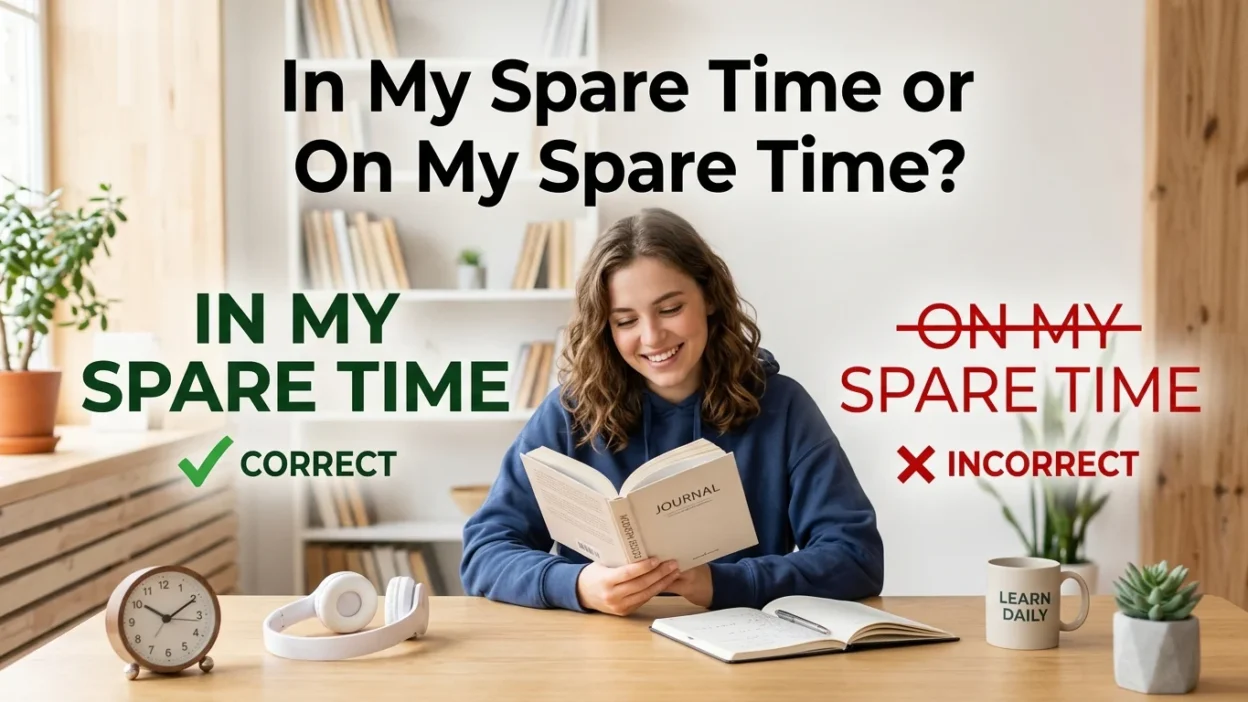
If you are wondering if to say “in my spare time” or “on my spare time,” the correct and natural expression is “in my spare time.” We use in because spare time refers to a period or amount of free time when you are not busy with work, school, or other responsibilities. For example, “I read books in my spare time” is correct.
“On my spare time” is not normally used in standard English. Although learners sometimes choose on because we say expressions such as “on the weekend” or “on my day off,” the phrase “in my spare time” follows a different pattern. Understanding this small preposition difference can help you sound more natural in conversations, writing, interviews, and everyday English.
Quick Answer
The correct phrase is “in my spare time.” Use it when talking about activities you do when you are free from work, school, or other responsibilities. “On my spare time” is generally incorrect in standard English. For example: “I practice Spanish in my spare time.”
Why Do People Confuse “In My Spare Time” and “On My Spare Time”?
The confusion comes from the fact that English uses different prepositions for different expressions of time.
We use in with periods or amounts of time:
- in my spare time
- in my free time
- in the evening
- in my childhood
We use on with particular days and dates:
- on Monday
- on my birthday
- on Saturday
- on the weekend
Because both in and on can describe time, learners may apply the wrong preposition to spare time.
What Does “In My Spare Time” Mean?
“In my spare time” means during the time when you are free and have no important work or responsibilities to deal with.
It is commonly used to talk about hobbies, interests, personal projects, exercise, reading, learning, or relaxing.
For example:
This means painting is something you like doing when you are not busy with your main responsibilities.
Is “In My Spare Time” Correct?
Yes. “In my spare time” is the standard and natural expression.
Examples:
- I play football in my spare time.
- She learns French in her spare time.
- He enjoys cooking in his spare time.
- I watch documentaries in my spare time.
What Does “On My Spare Time” Mean?
“On my spare time” is generally not the correct expression in standard English.
A learner might say:
A natural English speaker would normally say:
The problem is the preposition on. It does not normally go with spare time in this expression.
“In My Spare Time” vs. “On My Spare Time”: Comparison Table
| Phrase | Correct? | Meaning | Example |
|---|---|---|---|
| in my spare time | Yes | During my free time | I exercise in my spare time. |
| on my spare time | Generally no | Intended to mean during free time | I exercise on my spare time. |
| in my free time | Yes | During my free time | I read in my free time. |
| during my spare time | Yes | Throughout or at some point during free time | I study during my spare time. |
When Should You Use Each?
Use “In My Spare Time”
Use in my spare time when describing what you normally do when you are free.
Examples:
- I enjoy gardening in my spare time.
- She studies psychology in her spare time.
- I write stories in my spare time.
Avoid “On My Spare Time”
Do not normally use on before my spare time.
Instead of
Say:
Use “In My Free Time” as an Alternative
“In my free time” has almost the same meaning and is also very common.
- I listen to music in my spare time.
- I listen to music in my free time.
Both sentences are correct.
12 Examples of “In My Spare Time”
- I read novels in my spare time.
- She practices the piano in her spare time.
- I enjoy hiking in my spare time.
- He learns new programming skills in his spare time.
- They play board games in their spare time.
- I watch movies in my spare time.
- She likes painting in her spare time.
- I volunteer at a local organization in my spare time.
- He studies Spanish in his spare time.
- I usually listen to podcasts in my spare time.
- My brother builds model cars in his spare time.
- She writes poetry in her spare time.
Common Mistakes
Mistake 1: Using “On My Spare Time”
❌ I exercise on my spare time.
✅ I exercise in my spare time.
Mistake 2: Using “At My Spare Time”
❌ I read books at my spare time.
✅ I read books in my spare time.
Mistake 3: Forgetting “My”
When talking about your own free time, “in my spare time” is natural.
✅ I play guitar in my spare time.
You can also say:
✅ I play guitar in my free time.
Memory Trick
Think of spare time as a period that you are inside.
So remember:
IN + spare time
You can also connect it with:
- in my free time
- in the morning
- in the evening
- in my childhood
A simple rule is:
Use “in” for spare/free time; use “on” for specific days and dates.
American vs. British English
Both American and British English commonly use “in my spare time.”
There is no major American-versus-British difference in this particular expression.
American English may also frequently use:
British English also uses spare time very naturally.
For example:
- British English: “I enjoy cycling in my spare time.”
- American English: “I enjoy cycling in my free time.”
Both varieties use in with spare time.
Similar Words and Expressions
Several expressions can communicate a similar idea.
In My Free Time
This is perhaps the closest alternative.
During My Spare Time
This is also grammatically correct, although it can sound slightly more formal.
When I Have Free Time
This emphasizes the situation of being available.
When I’m Free
This is shorter and very natural in conversation.
In My Leisure Time
This is correct but somewhat more formal.
Final Verdict
The correct phrase is “in my spare time.”
Use in when you mean activities you do during your free or available time:
“On my spare time” is not the standard expression. If you want another natural option, you can use “in my free time” or “during my spare time.”
FAQs:
Is it “in my spare time” or “on my spare time”?
The correct phrase is “in my spare time.” For example, “I learn Italian in my spare time.”
Is “on my spare time” grammatically correct?
It is generally considered incorrect or unnatural in standard English. Use “in my spare time” instead.
Can I say “in my free time”?
Yes. “In my free time” is completely correct and has almost the same meaning as “in my spare time.”
What is the difference between spare time and free time?
There is very little difference. Both refer to time when you are not occupied with your main responsibilities. “Free time” is often more direct, while “spare time” can emphasize time available between other activities.
Can I say “during my spare time”?
Yes. “During my spare time” is grammatically correct, although “in my spare time” is usually the simpler and more natural choice.
Is “in my spare time” formal or informal?
It works in both casual and formal English. You can use it in everyday conversations, school writing, job interviews, and professional contexts.
Which is better: “in my spare time” or “in my free time”?
Both are correct. “In my spare time” is especially common when describing hobbies and activities you do outside your main responsibilities.
Remember This
IN my spare time ✅
ON my spare time ❌
Use “in my spare time” to talk about things you do when you are free.
Conclusion
When choosing between “in my spare time” and “on my spare time,” always choose “in my spare time.” The preposition in is the natural choice because spare time refers to a period when you are available to do something other than your main responsibilities.
If you want variety, you can also use “in my free time,” “during my spare time,” or “when I’m free.” However, for everyday English, “in my spare time” is a simple, natural, and reliable choice.

Levi Jack is a creative writer and conversation expert passionate about helping people communicate confidently. At ReplyCorner, he shares charming, witty, and engaging reply ideas that make everyday conversations more enjoyable and memorable.