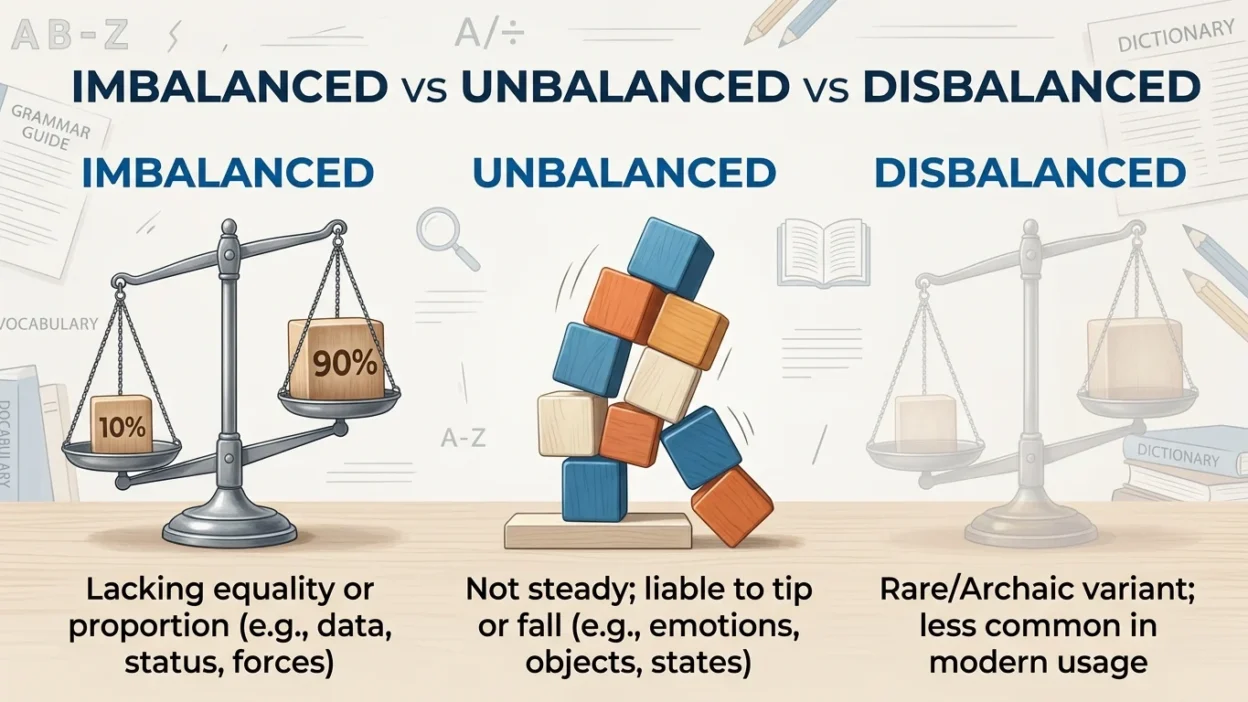
When deciding between imbalanced vs unbalanced vs disbalanced, the most important point is that imbalanced and unbalanced are both standard English words, while disbalanced is uncommon and often sounds awkward or nonstandard in everyday English. Although all three can relate to a lack of balance, they are not equally natural or widely used.
Imbalanced is commonly used when something lacks balance, especially when discussing systems, proportions, situations, diets, markets, or relationships. Unbalanced is broader and can describe something that is physically uneven, emotionally unstable, unfair, or lacking balance.
Disbalanced exists in some dictionaries and specialized contexts, but it is much less common than the other two. Choosing the right word therefore depends on both meaning and natural usage.
Quick Answer
Imbalanced and unbalanced are correct and widely used words. Imbalanced often emphasizes an unequal or disproportionate condition, while unbalanced has a broader meaning, including physical, emotional, and structural situations. Disbalanced is rare and usually better replaced with imbalanced or unbalanced.
Why Do People Confuse Imbalanced, Unbalanced, and Disbalanced?
These words are confusing because they all contain the idea of something being out of balance.
The prefixes im-, un-, and dis- can all suggest a negative or opposite condition. However, English does not always use these prefixes interchangeably.
For example:
- An imbalanced diet has too much or too little of certain nutrients.
- An unbalanced table may wobble because its legs are uneven.
- A disbalanced system is understandable, but many speakers would naturally choose imbalanced or unbalanced instead.
The key is to learn how each word is normally used rather than assuming that the prefixes have exactly the same function.
What Does “Imbalanced” Mean?
Imbalanced means lacking balance or having an unequal distribution between different parts.
It is especially common when two or more things are not properly proportioned or evenly distributed.
Common uses of “imbalanced”
You can use imbalanced for:
- diets
- economies
- relationships
- systems
- workloads
- populations
- chemical conditions
- power or resources
Examples
- She has an imbalanced diet.
- The team has an imbalanced workload.
- The market is imbalanced because demand is much higher than supply.
- The relationship became imbalanced over time.
Imbalanced often focuses on an unequal relationship between components.
What Does “Unbalanced” Mean?
Unbalanced is a broader word meaning not balanced, unstable, uneven, or lacking proper balance.
It can describe physical objects as well as abstract situations.
Common uses of “unbalanced”
You can use unbalanced for:
- physical objects
- arguments
- diets
- emotions
- people or behavior
- workloads
- structures
- situations
Examples
- The chair is unbalanced.
- He gave an unbalanced argument.
- She has been emotionally unbalanced since the stressful event.
- The machine becomes unbalanced when it spins too quickly.
Because unbalanced has several meanings, it is usually the more flexible word.
What Does “Disbalanced” Mean?
Disbalanced means lacking balance or having balance disturbed.
However, it is much less common than imbalanced and unbalanced in modern general English.
You may occasionally encounter disbalanced in technical, specialized, or translated writing. In ordinary English, however, most readers will find imbalanced or unbalanced more natural.
For example, instead of:
- The system is disbalanced.
Most writers would normally say:
- The system is imbalanced.
- The system is unbalanced.
This does not mean that every use of disbalanced is automatically incorrect. It means that it is not usually the first choice for general writing.
Imbalanced vs Unbalanced vs Disbalanced: Comparison Table
| Word | Basic meaning | Commonness | Typical use | Natural choice? |
|---|---|---|---|---|
| Imbalanced | Not properly balanced or proportioned | Common | Systems, diets, resources, relationships | Yes |
| Unbalanced | Not balanced, stable, or even | Very common | Physical, emotional, structural, abstract contexts | Yes |
| Disbalanced | Having balance disturbed or lacking balance | Uncommon | Specialized or less common usage | Usually replace it |
When Should You Use Each Word?
Use “imbalanced” for unequal proportions
Choose imbalanced when you want to emphasize that different parts are unequal or disproportionate.
- an imbalanced diet
- an imbalanced economy
- an imbalanced relationship
- an imbalanced workload
It works particularly well when there are multiple components that should be distributed more evenly.
Use “unbalanced” for a broader meaning
Choose unbalanced when something is physically unstable, uneven, emotionally unstable, or generally lacking balance.
- an unbalanced table
- an unbalanced argument
- an unbalanced structure
- an unbalanced diet
It is a very flexible everyday word.
Use “disbalanced” sparingly
Disbalanced is understandable, but it is not normally the preferred choice in everyday English.
If you are unsure, use imbalanced or unbalanced depending on the intended meaning.
10+ Examples of Imbalanced, Unbalanced, and Disbalanced
Examples with “imbalanced”
- His imbalanced diet lacks several important nutrients.
- The company has an imbalanced distribution of resources.
- The ecosystem has become imbalanced.
- The negotiations created an imbalanced relationship between the two sides.
- The workload is severely imbalanced across the team.
- The economy has become imbalanced because of unequal demand and supply.
Examples with “unbalanced”
- The old table is unbalanced and keeps wobbling.
- She gave an unbalanced account of what happened.
- The machine became unbalanced during operation.
- He is trying to maintain a more balanced lifestyle instead of an unbalanced one.
- The argument seems unbalanced because it considers only one side.
- The bicycle feels unbalanced when the load is placed on one side.
Examples with “disbalanced”
- The report described a disbalanced system, although imbalanced system would sound more natural to many readers.
- The process became disbalanced after the new component was introduced.
The final examples show why disbalanced may be understandable without being the preferred everyday choice.
Common Mistakes
Mistake 1: Treating all three words as equally common
Although the meanings overlap, the words do not have the same frequency or naturalness.
Better: Prefer imbalanced or unbalanced in ordinary writing.
Mistake 2: Using “disbalanced” automatically
Some writers assume that adding dis- to “balanced” creates the most natural opposite.
English does not always work that way.
Better: Use the established forms imbalanced or unbalanced.
Mistake 3: Thinking “imbalanced” is always wrong
Some learners believe that only unbalanced is correct.
That is not true. Imbalanced is a well-established word and is particularly useful for unequal proportions or distributions.
Mistake 4: Using “unbalanced” when “imbalanced” is more precise
Both can work in some contexts, but imbalanced can more clearly communicate that different parts are unequal.
For example:
- The system has an imbalanced distribution of power.
This emphasizes unequal distribution.
Memory Trick
A simple way to remember the difference is:
Imbalanced = unequal parts
Unbalanced = not balanced in a broad sense
Disbalanced = uncommon alternative
Think of imbalanced when you see two sides or several components that are not distributed equally.
Think of unbalanced when something is unstable, uneven, or simply not in balance.
When you are tempted to use disbalanced, pause and ask if imbalanced or unbalanced would sound more natural.
American vs British English
Both imbalanced and unbalanced are used in both American and British English.
There is no simple American-versus-British rule that makes one of these words correct and the other incorrect.
Unbalanced is especially common in everyday contexts, while imbalanced is also widely used when discussing unequal distributions, systems, diets, and relationships.
Disbalanced remains relatively uncommon in general English regardless of wif you are writing for an American or British audience.
Similar Words
Several words are related to imbalanced and unbalanced, but they are not exact replacements in every sentence.
Uneven
Uneven means not equal, level, or regular.
- The ground is uneven.
- The distribution of wealth is uneven.
Unequal
Unequal focuses directly on differences in amount, size, value, or status.
- The two groups received unequal amounts of funding.
Unstable
Unstable means not firmly established, steady, or secure.
- The structure is unstable.
Disproportionate
Disproportionate means too large or too small compared with something else.
- The punishment was disproportionate to the offense.
Asymmetrical
Asymmetrical means that two sides or parts do not have matching shapes or arrangements.
- The building has an asymmetrical design.
Final Verdict
Imbalanced and unbalanced are both standard and useful English words, but they often highlight slightly different ideas.
Use imbalanced when you are talking about unequal proportions, distributions, or relationships. Use unbalanced for the broader idea of something being physically uneven, unstable, one-sided, or lacking balance.
Disbalanced can be understood, but it is uncommon in general English. In most everyday and professional writing, imbalanced or unbalanced will be the more natural choice.
FAQs:
Is “imbalanced” a correct word?
Yes. Imbalanced is a standard English word meaning lacking balance or having unequal proportions. It is commonly used for things such as diets, systems, workloads, economies, and relationships.
Is “unbalanced” correct English?
Yes. Unbalanced is a very common English word. It can describe physical objects, arguments, situations, structures, emotions, and other things that lack balance or stability.
Is “disbalanced” a real word?
Yes, disbalanced can be found in English, but it is uncommon. In general writing, imbalanced or unbalanced is usually a more natural choice.
What is the difference between imbalanced and unbalanced?
Imbalanced often emphasizes unequal proportions or distribution, while unbalanced has a broader meaning and can refer to physical instability, unevenness, one-sidedness, or other forms of lacking balance.
Is it “imbalanced diet” or “unbalanced diet”?
Both expressions are possible. Imbalanced diet emphasizes an inappropriate or unequal nutritional composition, while unbalanced diet is also a natural and widely understood expression.
Is “disbalanced” better than “imbalanced”?
Usually not in general English. Imbalanced is much more natural when describing something with unequal proportions or distribution.
Can I use “imbalanced” and “unbalanced” interchangeably?
Sometimes, yes. Their meanings overlap, but they are not identical in every context. Unbalanced is broader, whereas imbalanced can be more specific about unequal components or proportions.
Remember This
- Imbalanced = lacking balance, especially because parts are unequal or disproportionate.
- Unbalanced = not balanced, uneven, unstable, or one-sided.
- Disbalanced = uncommon; usually choose imbalanced or unbalanced instead.
- Imbalanced and unbalanced are both correct.
- When in doubt, consider the exact meaning and choose the word that sounds natural in that context.
Understanding this distinction will help you write more naturally and avoid using disbalanced when a more familiar English word would communicate your meaning clearly.
The easiest rule is to remember that unbalanced is the broad everyday choice, while imbalanced is especially useful when you are describing unequal parts, proportions, or distributions. Disbalanced is best avoided in most general writing unless a particular technical context calls for it.
Conclusion
The difference between imbalanced vs unbalanced vs disbalanced is mainly a matter of meaning, range, and natural usage. Imbalanced and unbalanced are both established words, while disbalanced is much less common. Choosing between the first two depends on what kind of balance you are describing.
For clear everyday English, focus on the context. Use unbalanced for a broad lack of balance and imbalanced when unequal proportions or distributions are important. If you are unsure about disbalanced, replacing it with one of these more common alternatives will usually make your writing sound more natural.

Levi Jack is a creative writer and conversation expert passionate about helping people communicate confidently. At ReplyCorner, he shares charming, witty, and engaging reply ideas that make everyday conversations more enjoyable and memorable.