The words whole and hole sound exactly alike, but they have completely different meanings and spellings. This makes them common sources of confusion for English learners, students, and even native speakers when writing quickly. Knowing the difference is important because using the wrong word can completely change the meaning of a sentence.
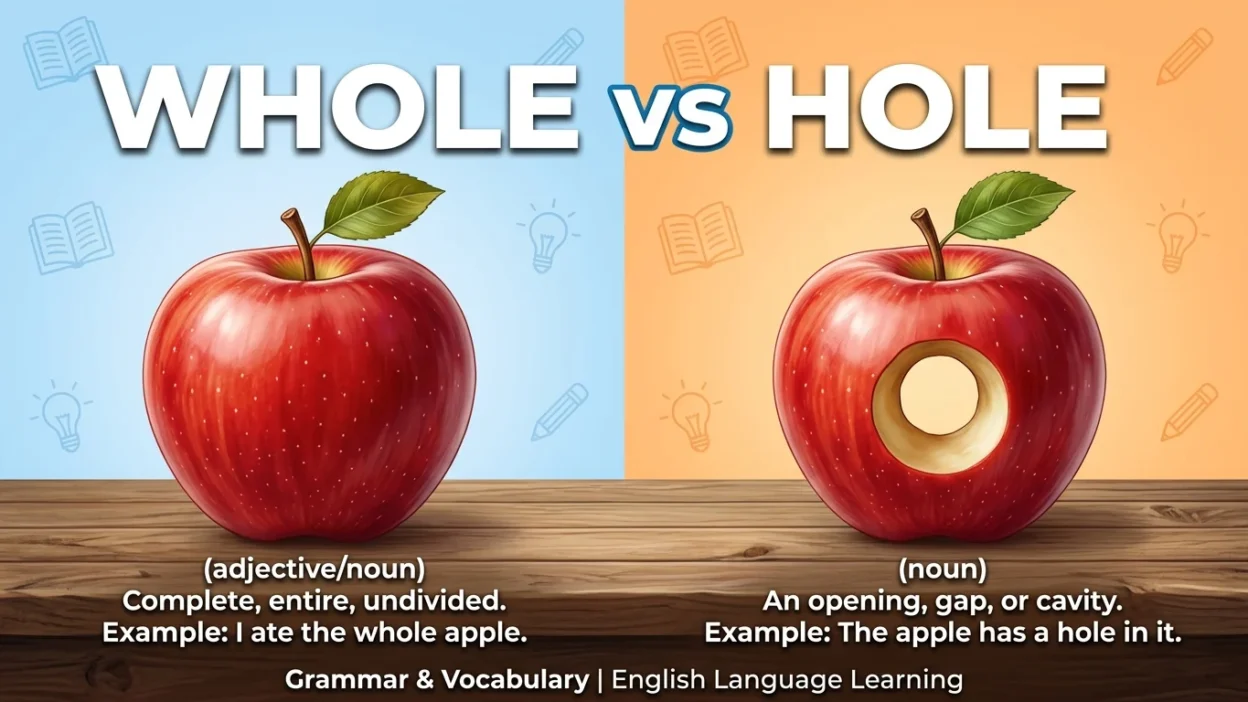
Whole usually means something that is complete, entire, or undivided. For example, “I ate the whole cake” means I ate the entire cake. Hole, on the other hand, means an opening, gap, or hollow space in something. For example, “There is a hole in my sock” describes an opening in the fabric. Once you understand these basic meanings and learn a simple memory trick, it becomes much easier to choose the correct word.
Quick Answer
Whole means complete, entire, or all of something, while hole means an opening, gap, or hollow space. They are pronounced the same but have different spellings and meanings. For example, “the whole book” means the entire book, while “a hole in the book” means an opening in it.
Why Do People Confuse Whole and Hole?
People often confuse whole and hole because they are homophones. Homophones are words that sound the same but have different spellings and meanings.
When speaking, there is no noticeable difference between the pronunciation of these two words. The difference becomes important when writing.
- Whole = complete or entire
- Hole = an opening or gap
Understanding the meaning rather than relying on pronunciation is the best way to choose the correct spelling.
What Does Whole Mean?
Whole is an adjective, noun, or determiner depending on how it is used. Its main meaning is complete, entire, or all of something.
Examples of Whole
- I read the whole book.
- She spent the whole day studying.
- He ate the whole pizza.
- The whole family came to dinner.
In each example, whole refers to something complete or entire.
Whole as a Noun
Whole can also refer to something considered as a complete unit.
Here, whole means the complete thing rather than its individual parts.
What Does Hole Mean?
Hole is a noun that means an opening, gap, or hollow place in something.
Examples of Hole
- There is a hole in my shoe.
- The dog dug a hole in the garden.
- We found a hole in the wall.
- Water is leaking through the hole.
A hole can be natural or created by people, animals, or objects.
Hole in Different Contexts
The word hole can describe many kinds of openings:
- a hole in a wall
- a hole in clothing
- a hole in the ground
- a hole in a bucket
- a hole in a tire
Whole vs Hole: Comparison Table
| Word | Meaning | Part of Speech | Example |
|---|---|---|---|
| Whole | Complete or entire | Adjective, noun, determiner | I ate the whole sandwich. |
| Hole | An opening or gap | Noun | There is a hole in the wall. |
The simplest distinction is:
Whole = complete
Hole = opening
When Should You Use Whole?
Use whole when you mean all of something or something that is complete.
Common expressions include:
- the whole day
- the whole story
- the whole world
- the whole family
- the whole truth
- the whole thing
- the whole time
Examples
- I watched the whole movie.
- She told me the whole story.
- We spent the whole afternoon outside.
- He ate the whole sandwich.
- The whole team celebrated the victory.
- I want to know the whole truth.
When Should You Use Hole?
Use hole when you mean an opening, gap, or hollow space.
Common expressions include:
- a hole in the wall
- a hole in the ground
- a hole in a shirt
- a hole in a tire
- dig a hole
- fill a hole
- fall into a hole
Examples
- There is a hole in my shirt.
- The children dug a hole in the sand.
- We need to fix the hole in the roof.
- The ball went through the hole.
- He fell into a hole in the ground.
- Please fill the hole with soil.
Whole vs Hole: 10+ Examples
Here are some examples that clearly show the difference:
- I ate the whole apple.
There is a hole in the apple. - She stayed home the whole day.
The mouse escaped through a hole. - He read the whole newspaper.
There is a hole in the paper. - We watched the whole game.
The ball went into the hole. - She knows the whole story.
Someone made a hole in the wall. - I cleaned the whole house.
There is a hole under the door. - They traveled across the whole country.
The workers dug a hole in the road. - He ate the whole cake.
The bird flew through the hole. - The whole family attended the event.
The fence has a hole in it. - I spent the whole morning working.
Water came through a hole in the pipe. - She listened to the whole song.
There is a hole in my sock. - We need the whole picture before deciding.
The carpenter drilled a hole in the wood.
Common Mistakes With Whole and Hole
The most common mistake is choosing hole when you mean complete.
❌ I ate the hole pizza.
✅ I ate the whole pizza.
Another common mistake is using whole when you mean an opening.
❌ There is a whole in my shirt.
✅ There is a hole in my shirt.
A Simple Rule
Ask yourself:
Do I mean “entire”? → Use whole.
Do I mean “opening”? → Use hole.
What Is a Good Memory Trick for Whole and Hole?
A useful memory trick is to connect whole with whole = complete.
Think:
For hole, imagine an actual opening:
You can also remember the phrase:
Whole = all
Hole = opening
This quick association can help you select the correct spelling when writing.
Whole vs Hole in American and British English
The meanings and spellings of whole and hole are the same in American and British English.
Both varieties use:
- whole for something complete or entire
- hole for an opening or gap
For example:
and:
The pronunciation is also essentially the same in both varieties, so context is especially important when listening.
What Are Some Similar Words?
Several words are related to whole and hole, but they do not have the same meanings.
Words Similar to Whole
Depending on the context, alternatives include:
- entire
- complete
- full
- all
- undivided
- total
Example:
This has a similar meaning to:
Words Related to Hole
Depending on the context, related words include:
- opening
- gap
- cavity
- hollow
- pit
- puncture
- opening
Example:
A gap and a hole can sometimes have similar meanings, but they are not always interchangeable.
Final Verdict: Whole or Hole?
The correct choice depends entirely on your intended meaning.
Use whole when you mean complete, entire, or all of something.
Use hole when you mean an opening, gap, or hollow space.
Remember:
Whole = complete
Hole = opening
Although these words sound identical, their meanings are easy to separate once you connect each spelling with its definition.
FAQs:
Is it whole or hole?
Both whole and hole are correct words, but they have different meanings. Whole means complete or entire, while hole means an opening or gap.
What is the difference between whole and hole?
Whole describes something complete or entire. Hole refers to an opening, gap, or hollow space. They are homophones because they sound the same.
Is “whole” a homophone of “hole”?
Yes. Whole and hole are homophones because they have the same pronunciation but different spellings and meanings.
How do you remember whole vs hole?
Remember whole = complete and hole = opening. If you could replace the word with entire, choose whole. If you mean an opening, choose hole.
Is “whole” an adjective?
Yes. Whole is commonly used as an adjective to mean complete or entire, as in “the whole book.” It can also function as a noun in expressions such as “the whole.”
Is “hole” a noun?
Yes. Hole is primarily a noun. It refers to an opening, gap, or hollow space, such as “a hole in the wall.”
Are whole and hole pronounced the same?
Yes. In standard English pronunciation, whole and hole are pronounced the same. Their spelling and meaning are what distinguish them.
Can whole and hole be used interchangeably?
No. They cannot normally be used interchangeably because their meanings are different. Using one instead of the other can change the meaning of a sentence or make it incorrect.
Remember This
- Whole = complete or entire
- Hole = opening or gap
- They are homophones
- Whole can describe an entire object, period, group, or amount.
- Hole usually refers to a physical or figurative opening.
If you mean all of something, use whole. If you mean an opening, use hole.
Conclusion
The difference between whole and hole is simple once you focus on meaning. Whole refers to something complete, entire, or undivided, while hole means an opening, gap, or hollow space. Although both words sound the same, their spellings and uses are completely different.
When writing, ask yourself if you mean “complete” or “opening.” If the answer is complete, choose whole. If you are talking about an opening or gap, choose hole. With this simple rule and a little practice, you can easily avoid one of the most common homophone mistakes in English.

John Leo is a skilled writer and communication enthusiast who specializes in crafting charming, witty, and thoughtful replies. Through ReplyCorner, he helps readers improve conversations with creative responses for everyday social interactions.