If you have ever wondered if to say “I’ve got” or “I’ve gotten,” you are not alone. The words got and gotten are both forms of the verb get, but they are not always used in the same way. The main difference depends on meaning and, especially, on the variety of English being used.
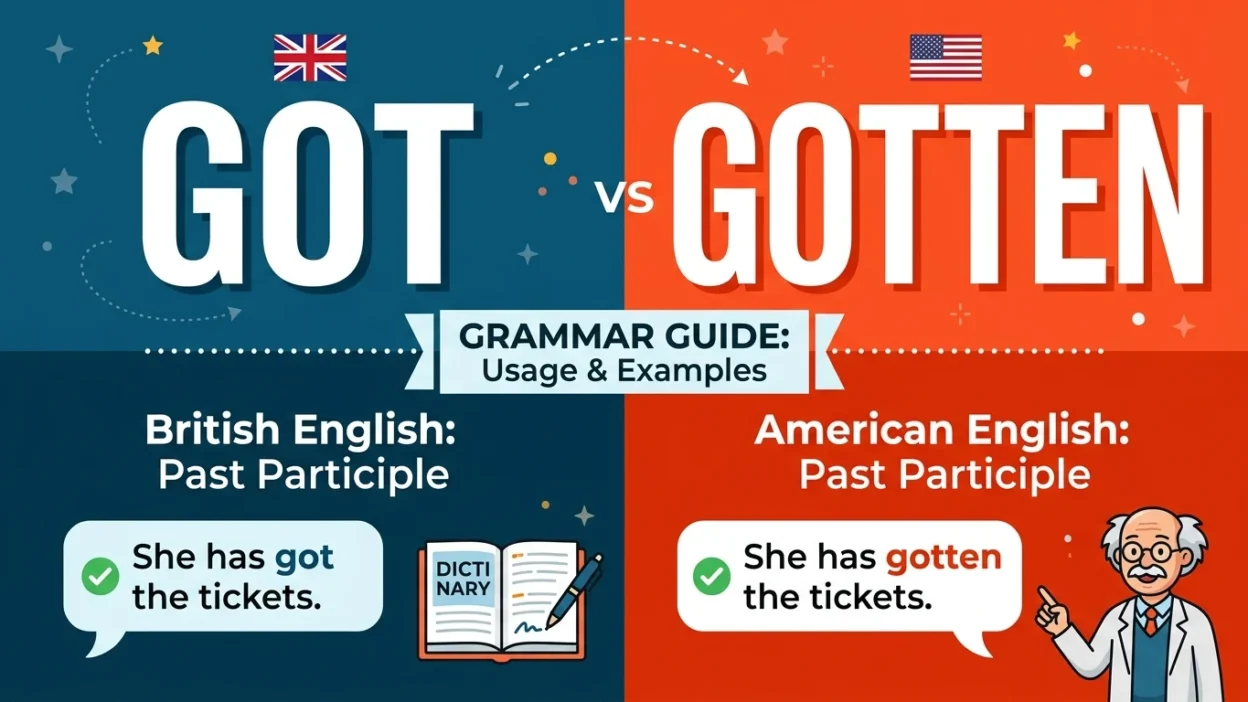
In American English, gotten is commonly used as the past participle of get when talking about receiving, becoming, or obtaining something. Got is also used as a past participle, particularly for possession and certain fixed expressions. In British English, got is generally used where American English may use gotten. Understanding this difference will help you choose the natural form in writing and conversation.
Quick Answer
Got and gotten are both forms of get. In American English, gotten is commonly used for changes, receiving, or obtaining something, while got is often used for possession. British English generally uses got instead of gotten. For example: “I’ve gotten better” but “I’ve got a car.”
Why Do People Confuse Got and Gotten?
The confusion happens because got and gotten come from the same verb: get.
The basic forms are:
- Get — present form
- Got — simple past
- Got — past participle in many varieties of English
- Gotten — past participle commonly used in American English
For example:
The choice becomes more complicated because get has many meanings, including receive, obtain, become, understand, arrive, and possess.
Got: Meaning and Usage
Got is the simple past form of get in standard English.
It can describe something that happened in the past:
- I got a new phone yesterday.
- She got home late.
- We got tickets for the concert.
In British English, got is also commonly used as the past participle:
- I have got a new job.
- She has got much better.
- They have got everything they need.
In both American and British English, have got is commonly used to express possession:
Here, gotten would not normally be used to express simple possession.
Gotten: Meaning and Usage
Gotten is the past participle of get commonly used in American English.
It is particularly useful when get means become, obtain, receive, or reach a particular state.
Examples include:
- She has gotten better at English.
- I have gotten several emails today.
- He has gotten angry.
- We have gotten permission to leave.
- The weather has gotten colder.
In these examples, gotten emphasizes an action, development, or change.
Got vs. Gotten: Comparison Table
| Feature | Got | Gotten |
|---|---|---|
| Simple past of get | Yes | No |
| Past participle | Yes | Yes, especially American English |
| Common in British English | Yes | Less common |
| Common in American English | Yes | Yes |
| Possession with “have” | Common | Usually not used |
| Becoming/changing | Common | Very common in American English |
| Receiving/obtaining | Common | Common in American English |
| Example | I got a job. | I’ve gotten a job. |
When Should You Use Got?
Use got when you are talking about a completed past event.
When Should You Use Gotten?
Use gotten mainly in American English when get describes an action, development, or change.
12 Examples of Got vs. Gotten
- I got home at midnight.
Simple past: the action happened in the past. - I’ve got a new car.
Got expresses possession. - I’ve gotten a new car.
In American English, this can emphasize acquiring a new car. - She got sick yesterday.
The change happened in the past. - She has gotten sick.
American English can use gotten to describe becoming sick. - He got angry during the meeting.
This describes a past event. - He has gotten angry several times.
American English uses gotten for the development of that state. - We got permission yesterday.
The permission was obtained in the past. - We have gotten permission to enter.
American English can use gotten for obtaining permission. - They’ve got enough money.
This means they currently possess enough money. - The weather has gotten colder.
This describes a change in condition. - My pronunciation has gotten better.
This means the pronunciation has improved.
Common Mistakes
Mistake 1: Using “gotten” for simple possession
❌ I’ve gotten two sisters.
✅ I’ve got two sisters.
For simple possession, have got is the natural expression.
Mistake 2: Thinking “gotten” is always incorrect
❌ I have gotten better at English.
This is perfectly natural in American English.
In British English, you would more commonly hear:
Mistake 3: Using “got” and “gotten” interchangeably
They can overlap, but they are not always interchangeable.
Compare:
This normally focuses on possession.
In American English, this can focus more on the act of acquiring the phone.
A Simple Memory Trick
Think of gotten as a word that often shows change or movement toward a new situation.
Got = possession or completed past action
Gotten = becoming, receiving, or obtaining, especially in American English
For example:
This distinction is not absolute in every context, but it is a useful starting point.
American vs. British English
The biggest difference is regional.
American English
American English commonly distinguishes between got and gotten:
British English
British English generally uses got where American English often uses gotten:
However, gotten is not completely unknown in British English. It survives in some expressions and historical or dialectal uses, but it is much less common in modern standard British English.
Similar Words and Forms
Understanding the other forms of get can make this topic easier.
- Get — present form
- Gets — third-person singular present
- Got — simple past
- Got — past participle in many contexts
- Gotten — past participle, especially American English
- Getting — -ing form
Examples:
Final Verdict
Got and gotten are both correct, but their use depends on meaning and regional variety.
Use got for the simple past, possession in expressions such as have got, and generally in British English as the past participle.
Use gotten mainly in American English when get means becoming, changing, receiving, or obtaining something.
The easiest examples to remember are:
FAQs:
Is “gotten” grammatically correct?
Yes. Gotten is a standard past participle of get, especially in American English.
Is “got” or “gotten” more correct?
Neither is universally more correct. The appropriate form depends on the meaning and variety of English. American English commonly uses both, while British English generally uses got.
Do British people use “gotten”?
Modern standard British English generally uses got instead of gotten as the past participle of get, although gotten can occur in some expressions and varieties.
Is “I have got” correct?
Yes. I have got is completely correct and commonly means I have or I possess.
Is “I have gotten” correct?
Yes, particularly in American English.
Here, gotten describes a change or improvement.
What is the past tense of “get”?
The simple past tense of get is got.
What is the past participle of “get”?
Both got and gotten can function as past participles, depending on the variety of English and the meaning. Gotten is especially common in American English.
Can I use “gotten” in formal writing?
Yes. Gotten is grammatically standard in American English and can be used in formal writing when it fits the intended meaning.
Remember This
Got = simple past and possession in have got.
Gotten = past participle commonly used in American English, especially for becoming, changing, receiving, or obtaining.
Once you understand the difference between possession and change or acquisition, choosing the right form becomes much easier.
Conclusion
The difference between got and gotten is mainly about meaning, grammar, and regional English. Both forms come from the verb get, but American English often uses gotten when describing a change, development, receipt, or acquisition. Got remains common for possession and the simple past.
If you are learning American English, becoming comfortable with both forms will help your English sound more natural. If you are learning British English, got will usually be the form you need as the past participle.

David Owen is a passionate writer and communication enthusiast dedicated to helping readers craft charming, witty, and thoughtful replies. Through ReplyCorner, he shares creative response ideas that make conversations engaging and memorable.