When talking about yourself and your relatives, you may wonder if to say “me and my family” or “my family and I.” Both expressions can be correct, but they are used in different grammatical situations. The key is to understand if the phrase is functioning as the subject or the object of a sentence.
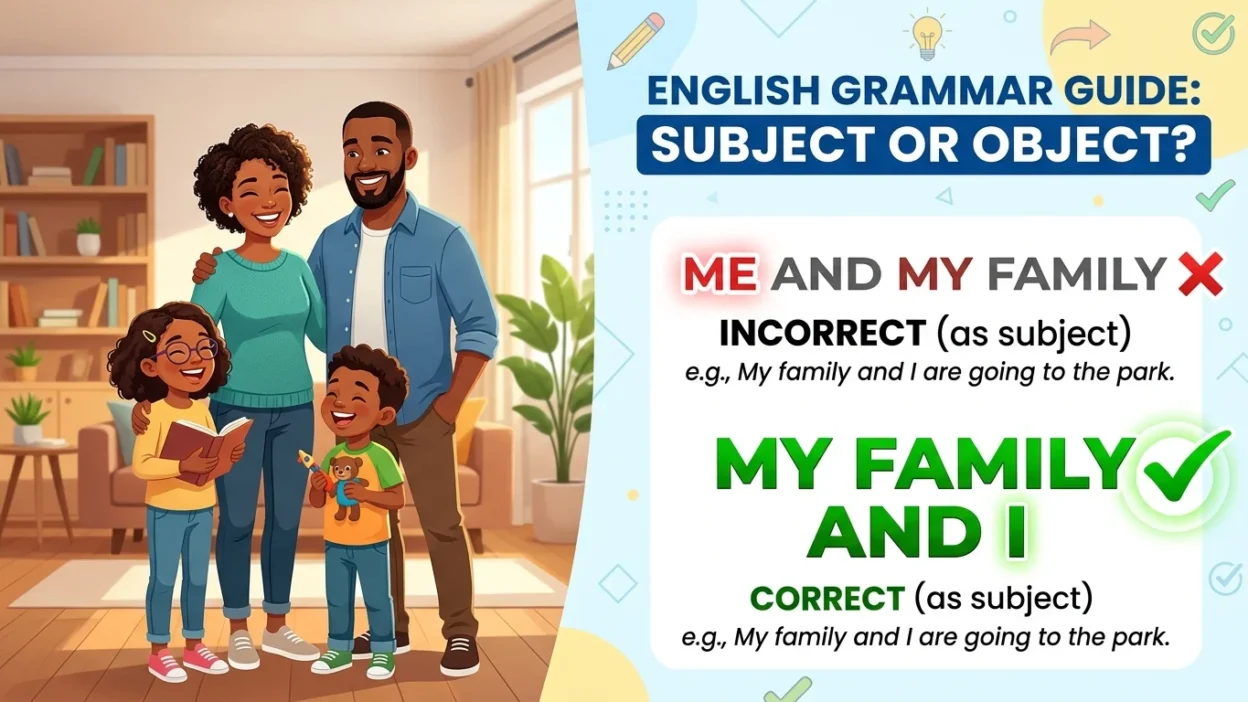
In standard English, “my family and I” is normally used when the group performs the action, while “my family and me” is used when the group receives the action. Although people commonly say “me and my family” in casual conversation, it is often considered nonstandard when it is used as the subject of a sentence. Learning this simple distinction can help you sound more natural and grammatically accurate in writing and formal speech.
Quick Answer
“My family and I” is correct when the phrase is the subject of a sentence: “My family and I went on vacation.” “My family and me” is correct when it is the object: “She invited my family and me.” “Me and my family” is common in informal speech but is generally avoided in formal writing.
Why Do People Confuse “Me and My Family” and “My Family and I”?
The confusion happens because I and me both refer to the speaker, but they have different grammatical roles.
- I is a subject pronoun.
- Me is an object pronoun.
- My family and I acts as a subject.
- My family and me acts as an object.
Another reason for the confusion is everyday speech. Native speakers sometimes put themselves first and say “me and my family.” This expression is widely understood, especially in casual conversation, but traditional grammar recommends putting the other person or people first and choosing the pronoun based on its role in the sentence.
First Word: “Me”
Me is an object pronoun. It is used when the speaker receives an action or follows a preposition.
For example:
- The teacher called me.
- She invited me.
- He spoke to me.
- They gave me a gift.
When you combine me with your family, you can say “my family and me” when the whole phrase is the object.
Example:
“Grandma invited my family and me to dinner.”
Here, “my family and me” receives the action of being invited.
Is “Me and My Family” Correct?
“Me and my family” is common in informal spoken English, but it is generally not the preferred form when the phrase is the subject.
For formal or careful writing, use “my family and I” as the subject.
Instead of:
Use:
However, if the phrase is the object, use “my family and me.”
Second Word: “My Family and I”
“My family and I” is a subject phrase. Use it when you and your family are performing the action.
Examples:
- My family and I live in Karachi.
- My family and I visited the museum.
- My family and I enjoy traveling.
- My family and I are planning a trip.
A useful test is to remove “my family” from the sentence.
For example:
Remove “my family”:
That sounds correct, so “my family and I” is appropriate.
Me and My Family vs My Family and I: Comparison Table
| Expression | Grammatical role | Typical use | Example |
|---|---|---|---|
| My family and I | Subject | Formal and standard English | My family and I traveled abroad. |
| My family and me | Object | Standard English | They invited my family and me. |
| Me and my family | Subject in informal speech | Casual conversation | Me and my family went there. |
| I and my family | Subject | Grammatically possible but unnatural | I and my family went there. |
The most natural standard choices are usually “my family and I” for subjects and “my family and me” for objects.
When Should You Use Each?
Use “My Family and I” as the Subject
Use “my family and I” when the group performs the action.
Examples:
- My family and I moved to a new house.
- My family and I watched a movie.
- My family and I visited our grandparents.
Use “My Family and Me” as the Object
Use “my family and me” when the group receives the action.
Examples:
- She invited my family and me.
- The guide showed my family and me around the city.
- They gave my family and me some useful advice.
Use “Me and My Family” in Casual Speech With Caution
You may hear “me and my family” frequently in conversation. It is understandable and commonly used in informal speech.
However, if you are writing an essay, application, formal email, academic assignment, or professional document, “my family and I” is usually the safer choice when the phrase is the subject.
12 Examples of “My Family and I”
- My family and I went to the park yesterday.
- My family and I are planning a vacation.
- My family and I live in a small town.
- My family and I watched the football match.
- My family and I celebrated my birthday together.
- My family and I enjoy eating dinner together.
- My family and I visited our relatives last weekend.
- My family and I are moving to another city.
- My family and I traveled to Lahore last summer.
- My family and I usually spend Sundays together.
- My family and I helped our neighbors.
- My family and I agreed to support the project.
In each sentence, the family and the speaker are doing the action, so “my family and I” is appropriate.
10 Examples of “My Family and Me”
- She invited my family and me to dinner.
- The teacher spoke to my family and me.
- They gave my family and me some advice.
- The host welcomed my family and me.
- He asked my family and me several questions.
- The tour guide helped my family and me.
- The company offered my family and me free tickets.
- Our neighbors congratulated my family and me.
- The doctor talked with my family and me.
- They took a photograph of my family and me.
Here, the phrase is receiving an action or follows a preposition, so “me” is correct.
Common Mistakes
Mistake 1: Always Using “I”
Some people believe I is always more correct than me.
That is not true.
The correct sentence is:
Mistake 2: Always Using “Me”
The opposite mistake is using me whenever you mention yourself.
Standard English uses:
Mistake 3: Putting Yourself First in Formal Writing
“Me and my family” is understandable, but it is generally better to use “my family and I” in formal writing when the phrase is the subject.
Mistake 4: Forgetting the Object Test
If you are unsure, remove the other people from the sentence.
Becomes:
But:
Becomes:
This quick test makes the choice much easier.
A Simple Memory Trick
Remember:
I = do the action
Me = receive the action
So:
Another useful trick is to temporarily remove “my family.”
- I went home → correct → My family and I went home.
- They invited me → correct → They invited my family and me.
American vs British English
The basic distinction between I and me is the same in American and British English.
Both varieties generally use:
- My family and I as a subject.
- My family and me as an object.
The expression “me and my family” can occur in informal speech in both varieties. It is more conversational than formal and may be avoided in edited writing.
The important point is not if you are using American or British English. The main issue is the grammatical function of the pronoun.
Similar Words and Expressions
Several related expressions can also cause confusion.
My Parents and I
Use this when you and your parents are the subject.
My Parents and Me
Use this when you and your parents are the object.
My Friends and I
Use this when you and your friends perform the action.
My Friends and Me
Use this when you and your friends receive the action.
My Brother and I
My Brother and Me
The same I vs. me rule applies regardless of if you are talking about family members, friends, colleagues, or other people.
Final Verdict
For standard English, use “my family and I” when you and your family are the subject of the sentence.
Use “my family and me” when you and your family are the object.
“Me and my family” is common in informal conversation, but it is generally not the preferred choice for formal writing when the phrase is acting as the subject.
The easiest rule to remember is:
FAQs:
Is “me and my family” grammatically correct?
“Me and my family” is common in informal spoken English, but standard formal English normally uses “my family and I” when the phrase is the subject.
Should I say “my family and I” or “me and my family”?
Use “my family and I” when the phrase is performing the action. For example, “My family and I went on vacation.”
Is “my family and me” correct?
Yes. “My family and me” is correct when the phrase is an object.
Which is correct: “my family and I went” or “my family and me went”?
“My family and I went” is correct in standard English because the phrase is the subject performing the action.
Can I say “me and my family” in conversation?
Yes, you may hear it in casual conversation, and listeners will understand it. However, “my family and I” is the more standard choice for formal writing and careful speech when it is the subject.
Why do we say “my family and I” instead of “I and my family”?
Although “I and my family” can be grammatically interpreted as a subject phrase, “my family and I” is the conventional and more natural order in standard English.
How can I quickly decide between “I” and “me”?
Remove the other people from the sentence. If I works, use “my family and I.” If me works, use “my family and me.”
Remember This
My family and I → subject → we perform the action.
My family and me → object → the action happens to us.
Me and my family → informal expression → generally avoid it in formal writing when used as the subject.
Conclusion
Choosing between “me and my family” and “my family and I” becomes simple once you understand the difference between subject and object pronouns. Use “my family and I” when you and your family perform an action, such as “My family and I traveled abroad.” Use “my family and me” when someone performs an action involving you and your family, such as “They invited my family and me.”
Although “me and my family” is often heard in casual conversation, “my family and I” is the standard choice for formal writing when the phrase is the subject. When you are unsure, remove “my family” and check if I or me fits the sentence. This simple test can help you choose the correct form quickly and confidently.

David Owen is a passionate writer and communication enthusiast dedicated to helping readers craft charming, witty, and thoughtful replies. Through ReplyCorner, he shares creative response ideas that make conversations engaging and memorable.