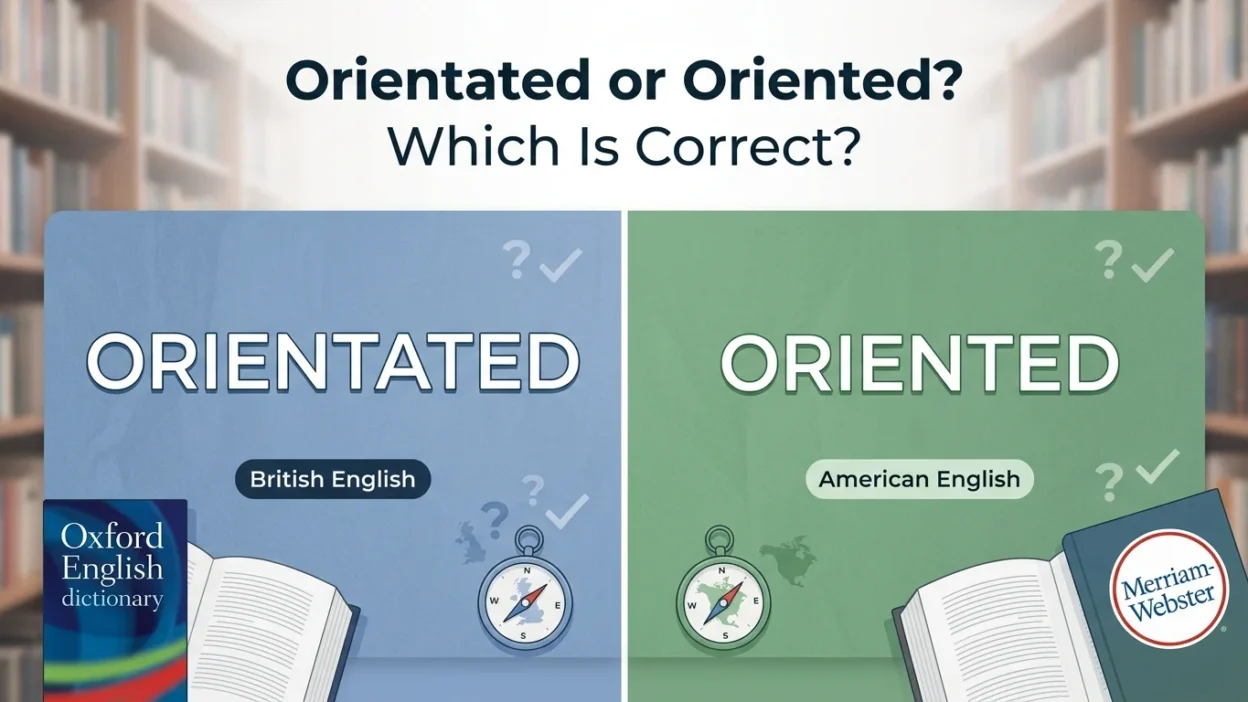
When choosing between orientated or oriented, both words are correct. They are forms of the verb orient, meaning to position something, help someone understand their surroundings, or become familiar with a situation. The main difference is regional preference: oriented is much more common in American English, while orientated is also widely used, especially in British English and some other varieties of English.
For most everyday writing, oriented is the safer and more widely recognized choice. However, orientated is not grammatically wrong or an incorrect alternative. Both can describe a person who has become familiar with a new environment or something that is focused toward a particular goal. Understanding how these forms are used can help you choose the most natural wording for your audience.
Quick Answer
Oriented and orientated are both correct. “Oriented” is more common in American English and is widely used internationally, while “orientated” is especially common in British English. They can have the same meaning, particularly when describing familiarity, direction, or focus. Choose oriented for the broadest everyday usage.
Why Do People Confuse Orientated and Oriented?
The confusion comes from the verb orient, which has two accepted past-participle forms:
- oriented
- orientated
Both are formed from the same verb and can function as adjectives or as forms of the verb.
For example:
- The new employees were oriented to the company.
- The new employees were orientated to the company.
The first version is generally more common, especially in American English.
What Does “Oriented” Mean?
Oriented is the past tense and past participle of orient. It can mean positioned in a particular direction, familiarized with something, or focused on a particular purpose.
Examples
- The building is oriented toward the south.
- The training is oriented toward practical skills.
- I am now oriented to my new surroundings.
- The program is customer-oriented.
Oriented is the form you will encounter most frequently in modern English.
What Does “Orientated” Mean?
Orientated is also a past tense and past participle of orient. It has the same basic meanings as oriented.
Examples
- The students were orientated to the new campus.
- The project is orientated toward community development.
- She quickly became orientated to her new surroundings.
Although some speakers consider orientated less natural, it is a legitimate English word rather than a grammatical error.
Orientated vs Oriented: Comparison Table
| Feature | Oriented | Orientated |
|---|---|---|
| Base verb | Orient | Orient |
| Correct? | Yes | Yes |
| Meaning | Position, familiarize, or focus | Position, familiarize, or focus |
| American English | Very common | Less common |
| British English | Common | Also common |
| Formal writing | Widely preferred | Acceptable |
| Everyday use | Very frequent | Less frequent |
| Safest general choice | Yes | Depends on audience |
When Should You Use Each?
Use “Oriented” When You Want the Most Widely Used Form
Oriented works well in almost every variety of standard English.
- The course is oriented toward beginners.
- She became oriented to her new surroundings.
- The company is results-oriented.
It is particularly natural in American English.
Use “Orientated” When It Fits Your Variety of English
Orientated can be appropriate when writing in British English or when following the established style of an organization or publication.
- The training is orientated toward professional development.
- New employees are orientated during their first week.
The important point is that orientated is not automatically wrong.
10+ Examples of Oriented and Orientated
- The new students were oriented to the university campus.
- The new students were orientated to the university campus.
- Our training program is oriented toward practical skills.
- The project is orientated toward improving public services.
- The house is oriented toward the ocean.
- The company has a customer-oriented approach.
- The organization has a community-orientated mission.
- It took me several days to become oriented to my new surroundings.
- She quickly became orientated with the new system.
- The course is oriented toward career development.
- The research is orientated toward finding practical solutions.
- The team is strongly oriented toward achieving its goals.
Notice that the meaning generally remains the same even when the form changes.
Common Mistakes
Mistake 1: Thinking “Orientated” Is Always Wrong
It is not. Orientated is an accepted English form.
Mistake 2: Assuming Both Forms Are Equally Common Everywhere
They are not equally common in every variety of English. Oriented is generally more widespread.
Mistake 3: Using “Orientated” Simply Because It Looks More Formal
Longer does not necessarily mean more formal or more correct. In many contexts, oriented is the more natural choice.
Mistake 4: Confusing “Oriented” With “Alternative”
These words are not interchangeable. Oriented relates to the verb orient, while Alternative is an older term associated with eastern regions and is often avoided when referring to people because more specific geographical or cultural terms are preferable.
Memory Trick
Think:
Orient → Oriented
The shorter form is usually the easiest choice.
You can remember it as:
If you are unsure which form to use in general writing, oriented is a reliable choice.
American vs British English
There is a noticeable regional preference.
American English strongly favors oriented:
- The course is oriented toward business.
- The employees were oriented to the new system.
British English uses oriented as well, but orientated is also established and commonly encountered:
- The course is orientated toward business.
- The employees were orientated to the new system.
Therefore, the distinction is mainly about usage and regional preference, not correctness.
Similar Words
Several related words can appear in similar contexts.
Orientation
Orientation is the noun referring to the process of becoming familiar with something or understanding one’s position.
- The university held an orientation for new students.
Orient
Orient is the base verb.
- The instructor helped us orient ourselves.
Disoriented
Disoriented means confused about one’s position, surroundings, or situation.
- I felt disoriented after waking up in the unfamiliar room.
Direction
Direction refers to the course or position toward which something moves or faces.
- The building faces in a southern direction.
Final Verdict
Orientated and oriented are both correct forms of the verb orient. They can often be used with the same meaning.
However, oriented is the more widely used form and is particularly dominant in American English. Orientated is also standard, especially in British English and some other varieties.
If you need one form for general-purpose writing and are unsure about your audience, oriented is usually the simplest choice.
FAQs:
Is “orientated” grammatically correct?
Yes. Orientated is a legitimate past tense and past participle of orient. It is especially familiar in British English.
Is “oriented” or “orientated” more common?
Oriented is generally more common, particularly in American English and in international usage.
Is orientated British English?
Orientated is commonly used in British English, although British speakers also use oriented.
Which is better: oriented or orientated?
Neither is universally “better.” The choice depends on regional usage and style. Oriented is the more broadly familiar option.
Can I use “oriented” in British English?
Yes. Oriented is perfectly acceptable in British English.
Can I use “orientated” in American English?
You can, but oriented is much more common in American English and will usually sound more natural to American readers.
Are oriented and orientated synonyms?
In many contexts, yes. Both can describe something positioned, directed, focused, or made familiar to someone.
Remember This
- Oriented = correct and widely used.
- Orientated = also correct.
- Oriented is especially common in American English.
- Orientated is especially established in British English.
- When unsure, oriented is usually the safest general choice.
Conclusion
The choice between orientated or oriented is mainly a matter of usage rather than grammar. Both forms come from the verb orient and can express the same basic ideas of direction, familiarity, or focus. Neither should automatically be treated as an error.
For everyday and international writing, oriented is usually the most natural choice because it is widely recognized and frequently used. If you are writing specifically for a British audience, orientated is also a perfectly acceptable option. The key is to consider your audience and maintain consistency throughout your writing.