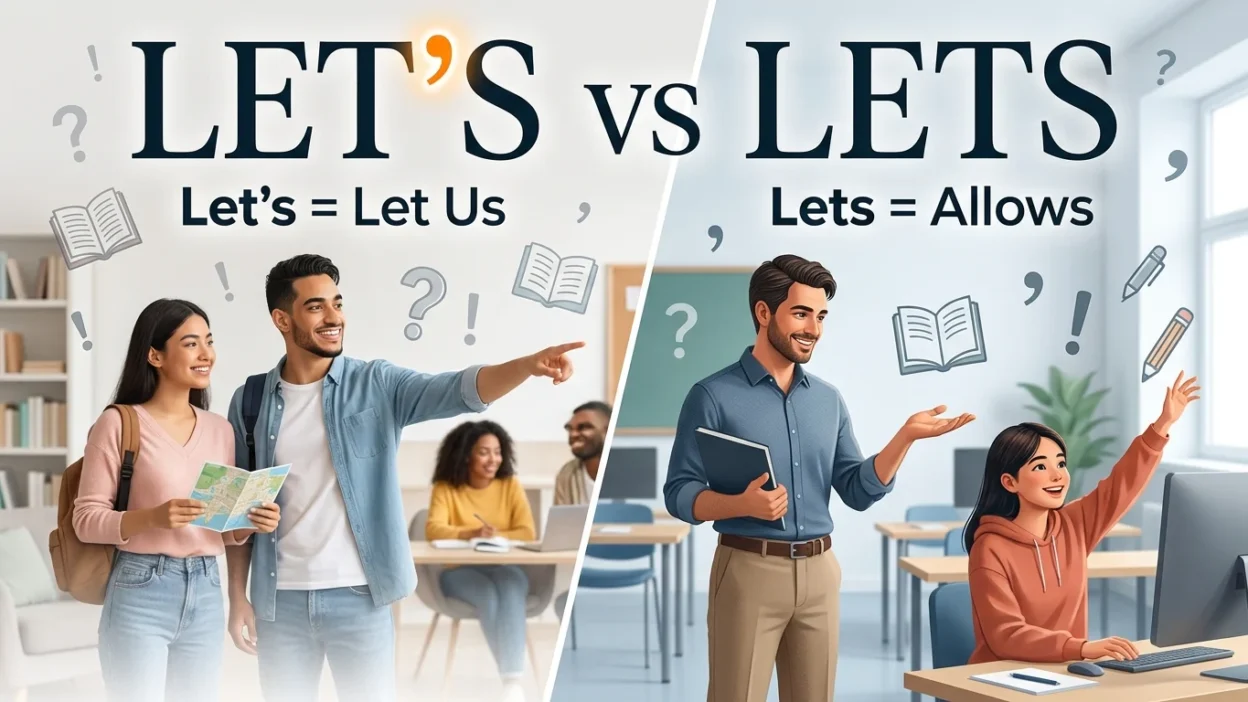
Let’s and lets look almost identical, but they have different meanings and grammatical functions. Let’s is a contraction of “let us” and is commonly used to make suggestions, invitations, or proposals, such as “Let’s go home.” Lets is the third-person singular form of the verb “let,” meaning allows or permits, as in “She lets her children play outside.”
Understanding the difference between let’s vs lets is important because the apostrophe changes the meaning of the word. This small punctuation mark can turn a verb meaning “allows” into a phrase meaning “we should.”
The good news is that the rule is simple once you know what each form means. If you are a student, ESL learner, writer, or everyday English speaker, learning when to use let’s and lets will help you write more accurately and confidently.
Quick Answer
Let’s means “let us” and is used mainly for suggestions or invitations: “Let’s study together.” Lets is a verb meaning “allows” or “permits”: “My teacher lets us ask questions.” Use the apostrophe in let’s when you could replace it with let us.
Why People Confuse It
People often confuse let’s and lets because they sound the same when spoken. The only visible difference is the apostrophe, but that apostrophe represents missing letters in the contraction let us → let’s.
The words also appear in similar sentence positions. For example:
- Let’s eat dinner.
- She lets us eat dinner early.
The first is a suggestion. The second says that someone allows something to happen.
First Word: Let’s
Let’s is a contraction of “let us.” It is generally used when the speaker is suggesting that we do something together.
Common uses of “let’s”
- Making a suggestion
- Giving an invitation
- Proposing an action
- Encouraging someone
- Starting a shared activity
Examples:
- Let’s go for a walk.
- Let’s finish this project today.
- Let’s try again.
- Let’s watch a movie tonight.
A useful test is to replace let’s with let us.
If the expanded version makes sense, let’s is probably correct.
Second Word: Lets
Lets is the third-person singular form of the verb “let.” It means allows, permits, or gives someone permission to do something.
It is used with subjects such as he, she, it, or a singular noun.
Examples:
- She lets me use her laptop.
- My father lets me drive his car.
- The teacher lets students ask questions.
- This software lets you edit photos.
Notice that lets does not need an apostrophe because it is not a contraction.
Let’s vs Lets Comparison Table
| Word | Meaning | Grammar | Example |
|---|---|---|---|
| Let’s | Let us | Contraction | Let’s go outside. |
| Lets | Allows or permits | Verb | He lets me use his phone. |
The easiest distinction
Let’s = let us
Lets = allows
That simple difference solves most let’s vs lets questions.
When to Use Each
Use “let’s” for suggestions
Use let’s when you are suggesting an action that you and another person or group can do.
- Let’s have lunch.
- Let’s meet tomorrow.
- Let’s start the lesson.
Use “lets” for permission
Use lets when someone or something allows another person to do something.
- She lets me borrow her books.
- The app lets users save their work.
- Our manager lets us leave early on Fridays.
Use “let us” when appropriate
In some formal or traditional contexts, let us may be preferable to let’s, especially when the full phrase sounds more formal.
For example:
- Let us consider the evidence.
- Let us begin the meeting.
In ordinary conversation, however, let’s is much more common.
10+ Examples of Let’s and Lets
Examples with “Let’s”
- Let’s go to the park.
- Let’s study for the test.
- Let’s order some food.
- Let’s call her later.
- Let’s clean the room.
- Let’s take a short break.
Examples with “Lets”
- My mother lets me stay up late on weekends.
- He lets his dog sleep on the sofa.
- The teacher lets us use dictionaries.
- This website lets you create an account for free.
- She lets her children choose their own clothes.
- The hotel lets guests check in early when rooms are available.
Common Mistakes
Mistake 1: Using “lets” for a suggestion
❌ Lets go shopping.
✅ Let’s go shopping.
You are suggesting that you and someone else go shopping, so let’s is correct.
Mistake 2: Using “let’s” for “allows”
❌ My brother let’s me use his computer.
✅ My brother lets me use his computer.
Here, lets means allows, so no apostrophe is needed.
Mistake 3: Thinking every word ending in “s” needs an apostrophe
An apostrophe is not used simply because a word ends in s. In lets, the s is part of the verb form.
Mistake 4: Forgetting that “let’s” means “let us”
When unsure, expand the word:
Let’s → let us
If that meaning works, use let’s.
Memory Trick
Remember this:
Let’s = Let Us = Suggestion
Lets = Allows = Permission
You can also remember the apostrophe as a clue:
Try this quick test:
“___ go!”
→ Let’s go!
“She ___ me go.”
→ She lets me go.
American vs British English
The distinction between let’s and lets is essentially the same in American and British English.
In both varieties:
- Let’s means let us.
- Lets means allows or permits.
For example, both American and British speakers would normally write:
Let’s meet after work.
And:
She lets her children play outside.
The main difference is not regional. It is grammatical and depends on the meaning of the sentence.
Similar Words
Several words and phrases can cause similar confusion.
Let
Let can mean allow:
- My parents let me choose.
Let us
Let us is the full form of let’s when used as a suggestion:
- Let us begin.
Lets
Lets means allows:
- The teacher lets us leave early.
Let’s
Let’s means let us:
- Let’s leave early.
Allowed
Allowed is another word for permitted:
- They allowed us to enter.
Allow
Allow has a similar meaning to let:
- My parents allow me to stay out late.
Final Verdict
The difference between let’s vs lets is straightforward once you focus on meaning.
Use let’s when you mean “let us” and are making a suggestion or invitation:
Let’s go home.
Use lets when you mean “allows” or “permits”:
She lets me use her car.
The apostrophe in let’s is important because it shows that the word is a contraction. If you are unsure, try replacing let’s with let us. If the sentence still makes sense, let’s is the right choice.
FAQs:
Is “let’s” short for “let us”?
Yes. Let’s is the contraction of “let us.” For example, “Let’s go” means “Let us go.”
What is the difference between “let’s” and “lets”?
Let’s means “let us,” usually for a suggestion or invitation. Lets means “allows” or “permits.”
Is “lets” a real word?
Yes. Lets is the third-person singular form of the verb let. For example, “He lets me borrow his car.”
Should I write “lets go” or “let’s go”?
Write “let’s go.” It means “let us go” and expresses a suggestion or invitation.
Is “let’s” always a contraction?
In standard modern English, let’s is the contraction of “let us.” The apostrophe represents the omitted letters.
Can “let’s” mean “allows”?
No. Let’s and lets have different grammatical functions. Lets means “allows,” while let’s normally means “let us.”
How can I quickly remember the difference?
Use the substitution test. If you can replace the word with “let us,” use let’s. If it means “allows,” use lets.
Remember This
Let’s = let us = suggestion or invitation.
Lets = allows or permits.
Let’s study.
She lets me study.
The apostrophe makes the difference.
Conclusion
Learning let’s vs lets does not require memorizing complicated grammar rules. The key is to identify the meaning of the word in the sentence. If you are making a suggestion or inviting someone to do something together, choose let’s. If you mean that someone or something allows an action, choose lets.
Whenever you are unsure, remember the two-word shortcut: let’s = let us, while lets = allows. With this simple test and a little practice, you can easily avoid one of the most common apostrophe mistakes in everyday English.

John Leo is a skilled writer and communication enthusiast who specializes in crafting charming, witty, and thoughtful replies. Through ReplyCorner, he helps readers improve conversations with creative responses for everyday social interactions.