
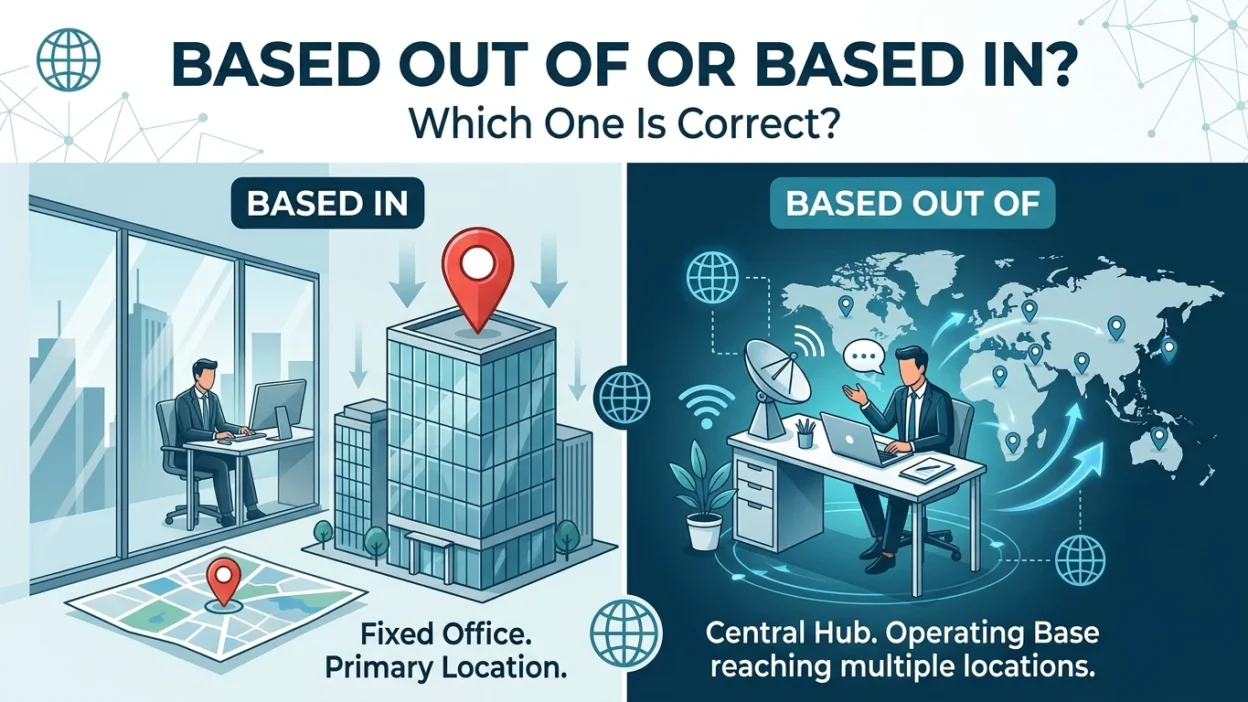
Choosing between “based out of” and “based in” can be confusing because both expressions are commonly used to describe where a person, business, or organization operates. However, they are not always interchangeable. Understanding the difference can help you sound more natural and precise in professional, academic, and everyday English.
The phrase “based in” is the standard and more widely accepted choice when you want to identify the place where someone lives, works, or operates. “Based out of” is also used, especially in informal and professional American English, but it often emphasizes a location that serves as a person’s or organization’s operating center rather than simply stating where they are located.
Quick Answer
“Based in” is the standard choice for saying where a person, company, or organization is located or operates. “Based out of” is also common, particularly in American English, and often emphasizes a base of operations. For formal writing, “based in” is usually the safer and clearer option.
Why Do People Confuse “Based Out Of” and “Based In”?
The confusion comes from the fact that both expressions can describe a person’s or organization’s location.
For example:
- She is based in London.
- She is based out of London.
Both sentences can communicate that London is where she operates. However, “based in” is more direct and standard, while “based out of” can sound more conversational or emphasize London as her operational base.
The choice also depends on context, regional usage, and the level of formality you want.
What Does “Based In” Mean?
“Based in” means that a person, company, organization, or activity has its main location in a particular place.
It is the most straightforward way to describe someone’s or something’s location.
Examples
- The company is based in New York.
- He is based in Toronto.
- Our office is based in Manchester.
- The organization is based in Nairobi.
“Based in” works especially well in formal writing, business descriptions, biographies, resumes, websites, and academic contexts.
What Does “Based Out Of” Mean?
“Based out of” generally means operating from a particular place or using that place as a base.
It is frequently heard in conversational and professional American English.
Examples
- She is based out of Chicago.
- Our sales team is based out of Dallas.
- The photographer is based out of Los Angeles.
- He works based out of our Boston office.
The expression can suggest that the person travels, works in multiple places, or uses a particular location as an operational headquarters.
Based In vs. Based Out Of: Comparison Table
| Feature | Based in | Based out of |
|---|---|---|
| Basic meaning | Located or operating in a place | Operating from a particular base |
| Formality | More formal and standard | More conversational |
| Common use | Formal and everyday English | Professional and conversational English |
| American English | Very common | Very common |
| British English | Preferred | Less common |
| Business writing | Excellent choice | Acceptable, but less direct |
| Travel-based work | Suitable | Often especially natural |
| Best general choice | Yes | Use when context calls for it |
When Should You Use “Based In”?
Use “based in” when your main purpose is simply to state a location.
It is particularly useful when:
- Introducing a company
- Describing someone’s workplace
- Writing a professional biography
- Creating a business profile
- Writing a resume or CV
- Describing an organization’s headquarters
- Writing formal correspondence
Examples
Our company is based in Sydney.
She is based in Paris but travels throughout Europe.
The charity is based in London.
In each example, “based in” clearly identifies the main location.
When Should You Use “Based Out Of”?
Use “based out of” when you want to emphasize a location as a base of operations.
It can be especially natural when someone:
- Travels for work
- Works across different locations
- Operates from a particular office
- Uses a city as a professional base
- Works remotely but has an operational home base
Examples
Our consulting team is based out of Denver.
He is based out of Miami but works across Florida.
The journalist is based out of the company’s Washington office.
Although these sentences are understandable, “based in” would often be a cleaner alternative.
10+ Examples of “Based In” and “Based Out Of”
1. Company Location
Based in: The company is based in Seattle.
Based out of: The company is based out of Seattle.
Both work, but “based in” is more direct.
2. Employee Location
Based in: Maria is based in Madrid.
Based out of: Maria is based out of Madrid.
The second version may suggest that Madrid is her working base.
3. Traveling Professional
Based in: He is based in Chicago and travels frequently.
Based out of: He is based out of Chicago and travels frequently.
“Based out of” fits naturally when the person travels for work.
4. Photographer
Based in: The photographer is based in Los Angeles.
Based out of: The photographer is based out of Los Angeles.
Both are possible, especially in professional profiles.
5. Remote Worker
Based in: I am based in Karachi and work remotely.
Based out of: I am based out of Karachi and work remotely.
The first is generally simpler.
6. Sales Team
Based in: Our sales team is based in Boston.
Based out of: Our sales team is based out of Boston.
The second can emphasize Boston as the team’s operating center.
7. International Organization
Based in: The organization is based in Geneva.
Based out of: The organization is based out of Geneva.
“Based in” is usually preferable in formal descriptions.
8. Consultant
Based in: She is based in Dallas but serves clients nationwide.
Based out of: She is based out of Dallas but serves clients nationwide.
“Based out of” highlights Dallas as her professional base.
9. Startup
Based in: The startup is based in Austin.
Based out of: The startup is based out of Austin.
“Based in” is normally the better choice for a company description.
10. Journalist
Based in: The journalist is based in London.
Based out of: The journalist is based out of London.
The second may suggest London is the journalist’s reporting base.
11. Research Team
Based in: The research team is based in Cambridge.
Based out of: The research team is based out of Cambridge.
Both are understandable, but the first is more concise.
12. Freelancer
Based in: I am a freelancer based in Manchester.
Based out of: I am a freelancer based out of Manchester.
The first sounds more polished for a professional profile.
What Are Common Mistakes?
One common mistake is assuming that “based out of” is always wrong. It is widely used and easily understood, particularly in American English.
Another mistake is using “based out of” when a simple location statement is all you need.
For example:
Less direct: The company is based out of New York.
Clearer: The company is based in New York.
You should also avoid using both expressions together.
Incorrect: The company is based in out of Chicago.
Choose one:
The company is based in Chicago.
or
The company is based out of Chicago.
What Is an Easy Memory Trick?
Remember:
“Based in” = location.
“Based out of” = operating base.
If you are simply answering the question “Where is it located?”, use “based in.”
If you are emphasizing “Where does this person or team operate from?”, “based out of” may be appropriate.
For formal writing, remember another simple rule:
When in doubt, choose “based in.”
Is “Based In” More Common in American or British English?
“Based in” is standard in both American and British English.
“Based out of” is particularly common in American English, especially in business, workplace, travel, sales, journalism, and other professional contexts.
British speakers generally favor “based in” when simply describing a location.
For example:
British-style preference: The company is based in London.
Common American usage: The company is based out of Chicago.
This does not mean Americans never use “based in.” In fact, “based in” remains completely natural and widely used in American English.
What Words Are Similar to “Based In” and “Based Out Of”?
Depending on the context, you can use several related expressions.
Based in
- Located in
- Situated in
- Operating in
- Headquartered in
- Established in
- Working from
- Living in
- Operating from
Based out of
- Operating from
- Working from
- Operating out of
- Working out of
- Using as a base
- Headquartered in
Be careful with “headquartered in.” It specifically refers to an organization’s headquarters and is not always interchangeable with “based in.”
What Is the Final Verdict?
“Based in” is the safest, clearest, and most standard choice.
Use it when you simply want to tell someone where a person, company, organization, or operation is located.
“Based out of” is also acceptable, particularly in American English and professional or conversational contexts. It is useful when the location functions as a base of operations.
If you are writing a formal email, resume, academic paper, business profile, or official description, “based in” is usually the better option.
FAQs:
Is “based out of” grammatically correct?
Yes. “Based out of” is a widely used expression, especially in American English. However, some readers consider “based in” more standard and concise, particularly in formal writing.
Is “based in” or “based out of” better?
“Based in” is generally better when you simply want to identify a location. “Based out of” works well when you want to emphasize a place as a base of operations.
Can I use “based out of” in formal writing?
You can, but “based in” is usually preferable for formal writing because it is more direct, concise, and broadly accepted.
Is “based out of” an American expression?
It is strongly associated with American English, although it is understood and used in other varieties of English as well.
Can “based in” refer to a person?
Yes. For example: “She is based in Paris.” It can describe where a person lives or works primarily.
Does “based in” mean headquarters?
Not necessarily. “Based in” can describe a person’s or organization’s main location. “Headquartered in” specifically identifies the headquarters.
Is “based out of” informal?
It can sound more conversational than “based in,” but it is also common in professional workplace language. Its suitability depends on the audience and context.
Which phrase should ESL learners use?
ESL learners can safely use “based in” in most situations. It is simple, natural, and appropriate in both formal and informal English.
Remember This
When you only need to state where someone or something is located, use “based in.”
When you want to emphasize where someone or something operates from, especially as a professional or operational base, “based out of” can work.
The easiest rule is:
Based in = location.
Based out of = base of operations.
Conclusion
The difference between “based out of” and “based in” is mainly about emphasis and usage rather than basic meaning. “Based in” is the standard and more straightforward expression for identifying a location, while “based out of” often presents a location as a working or operating base.
For students, ESL learners, and anyone who wants clear English, “based in” is the best default choice. Once you understand the difference, you can use “based out of” naturally when the context calls for a stronger sense of operation or professional base.

John Leo is a skilled writer and communication enthusiast who specializes in crafting charming, witty, and thoughtful replies. Through ReplyCorner, he helps readers improve conversations with creative responses for everyday social interactions.