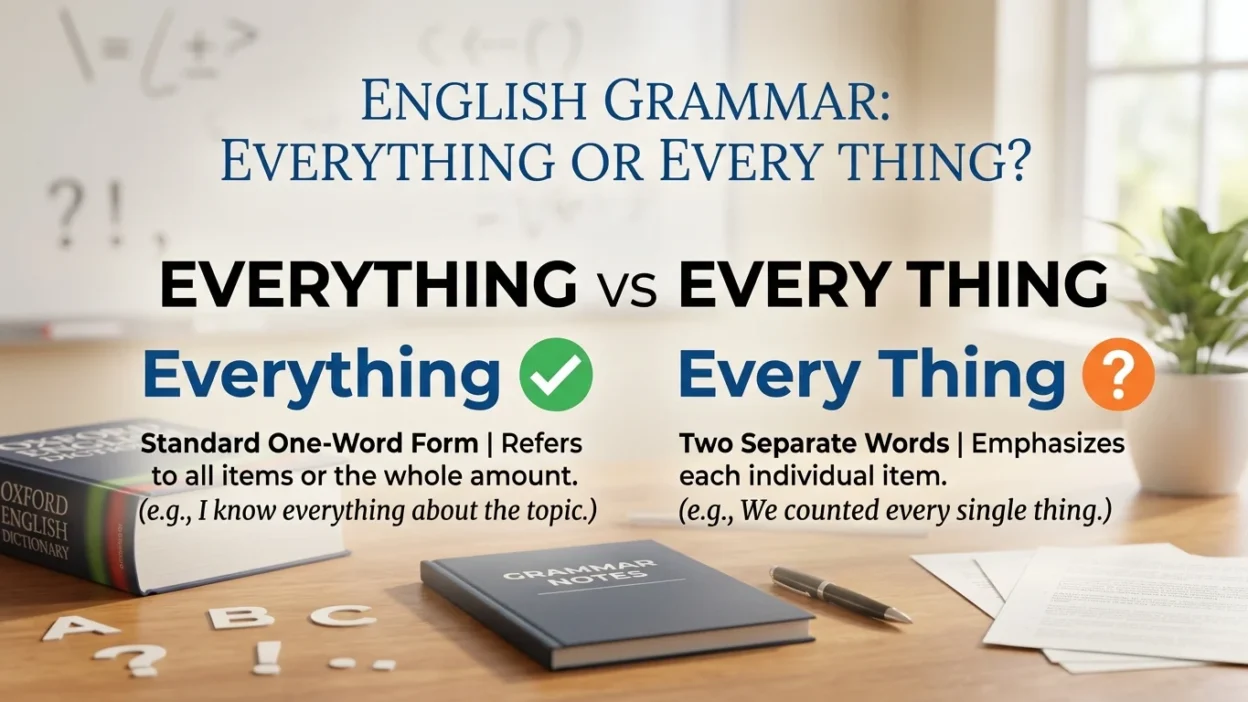
When should you write everything and when should you write every thing? The answer is usually simple: everything is the standard word when you mean “all things” or “all the things in general.” For example, “Everything is ready” means that all necessary things are ready. Every thing, written as two words, is much less common and is used only when you want to emphasize each individual thing separately.
Although these forms look almost identical, they do not always work in the same way. English learners often wonder if everything should be written as one word or two, especially when a sentence focuses on individual objects. Understanding the difference will help you choose the natural form in everyday writing, schoolwork, emails, and professional communication.
Quick Answer
Everything is the correct choice in most situations. It is an indefinite pronoun meaning “all things” or “all that exists, happens, or is relevant.” Every thing is possible when every modifies the noun thing individually, but this construction is uncommon and usually requires special emphasis or contrast.
Why Do People Confuse Everything and Every Thing?
The confusion comes from the fact that everything has the same basic meaning as the combination every + thing.
For example:
This means all the things are packed.
However, everything has developed into a standard single-word pronoun. It normally refers to things collectively rather than emphasizing each object separately.
Compare:
with the much less common:
The second sentence emphasizes each individual thing.
What Does “Everything” Mean?
Everything is an indefinite pronoun meaning all things.
It can refer to objects, ideas, events, situations, facts, or experiences.
Examples:
- Everything is ready.
- I told her everything.
- Everything looks different now.
- He knows everything about the project.
- Everything went well.
Because everything is treated as singular grammatically, it usually takes a singular verb.
Not:
What Does “Every Thing” Mean?
Every thing consists of two separate words:
- every = each individual member of a group
- thing = an object or item
It can be used when you deliberately want to emphasize each individual thing.
For example:
This construction is grammatically possible, but in ordinary modern English, everything in the room had to be checked is usually more natural.
If you want strong emphasis on individual items, you may instead say:
Everything vs Every Thing: Comparison Table
| Feature | Everything | Every thing |
|---|---|---|
| Form | One word | Two words |
| Meaning | All things collectively | Each individual thing |
| Frequency | Very common | Uncommon |
| Part of speech | Indefinite pronoun | Determiner + noun |
| Everyday use | Standard choice | Usually unnecessary |
| Example | Everything is ready. | Every thing was inspected separately. |
When Should You Use “Everything”?
Use everything when you mean all things as a group.
5. Talking about a person’s whole experience
In most normal sentences, everything is the natural choice.
When Should You Use “Every Thing”?
Use every thing only when there is a genuine reason to treat thing as an individual noun modified by every.
This is uncommon in modern everyday English.
For example:
Here, the speaker is focusing on each separate thing rather than the collection as a whole.
However, every single thing is often clearer:
This construction makes the intended emphasis obvious.
10+ Examples of Everything
Here are practical examples showing how everything works in natural English.
- Everything is ready for the meeting.
- I packed everything before leaving.
- Everything looks beautiful today.
- She knows everything about the subject.
- Did you remember everything?
- Everything went smoothly.
- He lost everything in the move.
- Everything in this room belongs to me.
- We discussed everything yesterday.
- Everything has changed since then.
- Please make sure everything is clean.
- I checked everything twice.
Examples of Every Thing
Although less common, every thing can appear when the individual items need special emphasis.
- Every thing was inspected separately.
- The scientist recorded every thing that changed.
- Every thing in the collection was carefully labeled.
- They examined every thing one by one.
- Every thing had to be accounted for.
In many of these sentences, however, a more natural modern alternative would be every single thing or simply everything, depending on the intended meaning.
Common Mistakes
Mistake 1: Always writing “every thing”
Some learners think every and thing should always remain separate.
Incorrect for normal general meaning:
Natural:
Mistake 2: Using “everything” when individual emphasis is needed
Sometimes the speaker wants to highlight each separate item.
Less precise:
More emphatic:
Mistake 3: Using a plural verb with everything
Because everything refers to many things, learners sometimes use a plural verb.
Incorrect:
Correct:
Mistake 4: Confusing “everything” with “every thing”
The single-word form is by far the normal choice in ordinary English.
Memory Trick
Think:
Everything = all things
If you can replace the word with all things, use everything.
= All things are ready.
If you specifically mean each individual thing, think:
every thing = each thing
For extra emphasis, every single thing is often the clearest choice.
American vs British English
There is essentially no major American-versus-British difference in the normal use of everything.
Both American and British English commonly use:
The two-word every thing remains uncommon in both varieties and is generally used only when the writer wants to emphasize thing as an individual noun.
Similar Words
Several related expressions can cause similar confusion.
Everyone vs Every One
Everyone means all people as a group.
Every one emphasizes each individual person or item.
Everything vs All Things
Everything is the normal single-word equivalent of all things.
The first is much more natural in everyday conversation
Everywhere vs Every Where
Everywhere means in all places.
Everywhere is normally one word. Every where is not the standard form for ordinary modern usage.
Final Verdict
In almost every ordinary sentence, choose everything.
Use everything when you mean all things collectively:
Use every thing only when every specifically modifies the noun thing and you need to emphasize individual things. In everyday writing, every single thing is often a clearer alternative.
So, if you are unsure, everything is almost certainly the form you need.
FAQs:
Is “everything” one word or two?
Everything is normally written as one word. It is an indefinite pronoun meaning “all things.”
Is “every thing” grammatically correct?
Yes, every thing can be grammatically possible when every modifies thing as a separate noun. However, it is uncommon and often replaced by everything or every single thing.
Is everything singular or plural?
Everything is grammatically singular and normally takes a singular verb.
Which is correct: “everything is” or “everything are”?
Everything is is correct because everything is grammatically singular.
Can I say “every single thing”?
Yes. Every single thing is natural when you want to emphasize each individual item.
Is “everything” formal or informal?
Everything is neutral and works well in casual, academic, and professional English.
What is the difference between “everything” and “all things”?
They can have similar meanings, but everything is much more common and natural in everyday English.
Remember This
- Everything = all things
- Everything is the normal choice.
- Everything takes a singular verb.
- Every thing is uncommon.
- Every single thing is useful when emphasizing individual items.
- When in doubt, use everything.
Conclusion
The difference between everything and every thing is mainly about how the words function and what you want to emphasize. Everything is the standard indefinite pronoun used to mean all things collectively, and it is the form you will need in most everyday sentences.
Every thing is possible when every separately modifies the noun thing, particularly when each individual item is being emphasized. However, this usage is uncommon. For clear and natural English, use everything for the general meaning and every single thing when you want strong individual emphasis.

Levi Jack is a creative writer and conversation expert passionate about helping people communicate confidently. At ReplyCorner, he shares charming, witty, and engaging reply ideas that make everyday conversations more enjoyable and memorable.