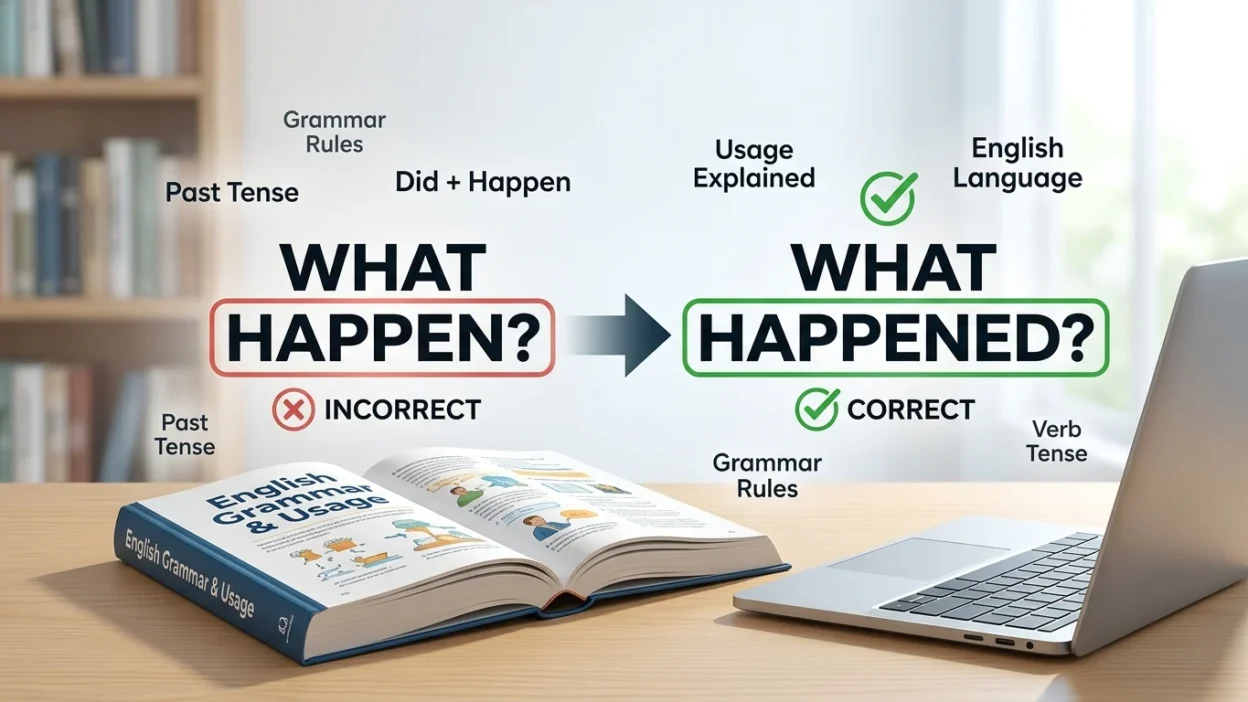
If you are wondering if to say “what happen” or “what happened,” the correct form depends on the sentence structure. “What happened?” is correct when you are asking about something that occurred in the past. For example, “What happened at school yesterday?” The phrase “what happen” is usually incorrect when used alone as a question because happen is the base form and needs an appropriate auxiliary or grammatical structure.
The confusion often comes from the fact that English uses different verb forms after helping verbs such as did. For example, we say “What did happen?”, not “What did happened?” However, when there is no auxiliary verb and you are simply asking about a past event, “What happened?” is the natural choice. Understanding this small difference can help you speak and write more accurately.
Quick Answer
“What happened?” is the correct phrase when asking about a past event. “What happen?” is generally incorrect as a standalone question. However, happen is correct after did, as in “What did happen?” The choice depends on the tense and sentence structure.
Why Do People Confuse “What Happen” and “What Happened”?
People often confuse these phrases because happen and happened are forms of the same verb.
- Happen = base form
- Happened = simple past form
- Happening = -ing form
The important rule is that a past question normally needs either a past-tense verb or the auxiliary did.
Compare:
- What happened? ✓
- What did happen? ✓
- What happen? ✗
The first sentence is the normal way to ask about a past event.
What Does “Happen” Mean?
Happen means to take place or occur.
It is the base form of the verb.
Examples:
- Accidents happen sometimes.
- What will happen next?
- Things can happen unexpectedly.
- Did something happen?
Notice that happen can correctly appear after helping verbs such as did, will, and can.
What Does “Happened” Mean?
Happened is the simple past form of happen.
We use it when something occurred in the past.
Examples:
- What happened yesterday?
- She told me what happened.
- Something strange happened at work.
- What happened to your phone?
When you ask about a completed past event without using did, happened is normally the correct form.
“What Happen” vs. “What Happened”: Comparison Table
| Phrase | Correct? | Main Use | Example |
|---|---|---|---|
| What happen? | ❌ Usually incorrect | Not normally used as a standalone question | What happen yesterday? |
| What happened? | ✅ Correct | Asking about a past event | What happened yesterday? |
| What did happen? | ✅ Correct | Emphasizing or clarifying a past event | What did happen there? |
| What will happen? | ✅ Correct | Asking about the future | What will happen next? |
| What can happen? | ✅ Correct | Asking about possibility | What can happen if we wait? |
When Should You Use “What Happened”?
Use “What happened?” when you want to ask about something that occurred in the past.
Examples
- What happened at the meeting?
- What happened to your car?
- What happened last night?
- What happened after I left?
- What happened between them?
- What happened at school?
- What happened to the project?
- What happened yesterday?
- What happened during the game?
- What happened after the accident?
- What happened while I was away?
- What happened to your plans?
In all these examples, happened tells us that the event took place in the past.
When Can You Use “Happen”?
Use happen when the grammar of the sentence requires the base form.
For example:
- What did happen?
- What will happen next?
- What might happen?
- What can happen here?
- What does happen when the system fails?
The most important pattern to remember is:
Did + happen, not did + happened.
Common Mistakes
Mistake 1: “What happen yesterday?”
❌ What happen yesterday?
✅ What happened yesterday?
Because yesterday refers to a completed past time, happened is appropriate.
Mistake 2: “What did happened?”
❌ What did happened?
✅ What did happen?
After did, use the base form of the verb.
Mistake 3: “What happen to you?”
❌ What happen to you? — when asking about a past event
✅ What happened to you?
However, “What happens to you?” can be correct when discussing something that occurs regularly.
Mistake 4: Thinking “happen” is always wrong
The word happen is not wrong. It is simply the wrong form in some sentence structures.
For example:
- What will happen?
- What might happen?
- What did happen?
All three are grammatically correct.
Memory Trick
Remember this simple rule:
Past question without “did” → happened
Past question with “did” → happen
So:
- What happened? ✓
- What did happen? ✓
- What did happened? ✗
Think of did as already carrying the past tense. The main verb stays in its base form.
American vs. British English
There is no meaningful difference between American and British English in the basic use of “What happened?”
Both varieties use:
- What happened?
- What did happen?
- What will happen?
- What might happen?
The grammar is essentially the same in this situation. Differences between American and British English may appear in vocabulary, pronunciation, spelling, or certain expressions, but not in this basic verb-form rule.
Similar Words and Expressions
Several expressions are related to “What happened?”
What happened?
Used to ask about a past event.
What is happening?
Used to ask about something occurring now.
What happens?
Usually asks about something that occurs generally, repeatedly, or as a result.
What will happen?
Used to ask about the future.
What did happen?
Used for emphasis, clarification, or contrast.
Final Verdict
“What happened?” is the standard and natural phrase when asking about something that occurred in the past.
“What happen?” is generally incorrect as a standalone past-tense question. However, happen is correct after auxiliary verbs such as did, will, can, might, and should.
The key distinction is simple: “What happened?” but “What did happen?”
FAQs:
Is “what happen” grammatically correct?
Usually, no. “What happen?” is not normally correct as a standalone question. If you are asking about a past event, say “What happened?”
Is it “what happened” or “what happen”?
Use “What happened?” when asking about something that occurred in the past. Use “happen” after a helping verb, such as “What did happen?”
Why is “what did happen” correct?
Because did already expresses the past tense. Therefore, the main verb stays in its base form: did + happen, not did + happened.
Is “what happened yesterday” correct?
Yes. “What happened yesterday?” is completely correct because happened is the past form of happen, and the question refers to a past event.
Can I say “what happens”?
Yes. “What happens?” is correct when asking about something that generally occurs or happens repeatedly.
Is “what will happen” correct?
Yes. “What will happen?” is correct because will is followed by the base form happen.
What is the difference between “what happened” and “what is happening”?
“What happened?” asks about a past event, while “What is happening?” asks about something occurring now or around the present time.
Remember This
What happened? → past event
What happens? → usual or general event
What is happening? → happening now
What will happen? → future
What did happen? → emphasized past question
And remember: did + base verb.
Conclusion
The correct choice between “what happen” and “what happened” depends on the grammar of the sentence. When you are simply asking about a past event, the natural form is “What happened?” The word happened already expresses the past.
Use happen when another verb or auxiliary carries the tense, such as “What did happen?”, “What will happen?”, or “What might happen?” Once you remember that did + base verb is the correct pattern, this common English mistake becomes much easier to avoid.