
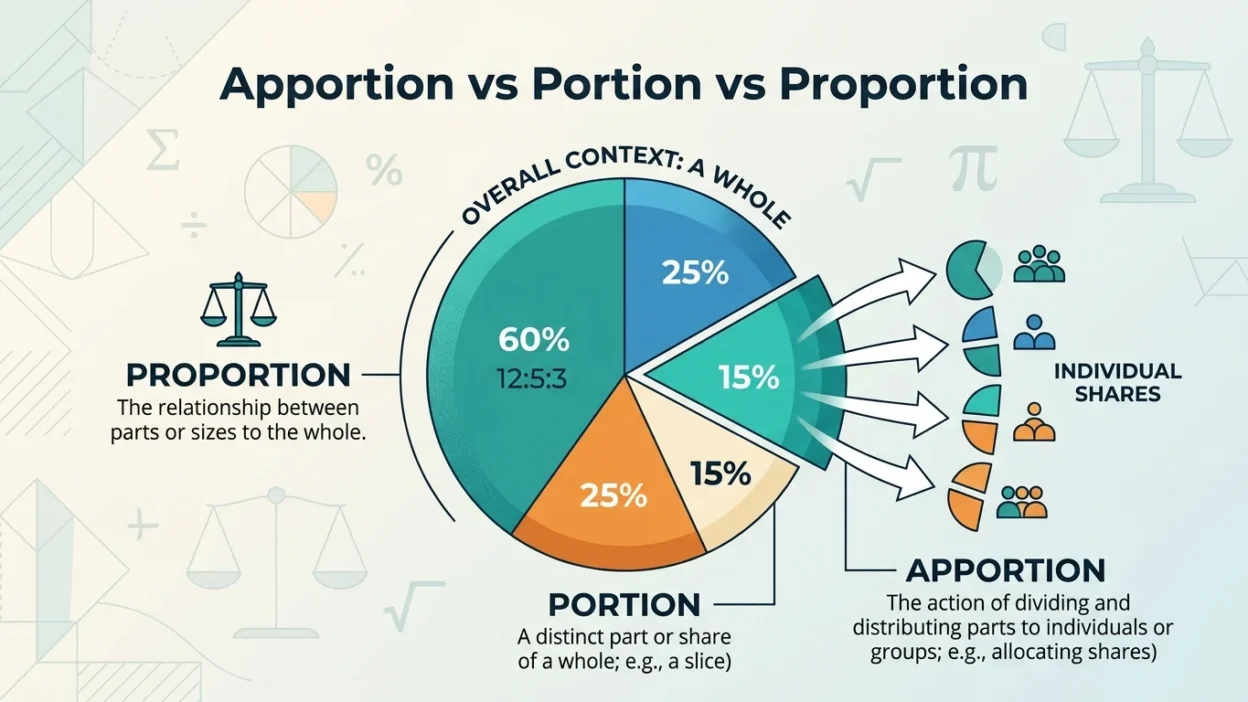
English has many words that look and sound related but serve different purposes. Apportion, portion, and proportion are a good example. All three words are connected with the idea of dividing or measuring something, but they are not interchangeable. Understanding their differences can help you write and speak more naturally and accurately.
The main challenge is that portion can refer to a part or share of something, proportion describes a relationship or comparative amount, while apportion is a verb meaning to divide and distribute something among people, groups, or purposes. Once you understand these basic roles, choosing the correct word becomes much easier.
Quick Answer
Apportion is a verb meaning to divide or distribute something fairly among people or groups. Portion usually means a part or share of something and can be a noun or verb. Proportion usually describes the relationship between parts and the whole or between different quantities.
Why Do People Confuse Apportion, Portion, and Proportion?
These three words are confusing because they share the idea of division, parts, shares, or amounts.
Their forms are also closely related:
- Apportion → to divide or distribute
- Portion → a part or share
- Proportion → the relationship between parts or quantities
The biggest difference is grammatical and conceptual. Apportion focuses on the action of dividing something, portion focuses on an individual part or share, and proportion focuses on how one amount relates to another.
What Does “Apportion” Mean?
Apportion is a verb that means to divide and distribute something among people, groups, places, or purposes according to a particular plan, rule, or share.
It is often used when resources, responsibilities, money, time, or costs must be divided.
Examples of “Apportion”
- The manager apportioned the budget among the departments.
- The teacher apportioned equal tasks to each group.
- The expenses were apportioned among the three partners.
- The government apportioned funding to different regions.
A useful pattern is:
apportion + something + among/between + people or groups
For example:
What Does “Portion” Mean?
Portion usually means a part, amount, or share of something larger.
It can be used as both a noun and a verb.
As a noun:
As a verb:
A portion can be physical, such as a portion of food, or abstract, such as a portion of someone’s income.
Examples of “Portion”
- She ate a small portion of rice.
- Each child received a portion of the prize.
- A large portion of the budget goes to education.
- Please portion the ingredients carefully.
What Does “Proportion” Mean?
Proportion refers to the relationship between the sizes, amounts, or numbers of different parts compared with each other or with the whole.
It is especially common in mathematics, statistics, design, science, and formal writing.
For example:
Here, proportion refers to the relationship between the number of people living in cities and the total population.
Examples of “Proportion”
- A high proportion of students passed the exam.
- The ingredients must be mixed in the correct proportion.
- The building has unusual proportions.
- The proportion of adults working remotely has increased.
Apportion vs Portion vs Proportion: Comparison Table
| Word | Part of speech | Basic meaning | Common use |
|---|---|---|---|
| Apportion | Verb | Divide and distribute | Money, duties, resources |
| Portion | Noun / Verb | A part or share | Food, amounts, shares |
| Proportion | Noun | Relationship between amounts or parts | Statistics, mathematics, comparisons |
When Should You Use Each Word?
Use “Apportion” When You Mean “Distribute”
Choose apportion when something needs to be divided among people, groups, areas, or purposes.
The emphasis is on the act of distribution.
Use “Portion” When You Mean “Part or Share”
Choose portion when you are talking about one part of a larger thing.
The emphasis is on the part itself.
Use “Proportion” When You Mean “Relationship or Relative Amount”
Choose proportion when comparing amounts or describing how much one part represents in relation to another.
The emphasis is on the relationship between quantities.
Apportion vs Portion vs Proportion: 12 Examples
- The committee apportioned the funds among the departments.
- Each employee received a portion of the annual bonus.
- A large proportion of employees work remotely.
- The teacher apportioned the assignments equally.
- I only want a small portion of dessert.
- The two ingredients should be mixed in the correct proportion.
- The court apportioned responsibility between the two parties.
- Each family received a portion of the available supplies.
- A significant proportion of the population supported the proposal.
- The organization apportioned its resources according to need.
- This portion of the report discusses financial results.
- The windows are designed in proportion to the size of the building.
Common Mistakes
Mistake 1: Using “Portion” Instead of “Apportion”
Incorrect:
This is possible in specialized contexts, but apportioned is the natural choice when you mean formally distributing a resource.
Better:
Mistake 2: Using “Apportion” as a Noun
Incorrect:
Apportion is a verb, not the noun for an individual share.
Better:
Mistake 3: Confusing “Portion” With “Proportion”
These words can both describe amounts, but their meanings differ.
This means a large part of the cake.
This describes the relationship between the number who passed and the total number of students.
Mistake 4: Assuming “Proportion” Always Means “Part”
A proportion is not simply any part. It usually describes a relative relationship or comparative amount.
What Is an Easy Memory Trick?
Remember these three ideas:
- Apportion = Assign
- Portion = Part
- Proportion = Relationship
Think of a manager dividing money:
Apportion → The manager divides the money.
Portion → Each person gets a portion.
Proportion → You compare each person’s share with the total.
This simple sequence makes the differences much easier to remember.
Apportion vs Portion vs Proportion in American and British English
There is no major difference in meaning between American and British English for these three words.
All three are standard in both varieties:
- apportion = divide or distribute
- portion = part or share
- proportion = relationship between amounts or parts
Differences may occur in preferred vocabulary depending on context, but the basic meanings remain the same.
Similar Words
Understanding related words can make the distinction clearer.
Apportion
Similar words include:
- allocate
- distribute
- divide
- assign
- allot
- share out
Portion
Similar words include:
- part
- share
- section
- amount
- piece
- serving
Proportion
Similar words include:
- ratio
- percentage
- relationship
- balance
- relative amount
- fraction
These words are not always exact substitutes, so context matters.
Final Verdict: Apportion vs Portion vs Proportion
The simplest distinction is:
Apportion means to divide and distribute something.
Portion means a part or share of something.
Proportion means the relationship between parts or quantities.
For example, a company might apportion its budget among several departments. Each department receives a portion of the budget. The proportion allocated to each department describes its share relative to the total.
FAQs:
Is “apportion” a noun or a verb?
Apportion is a verb. It means to divide or distribute something among people, groups, or purposes.
What is the difference between portion and proportion?
A portion is a part or share of something. A proportion describes the relationship between an amount and another amount or the whole.
Can “portion” be used as a verb?
Yes. Portion can be a verb meaning to divide something into parts or measured amounts.
Is apportion the same as allocate?
They are very similar. Both can mean distributing something among people or groups. Apportion often emphasizes dividing something into shares, especially according to a particular basis.
Is proportion the same as percentage?
Not always. A percentage expresses an amount out of 100, while a proportion describes a relationship between quantities. A proportion can be expressed as a percentage.
What is the noun form of apportion?
There is no common noun “apportion” meaning a share. Depending on the meaning, use words such as apportionment, portion, allocation, or share.
Which word is used for food: portion or proportion?
Usually portion.
Proportion would be used when discussing the relationship between ingredients or amounts.
Remember This
Apportion = divide and distribute.
Portion = a part or share.
Proportion = a relationship between amounts or parts.
If you can remember “assign, part, relationship,” you can usually choose the correct word.
Conclusion
Although apportion, portion, and proportion are closely related, each word has a distinct role. Apportion is an action, portion is generally a part or share, and proportion describes a relationship between quantities or parts.
When choosing between them, focus on what you are trying to express. If you are distributing something, use apportion. If you mean a specific part or share, use portion. If you are comparing relative amounts or describing a relationship, use proportion. With these three simple meanings in mind, the distinction becomes much easier.

Levi Jack is a creative writer and conversation expert passionate about helping people communicate confidently. At ReplyCorner, he shares charming, witty, and engaging reply ideas that make everyday conversations more enjoyable and memorable.