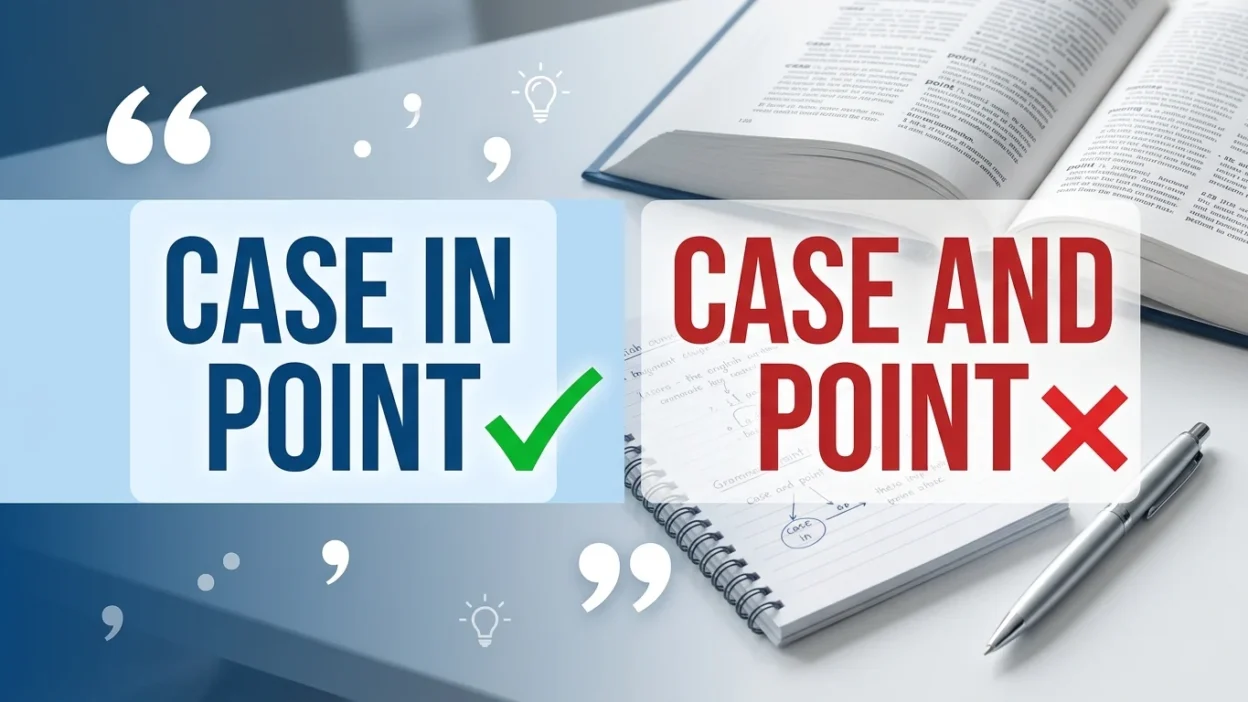
When you want to give a specific example that clearly proves or illustrates an idea, the correct expression is “case in point.” It is a common English idiom meaning “a relevant example of what has just been mentioned.” For example, “Many students struggle with spelling; case in point, look at the number of errors in this essay.”
The phrase “case and point” is not the standard idiom. People sometimes say it because “case” and “point” both sound related to the idea of an example or argument. However, in standard English, case in point is the expression you should use in writing and careful speech. Understanding the difference is especially useful for ESL learners because this is a fixed phrase, so changing the preposition from in to and makes the expression incorrect.
Quick Answer
“Case in point” is correct; “case and point” is not the standard expression. Use case in point when introducing a specific example that supports or demonstrates your previous statement. Example: “The team needs better communication. Case in point, they missed an important deadline because no one shared the update.”
Why People Confuse It
The confusion usually comes from the similar meanings of case and point.
A case can refer to a particular situation or example, while a point can refer to an idea, fact, or argument. Because both words are associated with explaining an idea, speakers may incorrectly combine them with and.
However, case in point is a fixed idiomatic expression. The word in is important and should not normally be replaced with and.
First Word: Case
Case has several meanings in English.
It can mean a particular situation:
- “This is an unusual case.”
- “The doctor studied the case carefully.”
It can also mean an example that demonstrates a general idea.
In case in point, the word case refers to a specific example or situation.
Second Word: Point
Point can mean an idea, fact, argument, or important detail.
For example:
- “That is an interesting point.”
- “She made a good point during the discussion.”
In the expression case in point, however, point is part of a fixed phrase rather than simply meaning “an argument.”
Comparison Table
| Expression | Correct? | Meaning | Example |
|---|---|---|---|
| Case in point | ✅ Yes | A specific example that illustrates a point | “He often arrives late. Case in point, he was late today.” |
| Case and point | ❌ No | Not the standard idiom | Avoid this form |
| Case | ✅ Yes | A situation, instance, or example | “This is a difficult case.” |
| Point | ✅ Yes | An idea, fact, or argument | “She made an important point.” |
When to Use Each
When to Use “Case in Point”
Use case in point when you have just made a general statement and want to provide a specific example.
Example:
“Technology can sometimes create distractions. Case in point, I spent an hour checking my phone instead of studying.”
It can appear at the beginning of a sentence or after a statement.
When to Use “Case”
Use case when you are talking about a particular situation, example, legal matter, medical situation, or instance.
Example:
“This is a complicated case that requires further investigation.”
When to Use “Point”
Use point when referring to an idea, argument, fact, or detail.
Example:
“You make a good point about the importance of practice.”
When Not to Use “Case and Point”
Avoid case and point when you mean “a specific example that demonstrates something.”
Instead, use case in point.
12 Examples of “Case in Point”
- “Exercise improves my mood. Case in point, I always feel better after a morning walk.”
- “The city needs better public transportation. Case in point, buses are often overcrowded.”
- “He is extremely organized. Case in point, he has already planned the entire trip.”
- “Practice makes a difference. Case in point, her English improved significantly after months of speaking practice.”
- “The company needs better communication. Case in point, two departments worked on the same project without knowing it.”
- “Small mistakes can become serious problems. Case in point, one missed email caused the meeting to be postponed.”
- “She is a talented musician. Case in point, she learned the difficult song in just two days.”
- “The weather can change quickly here. Case in point, it was sunny this morning and raining by afternoon.”
- “Online learning requires discipline. Case in point, students who follow a schedule usually stay on track.”
- “He is always willing to help others. Case in point, he stayed late to help his colleague.”
- “Good preparation reduces stress. Case in point, I felt much calmer after preparing my presentation in advance.”
- “The restaurant has become very popular. Case in point, there was a long line outside before opening time.”
Common Mistakes
Mistake 1: Saying “Case and Point”
❌ “Case and point, he forgot his keys again.”
✅ “Case in point, he forgot his keys again.”
Mistake 2: Using It Without a Relevant Example
Case in point should introduce or highlight a specific example connected to the previous statement.
Weak:
❌ “I like reading. Case in point, my brother plays football.”
The second sentence does not support the first idea.
Better:
✅ “I love reading. Case in point, I finished three novels this week.”
Mistake 3: Treating It as Two Separate Nouns
Case in point is a fixed expression. You should learn it as a complete phrase rather than trying to construct it from the individual meanings of case and point.
Memory Trick
Think:
“The example is IN the point.”
So remember:
Case IN point = correct
Case AND point = incorrect
Another simple trick is to associate case in point with the word example:
American vs. British English
Case in point is standard in both American English and British English.
There is no major American-versus-British difference in the expression itself. Speakers in both varieties use case in point to introduce or emphasize a relevant example.
The incorrect form case and point does not become standard simply because of regional English differences.
Similar Words
Several expressions can have a meaning similar to case in point:
- For example — introduces an example.
- For instance — introduces a particular example.
- A good example is — clearly identifies an example.
- Take ___, for example — asks the reader or listener to consider an example.
- To illustrate — introduces something that explains an idea.
- As an example — introduces supporting evidence or an instance.
- A prime example — emphasizes a particularly strong example.
For everyday writing, for example is often the simplest choice. Case in point is especially useful when the example strongly demonstrates the statement you have just made.
Final Verdict
Case in point is the correct expression.
Use it when you want to point to a particular example that supports or illustrates an earlier statement.
Correct: “He is very forgetful. Case in point, he forgot his wallet again.”
Incorrect: “He is very forgetful. Case and point, he forgot his wallet again.”
If you are unsure, remember: case in point = relevant example.
FAQs:
Is “case in point” correct?
Yes. Case in point is the standard English expression used to introduce a specific example that illustrates or supports a previous statement.
Is “case and point” grammatically correct?
No. Case and point is not the standard form of the idiom. When you mean “a relevant example,” use case in point.
What does “case in point” mean?
Case in point means a particular example that clearly illustrates or supports an idea, statement, or argument.
Can I use “case in point” in formal writing?
Yes. Case in point is appropriate in many formal, academic, professional, and conversational contexts, although for example may sound simpler in some situations.
What is another way to say “case in point”?
Depending on the context, you can say for example, for instance, a good example is, to illustrate, or a prime example.
Does “case in point” mean “proof”?
Not necessarily. It means a relevant example that illustrates or supports an idea. If that example actually proves something depends on the context.
Is “case in point” used in American English?
Yes. Case in point is commonly understood and used in American English as well as British English.
Why do people say “case and point”?
It is likely a mistaken variation caused by combining the familiar words case and point. The established idiom is case in point.
Remember This
Case in point = a relevant or specific example
✅ Case in point
❌ Case and point
The key word is in.
Conclusion
The correct expression is case in point, not case and point. Use case in point when you want to introduce a specific example that demonstrates or supports an idea you have just mentioned.
Although case and point may sound logical, it is not the standard idiom. Learning case in point as a fixed phrase will help you avoid this common wording mistake and make your English sound more natural and precise.

David Owen is a passionate writer and communication enthusiast dedicated to helping readers craft charming, witty, and thoughtful replies. Through ReplyCorner, he shares creative response ideas that make conversations engaging and memorable.