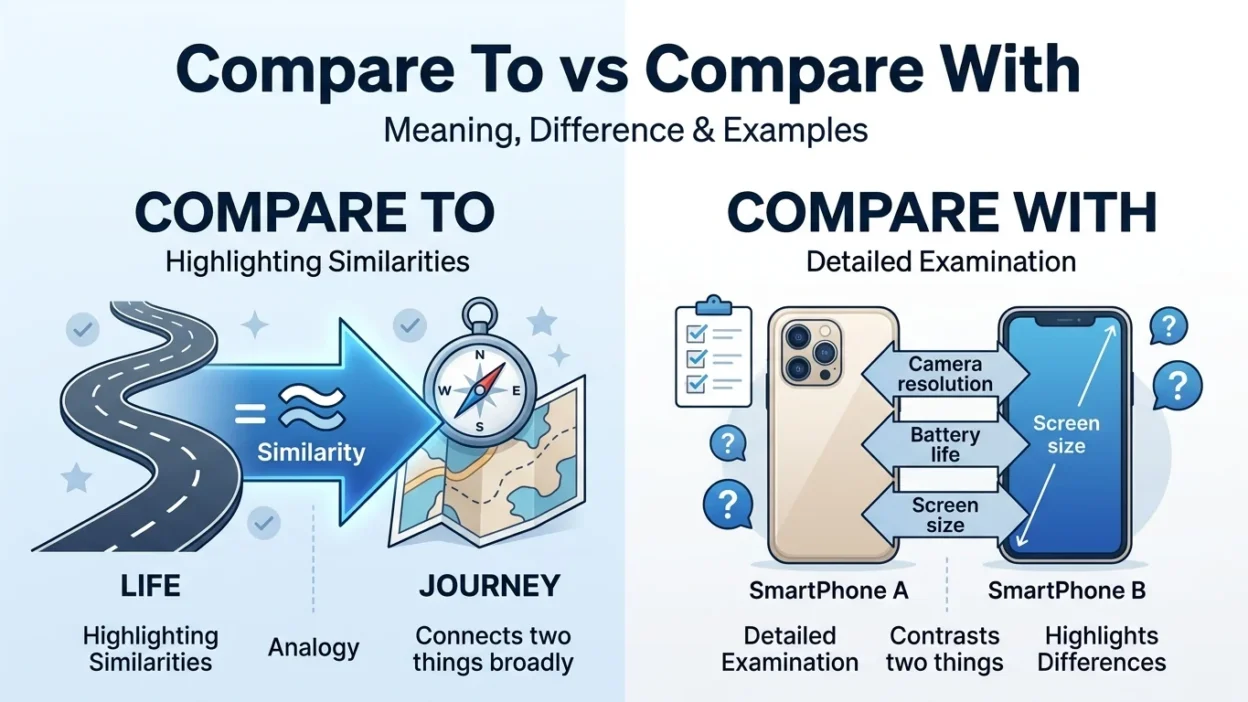
If you are unsure if to say compare to or compare with, you are not alone. Both expressions are grammatically correct, but they are often used in slightly different situations. The main difference is that compare to commonly highlights a similarity or resemblance between two things, while compare with often focuses on examining two or more things to identify similarities and differences.
For example, you might say, “She compared his voice to a famous singer’s voice” when emphasizing a resemblance. However, “The teacher compared the two essays with each other” suggests a detailed examination of their similarities and differences. Understanding this small distinction can make your English more precise and natural in writing and conversation.
Quick Answer
Compare to is generally used when you point out that one person or thing is similar to another. Compare with is generally used when you examine two or more things carefully to identify both similarities and differences. However, the two forms can overlap, and actual usage depends on context.
Why Do People Confuse Compare To and Compare With?
People confuse these expressions because compare can be followed by either to or with, and both constructions can describe a relationship between two things.
The easiest way to understand the difference is to think about the purpose of the comparison.
- Compare to often emphasizes similarity, resemblance, or analogy.
- Compare with often emphasizes a careful examination of similarities and differences.
- In many contexts, especially modern English, the two expressions can overlap.
- The surrounding sentence usually tells you which meaning is intended.
For example:
Here, the focus is on resemblance.
Here, the focus is on examining their similarities and differences.
What Does “Compare To” Mean?
Compare to means to describe one thing as similar to, like, or resembling another thing.
It is especially common when making an analogy, metaphor, or direct statement about resemblance.
Examples
- The teacher compared the student’s memory to a computer.
- She compared his smile to sunshine.
- The writer compared life to a journey.
- He compared the new phone to a small computer.
In these examples, the speaker is mainly drawing attention to a similarity.
When Should You Use “Compare To”?
Use compare to when your main purpose is to say that something resembles or can be understood in terms of something else.
It is particularly natural with:
- metaphors
- analogies
- descriptions
- literary comparisons
- statements about resemblance
What Does “Compare With” Mean?
Compare with means to examine two or more things alongside each other, usually to identify their similarities and differences.
This expression is common in academic, professional, scientific, and analytical writing.
Examples
- The researchers compared the results with previous studies.
- We compared the two products with each other.
- The manager compared this year’s sales with last year’s figures.
- Students should compare the two poems with each other.
Here, the purpose is generally a more detailed analysis rather than simply pointing out resemblance.
Compare To vs Compare With: Comparison Table
| Expression | General Meaning | Main Focus | Common Context |
|---|---|---|---|
| Compare to | Show similarity or resemblance | Similarity | Analogies, descriptions, metaphors |
| Compare with | Examine things side by side | Similarities and differences | Analysis, research, business |
| Compare to | Relate one thing to another | Resemblance | Everyday and literary English |
| Compare with | Evaluate against another thing | Detailed comparison | Academic and professional writing |
The distinction is useful, but it is not an absolute grammar rule. Native speakers sometimes use compare to and compare with interchangeably, especially when the intended meaning is clear.
When Should You Use “Compare To” or “Compare With”?
Choose compare to when you want to emphasize that two things are alike or that one thing resembles another.
Example:
Choose compare with when you want to evaluate two things by looking at their qualities, differences, or performance.
Example:
A useful distinction is:
Compare to = “This is like that.”
Compare with = “Let’s examine these side by side.”
However, context matters more than this simple rule.
12 Examples of “Compare To”
1. Life can be compared to a journey.
The sentence presents life as being similar to a journey.
2. She compared his voice to thunder.
The comparison emphasizes the powerful quality of his voice.
3. The author compared the city to a sleeping giant.
This is an imaginative comparison that highlights resemblance.
4. He compared her eyes to stars.
The speaker is describing the eyes by relating them to stars.
5. The teacher compared the brain to a computer.
The sentence uses an analogy to explain how the brain works.
6. The athlete compared the final race to a battle.
The speaker emphasizes the intensity and difficulty of the race.
12 Examples of “Compare With”
1. Compare this year’s sales with last year’s sales.
The speaker wants to examine changes between the two sets of figures.
2. We compared the two laptops with each other.
The purpose is to examine their features and differences.
3. The researcher compared the results with earlier findings.
The researcher is analyzing how the results relate to previous findings.
4. Compare your answer with your partner’s answer.
The instruction asks you to look at both answers and identify differences or similarities.
5. The doctor compared the new test results with the previous ones.
The comparison helps identify changes in the patient’s results.
6. The company compared its prices with those of its competitors.
The company is evaluating its prices against competing prices.
Common Mistakes With Compare To and Compare With
Mistake 1: Thinking One Is Always Correct
It is incorrect to assume that compare to is always right or that compare with is always right.
Both are standard expressions.
Mistake 2: Using “Compare To” for Every Comparison
Although compare to is common, compare with can be more appropriate when you are performing a detailed analysis.
Less precise:
More analytical:
The first sentence is not necessarily wrong, but the second clearly suggests a side-by-side examination.
Mistake 3: Assuming “With” Always Means Differences
Compare with does not mean that you must find differences. You can use it when examining both similarities and differences.
Mistake 4: Assuming “To” Only Works in Literary Writing
Compare to is not limited to poetry or literature. It is also common in ordinary speech.
This is perfectly natural English.
What Is the Easiest Memory Trick?
Remember this simple idea:
Compare TO = Similar TO something
Compare WITH = Examine WITH something
For example:
Think: “His voice is like that.”
Think: “Let’s examine both voices.”
This trick is not a strict grammar rule, but it is useful for remembering the most common distinction.
Compare To vs Compare With in American and British English
Both compare to and compare with are used in American and British English.
There is no simple rule saying that one belongs exclusively to American English and the other belongs exclusively to British English.
In both varieties, compare to is common when emphasizing similarity, while compare with is often used when making a more analytical comparison.
For example:
This sounds natural in both American and British English.
Likewise:
This is also natural in both varieties.
Usage can vary according to context, writing style, and individual preference.
Similar Words and Expressions
Several words and phrases can express an idea similar to compare to or compare with.
Contrast
Contrast focuses mainly on differences.
Resemble
Resemble means to look or seem similar to something.
Similar to
This directly describes similarity.
Different from
This emphasizes difference.
Compared with
This is commonly used when evaluating two things.
Compared to
This can introduce a comparison that emphasizes similarity or simply establishes a comparison.
Final Verdict: Compare To vs Compare With
Both compare to and compare with are correct.
Use compare to when you mainly want to emphasize similarity, resemblance, analogy, or metaphor.
Use compare with when you mainly want to examine two or more things side by side, especially for similarities and differences.
However, the distinction is not absolute. In modern English, there are many situations where either preposition can sound natural. When deciding which one to use, focus on what you are trying to communicate rather than relying on a rigid rule.
FAQs:
Is “compare to” or “compare with” correct?
Both compare to and compare with are correct. Compare to often emphasizes similarity or resemblance, while compare with often suggests a detailed examination of similarities and differences.
What is the main difference between compare to and compare with?
The main difference is emphasis. Compare to commonly highlights how one thing resembles another, whereas compare with commonly highlights examining things side by side.
Can compare to and compare with be used interchangeably?
Sometimes, yes. In many contexts, either expression can be understood correctly. The choice often depends on if the writer wants to emphasize resemblance or analytical comparison.
Is “compare with” better for formal writing?
Compare with can be a useful choice in formal or analytical writing when you are examining two things carefully. However, compare to is also completely acceptable when the intended meaning is similarity or analogy.
Should I say “compare this to” or “compare this with”?
Both can be correct. Say compare this to when highlighting what it resembles. Say compare this with when asking someone to examine it alongside another thing.
Is “compare to” used in American English?
Yes. Compare to is widely used in American English and is also common in British English.
Is “compare with” used in British English?
Yes. Compare with is standard in British English and is also widely used in American English.
Which one should ESL learners use?
ESL learners can remember compare to for resemblance and compare with for detailed side-by-side examination. As you become more familiar with English, you will see that the two forms sometimes overlap.
Remember This
Compare to → think similarity or resemblance.
Compare with → think side-by-side examination.
Examples:
Both forms are correct, and context can determine which sounds more natural.
Conclusion
Understanding compare to vs compare with becomes much easier when you focus on the purpose of the comparison. Compare to is often used to show that something resembles another thing, while compare with commonly describes a careful examination of two or more things. This distinction is especially helpful when choosing words for academic, professional, or everyday English.
Still, English usage is flexible, and these expressions can overlap. You do not need to worry about treating the distinction as an unbreakable grammar rule. Remember the basic pattern—compare to for resemblance and compare with for side-by-side analysis—and then let the context guide your choice.

Levi Jack is a creative writer and conversation expert passionate about helping people communicate confidently. At ReplyCorner, he shares charming, witty, and engaging reply ideas that make everyday conversations more enjoyable and memorable.