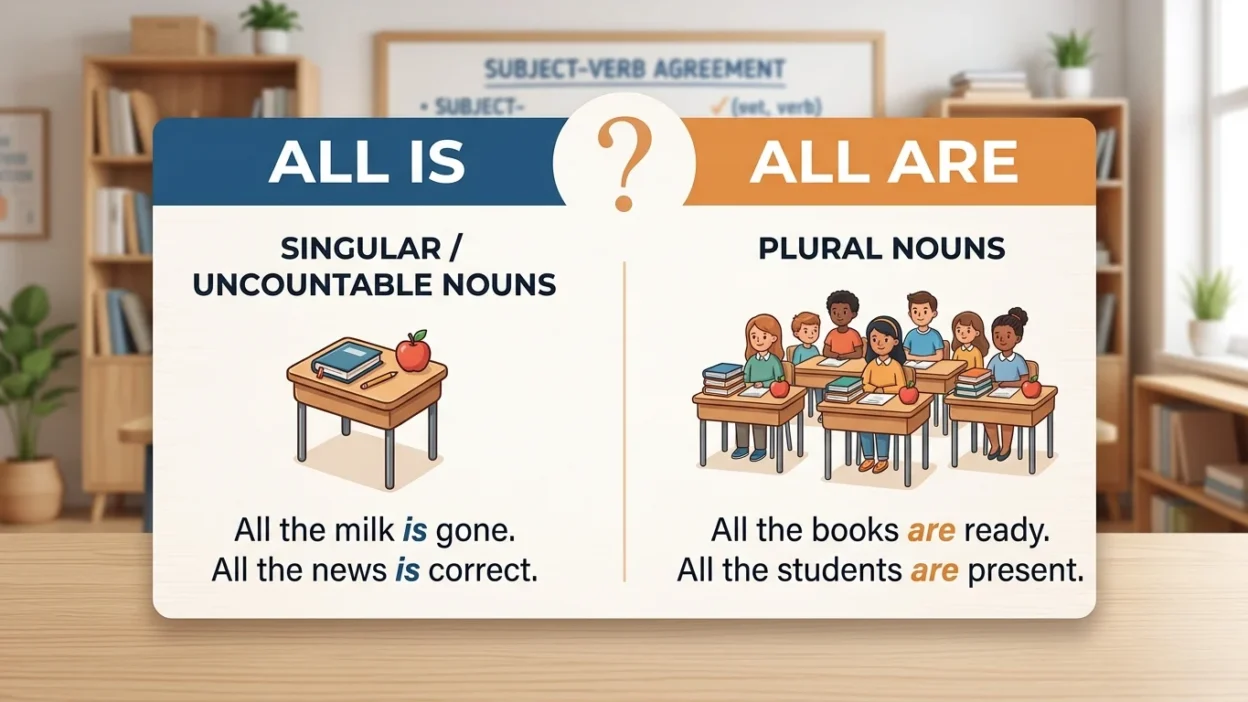
English learners often hesitate between “all is” and “all are” because the word all can refer to one thing, several things, or an uncountable amount. The correct choice depends on the noun or idea that all represents. In some sentences, “all is” is correct, while in others, “all are” is the right choice.
The good news is that the rule is easier than it first appears. If all refers to a singular or uncountable noun, use is. If it refers to a plural countable noun, use are. However, expressions such as “All is well” have a special meaning and are very common in everyday English. Understanding what all refers to will help you choose the correct verb naturally.
Quick Answer
Use “all is” when all refers to something singular or uncountable, especially in expressions like “All is well.” Use “all are” when all refers to plural people or things. The noun after all, or the meaning understood from context, determines if is or are is correct.
Why Do People Confuse “All Is” and “All Are”?
The confusion happens because all does not always behave like an ordinary singular or plural word.
Compare:
- All is well. → “All” means everything.
- All are welcome. → “All” means all people.
- All the water is gone. → “Water” is uncountable.
- All the students are ready. → “Students” is plural.
So, instead of asking if all is singular or plural, look at what all refers to.
The First Word: “All”
All is a determiner, pronoun, or quantifier that can refer to an entire group, amount, or situation.
It can be used with:
- Plural countable nouns: all students
- Uncountable nouns: all information
- Pronouns: all of them
- General ideas: all is well
The verb must agree with the meaning and grammatical noun involved.
The Second Word: “Is”
Is is the third-person singular form of the verb be.
Use is with singular nouns and uncountable nouns.
Examples:
- All the information is correct.
- All the money is gone.
- All the food is ready.
- All is well.
In “all is well,” the phrase means that everything is satisfactory or okay.
“Are”
Are is used with plural subjects.
Use are when all refers to several people or things.
Examples:
- All the students are present.
- All the answers are correct.
- All of them are ready.
- All the houses are occupied.
All Is vs All Are: Comparison Table
| Expression | When to Use It | Example |
|---|---|---|
| All is | Singular or uncountable meaning | All the water is cold. |
| All are | Plural people or things | All the children are outside. |
| All is well | Everything is okay | Don’t worry. All is well. |
| All of it is | One uncountable thing or situation | All of it is useful. |
| All of them are | Multiple people or things | All of them are invited. |
When Should You Use “All Is”?
Use all is when all refers to an uncountable noun or a general situation.
With uncountable nouns
- All the furniture is new.
- All the equipment is working.
- All the information is accurate.
- All the money is missing.
- All the water is clean.
In “All Is Well”
All is well is a common expression meaning everything is okay.
For example:
You can also say:
When Should You Use “All Are”?
Use all are when all refers to plural countable people or things.
Examples:
- All the employees are working.
- All the books are on the shelf.
- All the children are asleep.
- All the questions are difficult.
- All the rooms are available.
A useful test is to replace all with they. If they are sounds right, all are will often be correct.
10+ Examples of “All Is” and “All Are”
- All is well at home.
- All the food is ready.
- All the information is correct.
- All the money is in the bank.
- All the furniture is new.
- All the students are present.
- All the teachers are ready.
- All the answers are correct.
- All the cars are parked outside.
- All the children are playing.
- All of them are invited.
- All of it is useful.
- All the water is gone.
- All the documents are signed.
Notice how is appears with uncountable nouns such as food, information, money, and water, while are appears with plural nouns such as students, teachers, cars, and documents.
Common Mistakes
Mistake 1: Always using “are” after “all”
❌ All the information are correct.
✅ All the information is correct.
Information is uncountable, so it takes is.
Mistake 2: Using “is” with a plural noun
❌ All the students is ready.
✅ All the students are ready.
Students is plural, so use are.
Mistake 3: Thinking “all” is always plural
“All” can refer to an uncountable amount or an entire situation.
✅ All the water is cold.
✅ All the books are expensive.
Mistake 4: Confusing “all is” with “all are”
Don’t choose the verb simply because you see all. Identify the noun or idea that all represents.
Memory Trick
Remember:
All + uncountable/singular idea → IS
All + plural people/things → ARE
Think:
- All the water → it → is
- All the students → they → are
Another easy example:
It = is. They = are.
American vs British English
The basic rule for all is and all are is essentially the same in American and British English.
Both varieties use:
- All the information is correct.
- All the students are ready.
- All is well.
Differences between American and British English are more noticeable with certain collective nouns, but all still follows the number of the noun or meaning it refers to.
Similar Words and Expressions
Understanding related expressions can make this rule easier.
Everything
Everything is grammatically singular.
- Everything is ready.
- Everything is fine.
This is similar to:
- All is well.
Everyone
Everyone is also grammatically singular.
- Everyone is welcome.
- Everyone is ready.
Not:
- ❌ Everyone are ready.
All of it
All of it normally takes is because it is singular.
- All of it is important.
- All of it is finished.
All of them
All of them takes are because them refers to multiple people or things.
- All of them are important.
- All of them are finished.
Final Verdict: All Is or All Are?
Both “all is” and “all are” are correct. The correct choice depends on what all refers to.
Use all is with an uncountable noun or a singular/general idea:
Use all are with plural people or things:
And remember the common expression:
The key is not to judge the word all by itself. Look at the noun or meaning behind it.
FAQs:
Is “all is” grammatically correct?
Yes. “All is” is grammatically correct when all refers to an uncountable amount or a general situation. “All is well” is a common example.
Is “all are” grammatically correct?
Yes. “All are” is correct when all refers to plural people or things, such as “All are welcome” or “All the books are new.”
Is it “all is well” or “all are well”?
The standard expression is “All is well.” Here, all means everything, so the singular verb is is used.
Is “all the information are” correct?
No. The correct sentence is “All the information is correct.” Information is an uncountable noun and takes a singular verb.
Is “all the people is” correct?
No. Say “All the people are…” because people is a plural noun.
Is “all of it is” or “all of it are” correct?
“All of it is” is correct because it is singular. For example: “All of it is important.”
Is “all of them is” correct?
No. Use “all of them are” because them refers to multiple people or things.
What is the easiest way to remember all is vs all are?
Look at what all refers to. If it means it/everything, use is. If it means they/multiple things or people, use are.
Remember This
All + uncountable noun → is
All + plural noun → are
All is well → everything is okay
All of it → is
All of them → are
Conclusion
Choosing between all is and all are becomes simple whe you identify what all refers to. Use is with uncountable nouns and general or singular ideas, while are is used with plural people and things. The expression “all is well” is a particularly common example of the singular form.
When you’re unsure, look at the noun after all or replace the phrase with it or they. If it is works, choose is; if they are works, choose are. With this simple method, you can use both forms confidently in everyday English.

John Leo is a skilled writer and communication enthusiast who specializes in crafting charming, witty, and thoughtful replies. Through ReplyCorner, he helps readers improve conversations with creative responses for everyday social interactions.