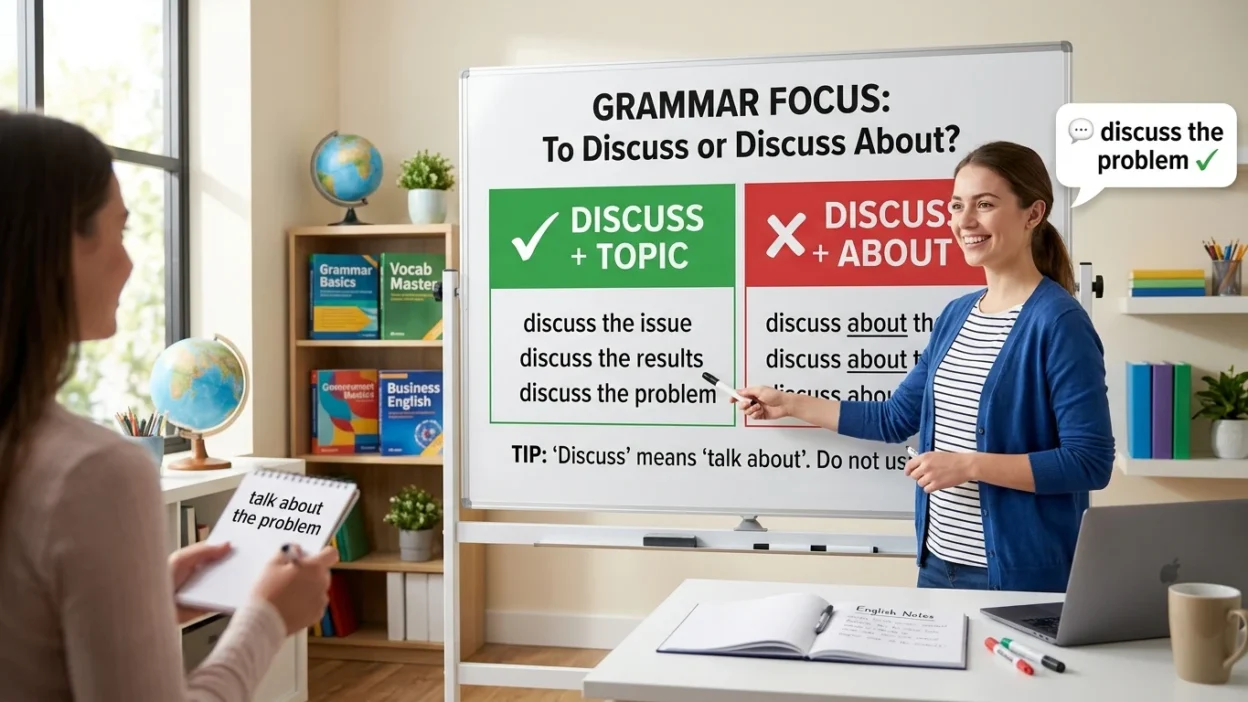
If you are wondering if to say “to discuss” or “to discuss about,” the correct choice in standard English is usually “to discuss.” The verb discuss is normally transitive, which means it takes its topic directly without the preposition about. For example, we say, “We need to discuss the problem,” not “We need to discuss about the problem.”
The confusion happens because talk about, speak about, and think about naturally use about before a topic. This can make “discuss about” sound reasonable, especially for English learners. However, in standard formal and everyday English, discuss + noun is the usual grammatical pattern. Understanding this small difference can make your writing and speaking sound more natural and accurate.
Quick Answer
Use “discuss” when you mention the topic directly: “We need to discuss the plan.” Avoid “discuss about” in standard English. Unlike “talk about,” the verb “discuss” already includes the idea of talking about a subject, so an additional about is normally unnecessary.
Why Do People Confuse “Discuss” and “Discuss About”?
The main reason is that many similar verbs use about.
For example:
- We talk about the problem.
- We speak about the problem.
- We think about the problem.
- We learn about the problem.
- We discuss the problem.
Because “talk about” is so common, learners may naturally transfer the same structure to “discuss.”
Another reason is that discuss means “talk about something in detail.” Since the meaning contains the idea of “about,” speakers sometimes add the preposition unnecessarily.
What Does “Discuss” Mean?
Discuss is a verb meaning to talk about, examine, or consider a particular subject, issue, or question.
The common structure is:
discuss + topic
Examples:
- We discussed the new project.
- They discussed the problem.
- Let’s discuss your idea.
- She discussed her plans with her parents.
Notice that no about is needed before the topic.
Can You Say “To Discuss”?
Yes. To discuss is the infinitive form of the verb.
Examples:
- I want to discuss something with you.
- We need to discuss the situation.
- They met to discuss the proposal.
- She called me to discuss the problem.
The word to here belongs to the infinitive to discuss. It is not a preposition introducing a topic.
What Does “Discuss About” Mean?
“Discuss about” is generally considered incorrect or unnecessary in standard English when about is followed by the topic being discussed.
For example:
❌ We need to discuss about the problem.
Better:
✅ We need to discuss the problem.
The verb discuss already takes the topic directly, so adding about creates an unnecessary preposition.
To Discuss vs Discuss About: Comparison Table
| Expression | Standard English? | Example |
|---|---|---|
| to discuss | Yes | We need to discuss the issue. |
| discuss the issue | Yes | They discussed the issue yesterday. |
| discuss about the issue | Generally no | Avoid this construction. |
| talk about the issue | Yes | We talked about the issue. |
| speak about the issue | Yes | She spoke about the issue. |
The key difference is that discuss normally takes its object directly, while talk and speak commonly use about before a topic.
When Should You Use “Discuss”?
Use discuss when you want to introduce the subject directly after the verb.
Discuss + Topic
- discuss the problem
- discuss the plan
- discuss the situation
- discuss the results
- discuss the matter
- discuss the possibility
- discuss the issue
- discuss the proposal
Examples:
- Let’s discuss the problem later.
- We need to discuss the results.
- They will discuss the proposal tomorrow.
- I would like to discuss this matter with you.
Discuss + Topic + With Someone
You can also say discuss something with someone.
Examples:
- I discussed the problem with my teacher.
- She discussed her plans with her family.
- We discussed the project with our manager.
The pattern is:
discuss + something + with + someone
Not:
❌ discuss about something with someone
10+ Examples of “Discuss” Used Correctly
- We need to discuss the new project.
- Let’s discuss your idea after lunch.
- They met to discuss the problem.
- She wants to discuss the situation with you.
- We discussed the issue yesterday.
- The students discussed the topic in class.
- Can we discuss this matter later?
- They discussed their plans with their parents.
- The committee will discuss the proposal tomorrow.
- I need to discuss something important with you.
- The manager discussed the results with the team.
- We should discuss the possible solutions.
- They sat down to discuss their differences.
- The two companies discussed a possible partnership.
- Let’s discuss what happened yesterday.
All of these examples use discuss without about.
Common Mistakes
Mistake 1: Adding “About” After Discuss
❌ We discussed about the problem.
✅ We discussed the problem.
The word about is unnecessary because discuss can take the topic directly.
Mistake 2: Saying “Discuss About It”
❌ We need to discuss about it.
✅ We need to discuss it.
Here, it is the direct object of discuss.
Mistake 3: Confusing “Discuss” With “Talk About”
❌ We discussed about our plans.
✅ We discussed our plans.
✅ We talked about our plans.
Both discuss and talk about can communicate a similar basic idea, but their grammatical structures are different.
Mistake 4: Using “Discuss With” Without an Object
The structure discuss with can be correct when the topic is understood from context, but in many situations, it is clearer to state the topic.
For example:
- I discussed the problem with Sarah.
- We discussed the proposal with the manager.
The natural pattern is:
discuss + topic + with + person
Memory Trick
A simple way to remember the rule is:
Talk about something, but discuss something.
Think of it like this:
- talk + about + topic
- discuss + topic
For example:
Talk about the movie.
Discuss the movie.
If you remember this pair, you can avoid most mistakes with discuss about.
American vs British English
There is no major American-versus-British difference in the basic grammatical pattern.
In both standard American English and standard British English, discuss + direct object is the normal construction.
Examples:
- American English: We discussed the issue.
- British English: We discussed the issue.
You may encounter “discuss about” in English used by speakers in different regions or by learners, but this does not make it the preferred standard construction in formal English.
Similar Words
Several verbs can express an idea related to discuss, but their structures are not always identical.
Talk About
Talk about means to speak about a subject.
- We talked about the problem.
- They talked about their plans.
Speak About
Speak about can also introduce a topic.
- She spoke about her experience.
- He spoke about climate change.
Debate
Debate means to discuss a subject, often with opposing views or arguments.
- The students debated the issue.
- They debated if the plan would work.
Consider
Consider means to think carefully about something.
- We need to consider the alternatives.
- She considered the proposal carefully.
Mention
Mention means to refer to something briefly rather than discuss it in detail.
- He mentioned the problem during the meeting.
- She mentioned your name yesterday.
Final Verdict
The standard choice is “to discuss,” not “to discuss about.”
Use:
✅ We need to discuss the problem.
Avoid:
❌ We need to discuss about the problem.
Remember that discuss normally takes its topic directly. If you want to use about, choose a verb such as talk, speak, or think.
FAQs:
Is “discuss about” grammatically correct?
In standard English, “discuss about” is generally considered incorrect or unnecessary when about introduces the topic. Use “discuss + topic” instead.
Should I say “discuss about the issue” or “discuss the issue”?
Say “discuss the issue.” The verb discuss directly takes the noun phrase as its object.
Is “to discuss” correct?
Yes. To discuss is the infinitive form of discuss.
Example: “We need to discuss the problem.”
Can I say “discuss with someone”?
Yes, but the most complete pattern is usually discuss something with someone.
Example: “I discussed the problem with my teacher.”
Why do people say “discuss about”?
People often confuse discuss with verbs such as talk and speak, which commonly take about before a topic.
Is “talk about” correct?
Yes. Talk about is a standard and very common expression.
Example: “We talked about the new project.”
Is “discuss the topic” correct?
Yes. Discuss the topic is completely natural and grammatically correct.
What is the easiest way to remember the difference?
Remember this simple rule:
Talk about something, but discuss something.
Remember This
- ✅ discuss the problem
- ✅ discuss the plan
- ✅ discuss the issue
- ✅ discuss it
- ✅ discuss something with someone
- ❌ discuss about the problem
- ❌ discuss about it
The key rule is simple: “discuss” normally takes the topic directly, without “about.”
Conclusion
When choosing between “to discuss” and “discuss about,” use “to discuss” when you are using the infinitive and “discuss” when the verb is followed directly by its topic. For example, “We need to discuss the problem” is correct and natural, while “We need to discuss about the problem” should generally be avoided.
The easiest way to remember the difference is to compare discuss with talk about. You discuss a topic, but you talk about a topic. Once you learn these two patterns, using discuss naturally becomes much easier in both speaking and writing.

Levi Jack is a creative writer and conversation expert passionate about helping people communicate confidently. At ReplyCorner, he shares charming, witty, and engaging reply ideas that make everyday conversations more enjoyable and memorable.