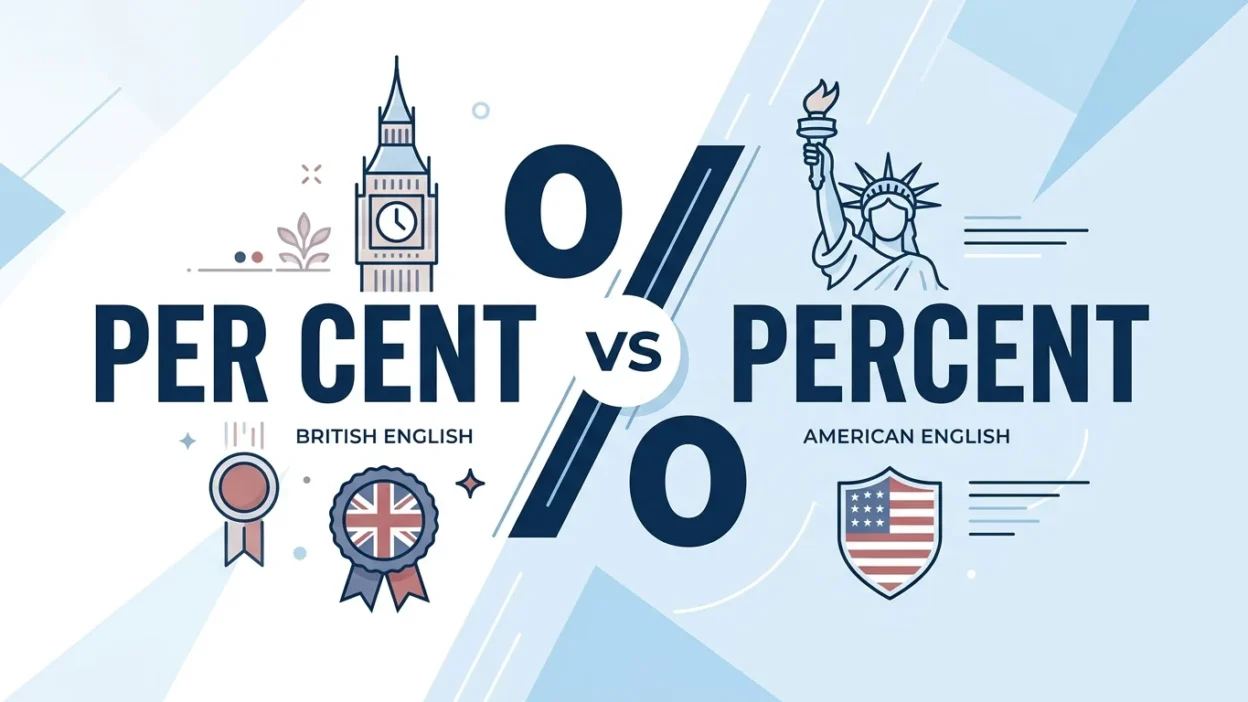
If you are wondering if per cent or percent is correct, the answer is that both are correct. They have the same meaning: one part out of every 100. The main difference is regional usage. Per cent is especially associated with British English, while percent is usually preferred in American English. (Oxford Learner’s Dictionaries)
These forms are used when talking about rates, proportions, increases, decreases, discounts, statistics, and measurements. For example, you can write “Twenty per cent of the students passed” in British English or “Twenty percent of the students passed” in American English. The meaning does not change. (Cambridge Dictionary)
Quick Answer
Per cent and percent mean exactly the same thing and are both correct. Per cent is especially common in British English, while percent is usually preferred in American English. In formal writing, follow the spelling convention of the variety of English you are using and remain consistent.
Why Do People Confuse Per Cent and Percent?
The confusion comes from the fact that the two expressions look slightly different but have the same meaning.
The expression comes from the idea of “per hundred.” The symbol % also represents the same concept.
For example:
- 10 per cent = 10%
- 25 percent = 25%
- 50 per cent = 50%
- 75 percent = 75%
There is no difference in mathematical value between the two spellings.
The main distinction is regional style rather than meaning or grammar. Oxford identifies per cent as especially British and percent as usually North American. Cambridge also recognizes both forms. (Oxford Learner’s Dictionaries)
First Word: Per Cent
Per cent is a two-word spelling traditionally associated with British English.
It means “out of every hundred.”
Examples
- Twenty per cent of the class was absent.
- The price increased by five per cent.
- Only ten per cent of applicants were selected.
- She received a twenty per cent discount.
The expression can be written with the percentage symbol as well:
- 20%
- 5%
- 10%
Oxford lists per cent as especially British English and gives percent as the usual North American form. (Oxford Learner’s Dictionaries)
Second Word: Percent
Percent is the one-word spelling and is particularly common in American English.
It has exactly the same meaning as per cent.
Examples
- Twenty percent of the class was absent.
- The price increased by five percent.
- Only ten percent of applicants were selected.
- She received a twenty percent discount.
American English dictionaries commonly use percent as the standard spelling. (Oxford Learner’s Dictionaries)
Per Cent vs Percent: Comparison Table
| Feature | Per cent | Percent |
|---|---|---|
| Meaning | One part out of 100 | One part out of 100 |
| Spelling | Two words | One word |
| Common association | British English | American English |
| Pronunciation | Essentially the same | Essentially the same |
| Symbol | % | % |
| Correct? | Yes | Yes |
| Example | 30 per cent | 30 percent |
| Main difference | Regional/style preference | Regional/style preference |
The two forms have the same basic meaning and can represent the same numerical value. (Cambridge Dictionary)
When Should You Use Per Cent?
Use per cent when you are writing in a style that follows British English conventions or when your publication prefers this form.
For example:
You may commonly encounter this spelling in British-oriented educational, governmental, academic, or publishing contexts.
However, British English does not make percent impossible. Cambridge also records percent in British English, and modern usage can vary by context and style. (Cambridge Dictionary)
When Should You Use Percent?
Use percent when writing in American English or when your chosen style guide or publication uses the one-word form.
For example
The one-word spelling is particularly standard in American English dictionaries. (Oxford Learner’s Dictionaries)
10+ Examples of Per Cent and Percent
Here are practical examples showing that the meaning remains unchanged.
- British: The company increased its sales by 15 per cent.
American: The company increased its sales by 15 percent. - British: About 40 per cent of students walk to school.
American: About 40 percent of students walk to school. - British: We received a 10 per cent discount.
American: We received a 10 percent discount. - British: Only 5 per cent of the budget was spent.
American: Only 5 percent of the budget was spent. - British: The temperature fell by 20 per cent.
American: The temperature fell by 20 percent. - British: Nearly 80 per cent of the land is agricultural.
American: Nearly 80 percent of the land is agricultural. - British: She scored 95 per cent on the test.
American: She scored 95 percent on the test. - British: The population grew by 3 per cent.
American: The population grew by 3 percent. - British: More than 50 per cent of customers preferred the new design.
American: More than 50 percent of customers preferred the new design. - British: The store offered a 25 per cent reduction.
American: The store offered a 25 percent reduction. - British: I am 100 per cent certain.
American: I am 100 percent certain. - British: The company reduced costs by 12.5 per cent.
American: The company reduced costs by 12.5 percent.
Common Mistakes
1. Thinking One Form Is Incorrect
A common mistake is assuming that per cent is wrong because percent looks more familiar.
Both are accepted forms.
2. Mixing Styles Unnecessarily
If you are following British English, you may prefer:
If you are following American English, you may prefer:
Consistency is more important than treating one spelling as universally correct.
3. Confusing Percent With Percentage
Percent and percentage are related but are not always interchangeable.
Compare:
and:
Percent commonly follows a particular number, while percentage is a noun referring to an amount or proportion expressed in relation to 100. (Cambridge Dictionary)
4. Forgetting the Difference Between Percentage Points and Percent
These terms can describe different mathematical relationships.
For example, if an interest rate rises from 5% to 7%, it has increased by 2 percentage points. Describing that change as a “2 percent increase” would mean something different mathematically.
Memory Trick
A simple way to remember the difference is:
Per cent = British style
Percent = American style
Think of per cent as two words and percent as one word.
Most importantly, remember:
American vs British English
The clearest traditional distinction is regional preference:
- British English: per cent is especially common.
- American English: percent is usually preferred.
- Both varieties: may recognize and understand both forms.
Oxford specifically labels per cent as especially British and says North American English usually uses percent. (Oxford Learner’s Dictionaries)
Cambridge, however, lists percent as a form used in British English too, showing that actual usage is not an absolute either-or distinction. (Cambridge Dictionary)
So if you are writing for an international audience, either spelling will generally be understood. If you are following a particular national variety or house style, follow that convention consistently.
Similar Words
Several terms are closely related to per cent and percent.
Percentage
Percentage is a noun meaning an amount expressed as a number out of 100.
Percentage Point
A percentage point describes the arithmetic difference between two percentages.
Percentile
A percentile is different. It describes a position in a distribution rather than simply an amount out of 100.
Proportion
A proportion describes a part in relation to a whole.
Final Verdict
Per cent and percent are both correct. They have the same meaning and represent the same mathematical concept.
The main difference is spelling preference. Per cent is especially associated with British English, while percent is usually preferred in American English. (Oxford Learner’s Dictionaries)
If you are writing American English, choose percent. If you are following a traditional British English style, per cent is a natural choice. Most importantly, keep your usage consistent.
FAQs:
Is “per cent” or “percent” correct?
Both per cent and percent are correct. They have the same meaning. Per cent is especially associated with British English, while percent is usually preferred in American English.
Is “per cent” British or American?
Per cent is traditionally associated with British English. American English normally uses percent as one word. (Oxford Learner’s Dictionaries)
Is “percent” British English?
Yes. Although per cent is especially associated with British English, dictionaries such as Cambridge also recognize percent in British English. (Cambridge Dictionary)
Should I write 20 per cent or 20 percent?
Use 20 per cent if you are following a British English style that prefers the two-word form. Use 20 percent in American English. Both mean 20%.
Is “percent” one word or two?
Percent is one word. Per cent is two words.
Is “percentage” the same as “percent”?
They are closely related but serve different grammatical roles. Percent commonly expresses a specific rate or amount, while percentage is a noun referring to an amount expressed in relation to 100. (Cambridge Dictionary)
Can I use the % symbol instead?
Yes. The symbol % represents a percentage and is widely used in numerical writing. If you should use the symbol or spell out per cent/percent can depend on the context and style guide.
Remember This
Per cent and percent have the same meaning.
- Per cent → especially British English
- Percent → usually American English
- % → symbol for the same concept
- Percentage → noun for an amount expressed out of 100
- Percentage point → difference between two percentage values
Conclusion
The choice between per cent or percent is mainly a matter of regional spelling and style, not meaning. Both forms describe something measured out of 100, and neither changes the numerical value.
For American English, percent is the usual choice. For traditional British English, per cent is especially common. Choose the form that matches your audience, publication, or style guide, and use it consistently throughout your writing. (Oxford Learner’s Dictionaries)

John Leo is a skilled writer and communication enthusiast who specializes in crafting charming, witty, and thoughtful replies. Through ReplyCorner, he helps readers improve conversations with creative responses for everyday social interactions.