Have you ever wondered if to use e.g. or i.e. in a sentence? These two Latin abbreviations appear frequently in emails, academic writing, articles, and everyday communication. Although they look similar, they have different meanings. Using the wrong one can change the message you want to communicate.
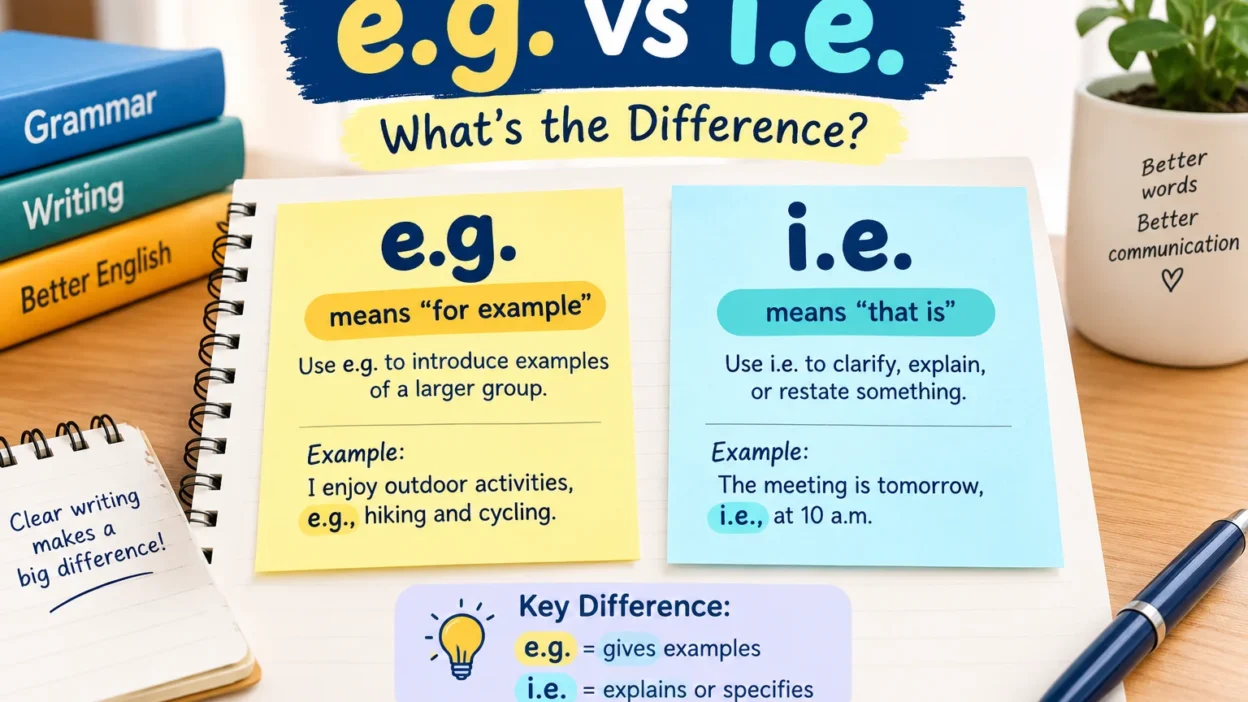
The main difference is simple: e.g. means “for example,” while i.e. means “that is” or “in other words.” Use e.g. when you want to provide examples of something, and use i.e. when you want to explain or clarify exactly what you mean. Understanding this distinction will help you write more clearly and avoid common grammar mistakes. In this guide, you will learn their meanings, differences, correct usage, punctuation rules, and practical examples.
Quick Answer: e.g. vs. i.e.
E.g. stands for the Latin phrase exempli gratia, meaning “for example.” Use it to introduce one or more examples from a larger group. I.e. stands for id est, meaning “that is.” Use it to restate, explain, or clarify something more precisely. Remember: e.g. gives examples, while i.e. explains what you mean.
Why Do People Confuse e.g. and i.e.?
People often confuse these abbreviations because both appear inside sentences to provide additional information. They also come from Latin and are commonly used in parentheses or after commas.
However, their purposes are different:
- e.g. introduces examples that illustrate a broader idea.
- i.e. introduces a clarification or a more precise restatement.
- e.g. usually leaves room for other examples.
- i.e. identifies what the writer specifically means.
For example:
- Bring some fruit, e.g., apples and bananas. (Apples and bananas are examples of fruit.)
- Bring one citrus fruit, i.e., an orange. (The writer specifies exactly what is meant.)
The easiest way to avoid confusion is to replace the abbreviation with its English meaning and check if the sentence still makes sense.
What Does e.g. Mean?
E.g. means “for example.” It comes from the Latin phrase exempli gratia. Writers use it to introduce examples that help readers understand a general statement.
When Should You Use e.g.?
Use e.g. when you want to provide examples without listing every possible option.
Examples:
- I enjoy outdoor activities, e.g., hiking and cycling.
- You should eat foods rich in vitamins, e.g., oranges and spinach.
- Some programming languages, e.g., Python and JavaScript, are widely used.
- We visited several European countries, e.g., France and Italy.
In each sentence, the examples illustrate a larger category.
What Is the Full Form of e.g.?
The full Latin form of e.g. is exempli gratia. In English, it means “for example” or “for the sake of example.”
You do not need to memorize the Latin phrase to use the abbreviation correctly. Remembering its English meaning is enough for most writing situations.
What Does i.e. Mean?
I.e. means “that is” or “in other words.” It comes from the Latin phrase id est. Writers use it to clarify a statement, explain a term, or express the intended meaning more precisely.
When Should You Use i.e.?
Use i.e. when you want to restate something more clearly or specify exactly what you mean.
Examples:
- I work remotely, i.e., I work from home rather than at an office.
- The meeting is biweekly, i.e., it takes place every two weeks.
- Please arrive early, i.e., before 8:00 a.m.
- We need a vegetarian meal, i.e., a meal containing no meat or fish.
In these examples, the information after i.e. clarifies the meaning of the preceding statement.
What Is the Full Form of i.e.?
The full Latin form of i.e. is id est, which means “that is.” It is used to provide a clearer explanation or a more precise interpretation of what has already been stated.
e.g. vs. i.e.: Comparison Table
| Feature | e.g. | i.e. |
|---|---|---|
| Meaning | For example | That is |
| Latin origin | Exempli gratia | Id est |
| Main purpose | Introduces examples | Clarifies or restates meaning |
| Type of information | Illustrative examples | A specific explanation |
| Does it suggest a complete list? | Usually not | Often specifies the intended meaning |
| Common use | Giving examples | Defining or narrowing a statement |
| Easy substitute | For example | In other words |
| Example | Pets, e.g., cats and dogs | My sibling, i.e., my brother |
When Should You Use e.g. or i.e.?
Choosing the right abbreviation depends on the relationship between the original statement and the information that follows it.
Use e.g. to Give Examples
Use e.g. when the information that follows is only a selection of possible examples.
Example: I enjoy reading classic novels, e.g., Pride and Prejudice and Jane Eyre.
The two books are examples of classic novels. Other examples could also be included.
Use i.e. to Explain or Clarify
Use i.e. when the information that follows explains the intended meaning of the statement.
Example: The deadline is tomorrow, i.e., October 28.
The second part identifies the specific date meant by “tomorrow” in this example.
A Simple Test
Ask yourself one question:
- Can I replace the abbreviation with “for example”? Use e.g.
- Can I replace it with “that is” or “in other words”? Use i.e.
This substitution test is a practical way to choose correctly.
12 Examples of e.g. vs. i.e. in Sentences
The following examples show how the abbreviations work in everyday, academic, and professional writing.
Examples Using e.g.
- I like tropical fruits, e.g., mangoes, pineapples, and papayas.
The fruits are examples of tropical fruits. - Several subjects interest me, e.g., history, science, and literature.
The subjects illustrate a broader category. - You can improve your English through different activities, e.g., reading and listening.
Reading and listening are examples of useful activities. - Some animals are nocturnal, e.g., owls and bats.
Owls and bats illustrate the statement. - We need office supplies, e.g., pens, paper, and notebooks.
The items are examples of office supplies. - You can learn a new skill online, e.g., coding or graphic design.
Coding and graphic design are possible choices.
Examples Using i.e.
- The event is free, i.e., you do not need to pay an admission fee.
The second part explains what “free” means here. - I need a monolingual dictionary, i.e., one that explains words in a single language.
The explanation clarifies the type of dictionary. - We have one sibling in common, i.e., the same brother.
The second part specifies the intended meaning. - The office is closed on public holidays, i.e., official holidays recognized by the relevant authority.
The second part clarifies the term. - The task is optional, i.e., you can choose if to complete it.
The explanation restates the meaning of “optional.” - Please submit a digital copy, i.e., a file that can be sent electronically.
The second part explains what kind of copy is required.
Common Mistakes When Using e.g. and i.e.
Even experienced writers sometimes use these abbreviations incorrectly. Here are common mistakes and how to correct them.
Mistake 1: Using e.g. When You Mean i.e.
Incorrect: I need a citrus fruit, e.g., an orange.
This sentence is not necessarily wrong, but it gives an example rather than specifying the exact fruit.
Clearer if an orange is required: I need a citrus fruit, i.e., an orange.
Mistake 2: Using i.e. to Introduce Several Examples
Incorrect for an illustrative list: I enjoy sports, i.e., football, tennis, and cricket.
Better: I enjoy sports, e.g., football, tennis, and cricket.
Use e.g. because the sports listed are examples, not necessarily a complete list.
Mistake 3: Forgetting Punctuation
In American English, the standard forms include periods: e.g. and i.e. Many style guides also recommend a comma after these abbreviations when they introduce an explanation or examples.
Example: I enjoy creative hobbies, e.g., painting and photography.
Punctuation conventions vary by style guide, so follow the rules required by your school, workplace, or publication.
Mistake 4: Writing the Wrong Abbreviation
Incorrect: I need a specific item, eg a calculator.
Better in conventional American punctuation: I need a specific item, i.e., a calculator.
If the item is merely one example of several possibilities, e.g. would be appropriate instead.
Mistake 5: Using Both Abbreviations Unnecessarily
Avoid inserting e.g. or i.e. into every sentence that contains additional information. Sometimes ordinary English is clearer.
Instead of: I enjoy outdoor activities, e.g., hiking.
You can write: I enjoy outdoor activities, such as hiking.
Memory Trick: How to Remember e.g. vs. i.e.
Here is a simple way to remember the difference.
- e.g. = example given. Both begin with the letter E.
- i.e. = in essence. Think of it as explaining what you mean.
Another useful trick is to remember these two short phrases:
- e.g. = for example
- i.e. = that is
Whenever you are unsure, replace the abbreviation with its meaning. If the sentence sounds natural and communicates the intended message, you have probably chosen the correct one.
e.g. vs. i.e. in American and British English
The meanings of e.g. and i.e. are essentially the same in American and British English. Both varieties use e.g. to introduce examples and i.e. to clarify meaning.
The main differences involve punctuation and editorial preferences.
American English
American style commonly uses periods in both abbreviations and often places a comma after them.
Example: You can use several tools, e.g., a calculator or spreadsheet.
British English
British publications also use these abbreviations, although punctuation and spacing may vary according to the publisher’s style guide.
Example: You can use several tools, e.g. a calculator or spreadsheet.
Some British style guides prefer alternative punctuation or recommend avoiding Latin abbreviations in general prose.
Practical tip: If you are writing for an American audience, use the punctuation required by your chosen American style guide. For British audiences, follow the publication’s preferred conventions. In either variety, the difference in meaning remains unchanged.
Similar Words and Abbreviations
Several English expressions serve purposes similar to e.g. and i.e. Understanding them can help you write more naturally.
Such As
“Such as” introduces examples, just like e.g.
Example: I enjoy outdoor activities such as hiking and swimming.
For Instance
“For instance” is another way to introduce an example.
Example: Some birds migrate in winter. For instance, many swallows travel to warmer regions.
In Other Words
“In other words” restates or clarifies an idea, similar to i.e.
Example: The project is incomplete. In other words, we need to do more work.
Namely
“Namely” identifies specific people or things, often providing a precise list.
Example: Two students received awards, namely, Sara and Ahmed.
Etc.
“Etc.” stands for the Latin et cetera, meaning “and other things.” It indicates that a list continues beyond the items mentioned.
Example: Bring your notebook, pens, pencils, etc.
Unlike e.g., which introduces examples, etc. indicates that additional items of the same general kind have been omitted.
FAQs:
1. Is e.g. the same as i.e.?
No. E.g. means “for example,” while i.e. means “that is” or “in other words.” Use e.g. to introduce examples and i.e. to clarify or specify meaning.
2. What does e.g. stand for?
E.g. stands for the Latin phrase exempli gratia, which means “for example.” It introduces examples that illustrate a general statement.
3. What does i.e. stand for?
I.e. stands for the Latin phrase id est, which means “that is.” It introduces an explanation, clarification, or more precise restatement.
4. Should I use a comma after e.g. and i.e.?
In American English, a comma commonly follows e.g. and i.e. when they introduce examples or explanations. British conventions and individual style guides may differ. Follow the style guide relevant to your writing.
5. Can I use e.g. and i.e. in formal writing?
Yes. Both abbreviations are accepted in many forms of formal writing, including academic and professional documents. However, some style guides prefer “for example” and “that is” in general prose for improved readability.
6. Is e.g. followed by a complete list?
Not necessarily. E.g. typically introduces selected examples rather than every possible item. If you want to make clear that a list is complete, choose wording that communicates this directly.
7. Is it correct to write e.g. and i.e. without periods?
The conventional forms in American English include periods: e.g. and i.e. Some publishers and style systems use different punctuation conventions. Follow the required style consistently.
Remember This
- e.g. = for example. Use it to give examples.
- i.e. = that is. Use it to explain or clarify.
- E.g. usually introduces selected examples from a larger group.
- I.e. provides a more precise explanation of what you mean.
- Both abbreviations are used in American and British English, although punctuation conventions can vary.
- When in doubt, replace the abbreviation with its full English meaning.
Conclusion
Understanding the difference between e.g. and i.e. makes your writing clearer and more accurate. Although both abbreviations introduce additional information, they serve different purposes. E.g. provides examples, while i.e. explains or clarifies a statement. Choosing the right one helps readers understand your intended meaning without confusion.
The next time you use either abbreviation, remember the simple rule: use e.g. when you mean “for example” and i.e. when you mean “that is.” With regular practice, you will be able to use both confidently in emails, essays, reports, and everyday communication.

David Owen is a passionate writer and communication enthusiast dedicated to helping readers craft charming, witty, and thoughtful replies. Through ReplyCorner, he shares creative response ideas that make conversations engaging and memorable.