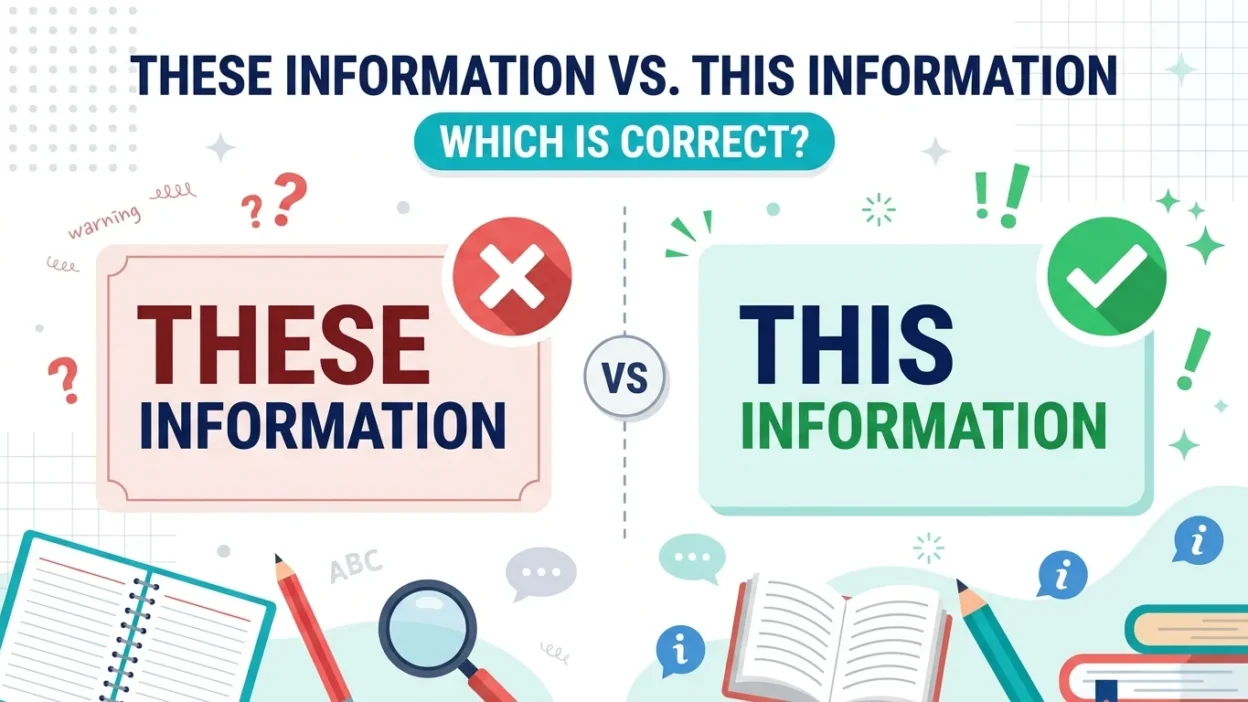
The correct phrase is “this information,” not “these information.” The word information is an uncountable noun in English, so it does not normally take a plural form. We use this with uncountable nouns and these with plural countable nouns. For example, “This information is useful” is correct, while “These information are useful” is incorrect in standard English.
English learners often make this mistake because information refers to facts, details, or knowledge, which can include many individual items. However, even when we talk about several facts, the word information remains uncountable. Understanding this grammar rule will help you write clearer sentences, speak more naturally, and avoid common errors in emails, school assignments, and everyday conversations.
Quick Answer
“This information” is correct, while “these information” is grammatically incorrect in standard English. Information is an uncountable noun, so it takes this and a singular verb. If you want to refer to several individual facts or details, use “these facts,” “these details,” or “these pieces of information.”
Why Do People Confuse “These Information” and “This Information”?
People confuse these expressions because information can contain many facts or details. In everyday thinking, several pieces of information may seem like several items that should take these.
However, English grammar distinguishes between the meaning of a noun and its grammatical form. Although information can describe many facts, it is still an uncountable noun.
Compare these sentences:
- Correct: This information is important.
- Incorrect: These information are important.
- Correct: These details are important.
- Correct: These pieces of information are important.
The key is to identify if the noun is countable or uncountable before choosing this or these.
What Does “This Information” Mean?
“This information” refers to a particular set of facts, details, knowledge, or data.
We use it when discussing information that someone has shared, collected, received, or discovered.
Examples:
- This information is helpful for my research.
- Please check this information before submitting the report.
- I received this information yesterday.
- This information explains the problem clearly.
In each sentence, information is treated as an uncountable noun and takes a singular verb.
What Does “These Information” Mean?
“These information” is an incorrect expression in standard English because these is used with plural countable nouns, not with the uncountable noun information.
Instead, choose an expression that matches your intended meaning:
- Incorrect: These information are useful.
- Correct: This information is useful.
- Correct: These facts are useful.
- Correct: These pieces of information are useful.
If you want to emphasize several separate items, use a countable noun such as facts, details, or pieces.
Comparison Table: These Information vs. This Information
| Expression | Correct? | Explanation |
|---|---|---|
| This information | Yes | Uses a demonstrative for an uncountable noun |
| These information | No | Uses a plural demonstrative with an uncountable noun |
| This piece of information | Yes | Refers to one item of information |
| These pieces of information | Yes | Refers to multiple items |
| These details | Yes | Uses a plural countable noun |
| These facts | Yes | Uses a plural countable noun |
| This informations | No | Information normally has no plural form |
| All this information | Yes | Treats information as uncountable |
When Should You Use “This Information” or “These Details”?
Use “this information” when referring to information as a whole or to a collection of facts without counting individual items.
Examples:
- This information comes from a reliable source.
- I need this information for my assignment.
- This information is confidential.
Use “these details” when referring to multiple separate pieces of information.
Examples:
- These details are missing from the report.
- Please review these details before the meeting.
- These details help explain what happened.
You can also use “these pieces of information” when you want to count individual items explicitly.
12 Examples of Correct and Incorrect Usage
Here are practical examples to help you understand the difference.
1. Incorrect: These information are correct.
Correct: This information is correct.
2. Incorrect: These information help me study.
Correct: This information helps me study.
3. Incorrect: I need these information for work.
Correct: I need this information for work.
4. Incorrect: These information were sent yesterday.
Correct: This information was sent yesterday.
5. Incorrect: These information are confidential.
Correct: This information is confidential.
6. Correct: These facts are important for the project.
7. Correct: These details are included in the document.
8. Correct: These pieces of information are useful.
9. Correct: All this information is available online.
10. Correct: Much of this information is outdated.
11. Correct: I have gathered several pieces of information about the topic.
12. Correct: This information helps us understand the situation.
Notice that the verb also changes depending on the noun. We say “this information is” and “these details are.”
Common Mistakes to Avoid
English learners commonly make these mistakes when using information.
1. Using “These” Before “Information”
Incorrect: These information are useful.
Correct: This information is useful.
2. Adding an “S” to “Information”
Incorrect: I collected many informations.
Correct: I collected a lot of information.
You can also say, “I collected several pieces of information.”
3. Using a Plural Verb
Incorrect: This information are important.
Correct: This information is important.
The noun information takes a singular verb in standard English.
4. Using “Much” and “Many” Incorrectly
Incorrect: Many information is available.
Correct: Much information is available.
Alternatively, say, “Many facts are available.”
5. Confusing Information With Details
Incorrect: These information are missing.
Correct: These details are missing.
When you mean separate items, details may be the more natural word.
Memory Trick: How to Remember the Rule
Use this simple trick: Information is uncountable, so use “this information.”
Remember these patterns:
- This + information + is
- That + information + is
- These + details + are
- Those + facts + are
Think of information like water or advice. You normally say “this water” and “this advice,” not “these water” or “these advice.”
When counting individual items, add a countable noun:
- One piece of information
- Two pieces of information
- Three pieces of information
This pattern makes the correct expression easier to remember.
Is “This Information” Correct in American and British English?
Yes. “This information” is correct in both American and British English. The word information is uncountable in standard usage in both varieties, so the same demonstrative and verb rules apply.
Examples in American English:
- This information is helpful.
- I received this information from my manager.
Examples in British English:
- This information is useful.
- We have received this information from the office.
There is no standard American-versus-British difference that makes “these information” correct.
Similar Words That Follow the Same Rule
Several common English nouns are uncountable and follow the same pattern as information.
| Uncountable noun | Correct expression | Incorrect expression |
|---|---|---|
| Advice | This advice | These advice |
| Furniture | This furniture | These furniture |
| Equipment | This equipment | These equipment |
| Knowledge | This knowledge | These knowledge |
| Research | This research | These research |
| Evidence | This evidence | These evidence |
| News | This news | These news |
| Luggage | This luggage | These luggage |
Some of these nouns can be counted using suitable expressions, such as “pieces of advice,” “items of furniture,” and “pieces of evidence.”
Final Verdict: Which Phrase Should You Use?
The correct expression is “this information.” Do not use “these information” in standard English because information is an uncountable noun.
If you want to refer to several separate facts, use “these facts,” “these details,” or “these pieces of information.” Remember that information itself does not normally become plural by adding -s.
FAQs:
1. Is “these information” grammatically correct?
No. In standard English, information is uncountable, so use “this information.” If you mean several separate items, say “these details” or “these pieces of information.”
2. Why do we say “this information” instead of “these information”?
We use this with uncountable nouns. Since information cannot normally be counted directly, it takes this rather than these.
3. Is it “this information is” or “this information are”?
The correct form is “this information is.” Information takes a singular verb in standard English.
Example: This information is accurate.
4. Can I say “these pieces of information”?
Yes. “These pieces of information” is grammatically correct because pieces is a plural countable noun.
Example: These pieces of information are useful.
5. What is the plural of information?
Information normally has no plural form. To count separate items, use “pieces of information.”
Example: I found three pieces of information about the subject.
6. Is “a lot of information” correct?
Yes. “A lot of information” is a natural and grammatically correct expression.
Example: The website provides a lot of information about learning English.
7. Is “this information” correct in formal writing?
Yes. It is appropriate in academic papers, business emails, reports, essays, and other formal writing.
Example: This information supports the findings of the study.
Remember This
- Use this information, not “these information.”
- Treat information as an uncountable noun.
- Use a singular verb: “This information is useful.”
- Use “these details” or “these facts” for separate items.
- Use “pieces of information” when you need to count them.
Conclusion
The difference between “these information” and “this information” is simple once you understand countable and uncountable nouns. Because information is uncountable in standard English, the correct expression is “this information,” and it normally takes a singular verb. This rule applies to both American and British English.
To express several individual items, use “these details,” “these facts,” or “these pieces of information.” Learning this distinction will help you avoid common grammar mistakes and communicate more clearly in everyday conversations, academic assignments, and professional writing.

John Leo is a skilled writer and communication enthusiast who specializes in crafting charming, witty, and thoughtful replies. Through ReplyCorner, he helps readers improve conversations with creative responses for everyday social interactions.