
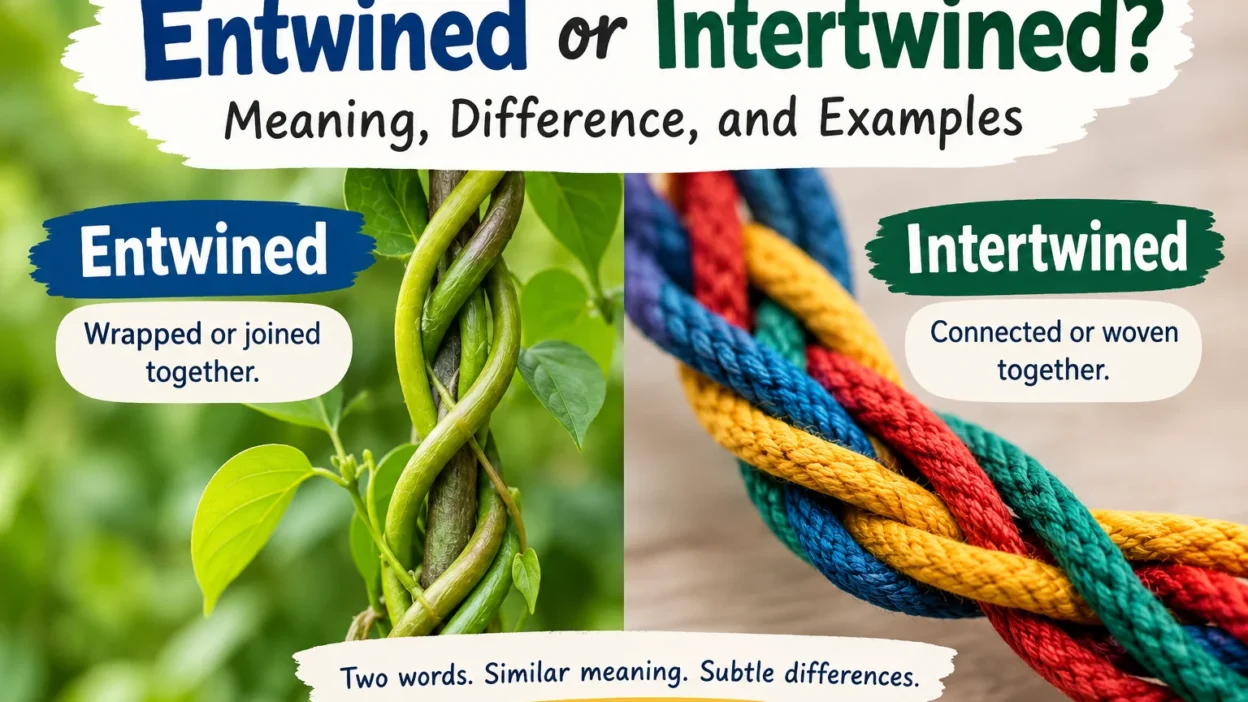
The words entwined and intertwined are closely related and often used interchangeably. Both describe things that are twisted, connected, or closely linked together. However, they can create slightly different impressions depending on the context. Understanding these differences can help you choose the most natural word when speaking or writing English.
You might use entwined to describe two vines growing around each other, two hands gently holding each other, or two lives connected by love. Intertwined can describe similar situations, but it often emphasizes how two or more things are connected through multiple links, relationships, or shared circumstances. Both words can also describe abstract connections, such as history, culture, business, and personal experiences. In everyday English, neither word is generally incorrect when the other could be used. The best choice depends on what you want to emphasize and how the sentence sounds.
Quick Answer
Entwined and intertwined both mean twisted or closely connected together. Entwined often emphasizes the state of being wrapped or joined together, while intertwined can emphasize the way separate parts are woven or linked together. Their meanings overlap considerably, so both can be correct in many situations.
Why Do People Confuse Entwined and Intertwined?
People confuse these words because they share the same basic meaning: things are joined, twisted, or connected together.
Both words are commonly used in literal and figurative contexts. For example, you can describe vines as entwined or intertwined, and you can describe two people’s lives in either way.
The main difference is emphasis rather than a strict difference in meaning.
- Entwined: Often highlights things wrapped or twisted around each other.
- Intertwined: Often highlights the interconnection of multiple parts, ideas, events, or relationships.
Neither word is limited to one particular type of connection.
What Does Entwined Mean?
Entwined is the past participle of entwine, a verb meaning to twist, wind, or wrap things around each other.
It can describe physical objects, such as branches, fingers, or strands of hair. It can also describe emotional relationships and close personal connections.
Examples of Entwined
- The couple walked along the beach with their fingers entwined.
- The vines were entwined around the garden fence.
- Their lives became entwined after years of friendship.
- She wore a bracelet made of entwined silver strands.
- Their memories remained entwined with the old family home.
In these examples, entwined emphasizes the condition of things being wrapped, joined, or closely connected.
What Does Intertwined Mean?
Intertwined is the past participle of intertwine, a verb meaning to twist or weave things together so that their parts become connected.
It can refer to physical objects, but it is especially useful when describing connected systems, events, ideas, or relationships.
Examples of Intertwined
- The two ropes were intertwined to create a stronger cord.
- History and culture are deeply intertwined.
- Their professional and personal lives became intertwined.
- The stories of the two families are intertwined.
- Technology and modern education are increasingly intertwined.
In these examples, intertwined emphasizes how different elements connect or influence one another.
Entwined vs. Intertwined: Comparison Table
| Feature | Entwined | Intertwined |
|---|---|---|
| Basic meaning | Twisted or closely joined together | Twisted, woven, or closely connected together |
| Common emphasis | The state of being wrapped or joined | The way separate elements connect |
| Physical use | Vines, fingers, branches, strands | Ropes, threads, wires, branches |
| Figurative use | Love, lives, memories | History, culture, ideas, lives |
| Emotional tone | Often intimate or poetic | Often descriptive or analytical |
| Correctness | Standard English | Standard English |
The distinction is not absolute. Both words can describe physical objects and abstract relationships, and the most natural choice depends on the sentence.
When Should You Use Each Word?
When to Use Entwined
Choose entwined when you want to emphasize the appearance or state of things being wrapped or joined together.
It is especially natural in descriptions of physical closeness, romantic relationships, and poetic imagery.
Examples:
- Their fingers were entwined as they watched the sunset.
- The branches were entwined above the garden path.
- Her identity was entwined with her family’s traditions.
When to Use Intertwined
Choose intertwined when you want to emphasize the links between different parts or the way separate things influence one another.
It is useful in discussions of history, society, economics, science, and complex personal relationships.
Examples:
- Economic growth and employment are intertwined.
- The two countries have intertwined histories.
- His work and personal interests became intertwined.
Can You Use Them Interchangeably?
Yes, in many sentences.
For example:
- Their lives are entwined.
- Their lives are intertwined.
Both sentences are correct. The first may sound more intimate or poetic, while the second can emphasize the connection between different aspects of their lives.
This is a difference in style and emphasis, not a strict grammatical rule.
12 Examples of Entwined and Intertwined in Sentences
The following examples show how both words work in everyday English.
- Entwined: The lovers sat together with their hands entwined.
- Intertwined: The two companies have intertwined business interests.
- Entwined: Colorful flowers were entwined around the wooden arch.
- Intertwined: Science and technology are closely intertwined.
- Entwined: Their childhood memories were entwined with the village.
- Intertwined: The characters’ stories become intertwined throughout the novel.
- Entwined: The artist created a pattern of entwined branches.
- Intertwined: Politics and economics are often intertwined.
- Entwined: The puppy slept beside its mother, their tails entwined.
- Intertwined: The two research projects are intertwined in several ways.
- Entwined: Their destinies seemed entwined from the beginning.
- Intertwined: Family history and local traditions are deeply intertwined.
Notice that some examples could use either word without becoming grammatically incorrect.
Common Mistakes to Avoid
1. Thinking the Words Have Completely Different Meanings
Incorrect assumption: Entwined describes physical things, while intertwined describes abstract ideas.
Both words can describe physical and abstract connections.
Correct examples:
- Their fingers were entwined.
- Their fingers were intertwined.
- History and culture are entwined.
- History and culture are intertwined.
2. Treating One Word as Always More Correct
Neither word is universally better. Choose the one that communicates your intended meaning and fits the tone of your sentence.
3. Confusing the Verb and Its Past Participle
The base verbs are entwine and intertwine. Their past-tense and past-participle forms are entwined and intertwined.
- Present: The vines intertwine.
- Past: The vines intertwined.
- Past participle: The vines have intertwined.
The same pattern applies to entwine.
4. Adding Unnecessary Words
Avoid awkward phrases such as “intertwined together with each other” when a simpler sentence works.
Instead, write: “The two strands are intertwined.”
The word already communicates that the strands are connected or twisted together.
Memory Trick: How to Remember Entwined vs. Intertwined
Use this simple memory trick:
- Entwined = wrapped together. Picture two hands or vines wrapped around each other.
- Intertwined = linked together. Picture several threads woven into one pattern.
The word intertwined contains the prefix inter-, which appears in words such as interconnected and interrelated. This can help you associate it with connections between different elements.
Remember that this trick is only a guide. The meanings overlap, and it does not establish a strict rule.
American vs. British English
There is no major difference between American and British English in the meanings or standard spellings of entwined and intertwined.
Both forms are used in both varieties of English.
| Usage | American English | British English |
|---|---|---|
| Entwined | Correct | Correct |
| Intertwined | Correct | Correct |
| Entwined lives | Natural | Natural |
| Intertwined histories | Natural | Natural |
Your choice should depend on meaning, tone, and context rather than the variety of English you are using.
Similar Words to Entwined and Intertwined
Several other words describe things that are physically or figuratively connected.
- Interconnected: Connected to one another, often as parts of a larger system. Example: The problems are interconnected.
- Interwoven: Woven together physically or closely combined figuratively. Example: Their stories are interwoven.
- Entangled: Twisted together or caught in a complicated situation. Example: The fishing lines became entangled.
- Interlocked: Joined firmly together. Example: The pieces interlocked perfectly.
- Linked: Connected by a relationship or association. Example: The two events are linked.
- Knotted: Tied or tangled into knots. Example: The ropes were knotted together.
- Related: Connected by meaning, origin, or circumstances. Example: The two topics are closely related.
Although these words are similar, they are not always interchangeable. For instance, entangled can suggest difficulty or complication, while interconnected often emphasizes relationships within a system.
Final Verdict: Entwined or Intertwined?
Both entwined and intertwined are correct words that describe things that are twisted, wrapped, or closely connected.
Choose entwined when you want to emphasize a state of being wrapped together or create an intimate, descriptive, or poetic impression. Choose intertwined when you want to highlight the links between different things, especially ideas, events, systems, and relationships.
However, these are tendencies rather than fixed rules. In many sentences, either word works naturally. Focus on the meaning you want to express instead of memorizing an absolute distinction.
FAQs:
1. Is entwined the same as intertwined?
They have very similar meanings. Both describe things that are twisted, wrapped, or closely connected. Entwined may emphasize the state of being wrapped together, while intertwined can emphasize connections between separate elements.
2. Is entwined or intertwined more romantic?
Both can sound romantic. Entwined is often used to describe hands, bodies, or lives in intimate or poetic writing. However, intertwined can also describe a deep romantic connection.
3. Can I say “our lives are entwined”?
Yes. “Our lives are entwined” is grammatically correct and natural. It means that your lives are closely connected, often through shared experiences, relationships, or circumstances.
4. Can I say “our lives are intertwined”?
Yes. This sentence is also correct. It expresses the idea that two people’s lives are connected, potentially through shared responsibilities, experiences, or relationships.
5. Which word is better for history and culture?
Intertwined is a common and natural choice because it emphasizes the connections between historical events, traditions, and cultural influences. However, entwined can also work in a more literary or poetic context.
6. Is intertwined a real word?
Yes. Intertwined is a standard English word. It is the past-tense and past-participle form of intertwine, meaning to twist or connect things together.
7. What is the difference between entwined and entangled?
Entwined usually describes things wrapped or joined together, often without suggesting a problem. Entangled can describe something tangled, caught, or involved in a complicated situation. The appropriate word depends on the context.
Remember This
- Entwined: Wrapped, twisted, or joined together.
- Intertwined: Twisted, woven, or connected together.
- Both words can describe physical objects, relationships, ideas, and experiences.
- Neither word is always more correct than the other.
- Choose according to the emphasis and tone you want.
Conclusion
The difference between entwined and intertwined is subtle. Both words describe things that are physically joined or figuratively connected, and both are correct in many of the same situations. Entwined often highlights the state of being wrapped together, while intertwined often draws attention to the connections between separate elements.
When choosing between them, consider the sentence’s context and intended tone. Use either word when it communicates your meaning clearly, and remember that natural English usage allows considerable overlap between the two. With practice, you will become more comfortable choosing the word that best fits your writing.

David Owen is a passionate writer and communication enthusiast dedicated to helping readers craft charming, witty, and thoughtful replies. Through ReplyCorner, he shares creative response ideas that make conversations engaging and memorable.