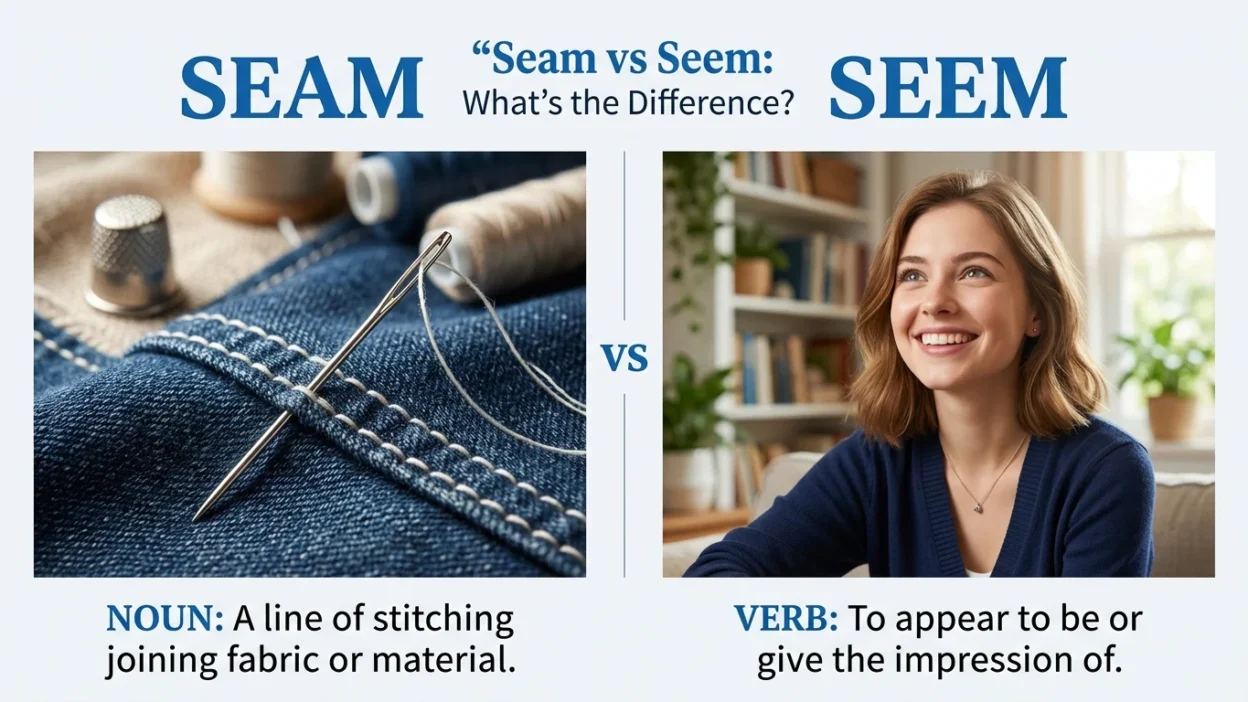
The words seam vs seem are easy to confuse because they sound exactly alike but have completely different meanings. Both are common English words, yet one usually relates to sewing or joining things, while the other is a verb used to describe how something appears or feels.
Understanding the difference between seam and seem can help you avoid common spelling and grammar mistakes in writing. Seam is a noun that refers to a line where two pieces are joined, especially with stitching. Seem is a verb that means “appear” or “give the impression of being.” Once you connect each word with its meaning, choosing the correct spelling becomes much easier.
Quick Answer
Seam means a line where two things are joined, especially by sewing. Seem means to appear or give an impression. They are pronounced the same but have different spellings, meanings, and grammatical uses. For example, “The seam is loose” and “You seem tired” use the words correctly.
Why Do People Confuse Seam and Seem?
Seam and seem are homophones. This means they have the same pronunciation but different spellings and meanings.
When spoken aloud, there is no obvious difference between them. The context tells you which word is intended.
Compare:
- The seam of my shirt is coming apart.
- You seem worried today.
The first sentence is about a joined part of clothing. The second describes someone’s appearance or impression.
What Does “Seam” Mean?
Seam is usually a noun. It refers to a line where two pieces of material are joined together, often by sewing.
It is commonly used when talking about:
- Clothing
- Fabric
- Sewing
- Carpentry
- Manufacturing
- Joined surfaces
Examples of “Seam”
- The seam on my jacket is coming loose.
- She repaired the seam in her dress.
- Check the seam before buying the trousers.
- The pillow has a strong seam around the edge.
Seam can also have a figurative meaning. For example, a “seam of gold” can describe a narrow layer or deposit of something valuable.
What Does “Seem” Mean?
Seem is a verb. It means to appear, look, or give a particular impression.
It is often used when something appears to be true based on what you see, hear, or understand.
Examples of “Seem”
- You seem happy today.
- She seems nervous.
- They seem ready to leave.
- It seems like a good idea.
The word seem is frequently followed by an adjective, an infinitive, or a clause.
For example:
- He seems tired.
- She seems to understand.
- It seems that we are late.
Seam vs Seem: Comparison Table
| Feature | Seam | Seem |
|---|---|---|
| Part of speech | Usually noun | Verb |
| Main meaning | A joined line or place | To appear or give an impression |
| Common context | Sewing, clothing, materials | Appearance, opinions, impressions |
| Pronunciation | Same as “seem” | Same as “seam” |
| Example | The seam is torn. | You seem tired. |
| Related word | Seamless | Seemingly |
When Should You Use “Seam”?
Use seam when you are talking about a joined edge, line, or section, especially in fabric or clothing.
Think about a shirt, dress, pair of trousers, or piece of fabric. If two parts are joined together, the joining line may be called a seam.
Common phrases with “seam”
- A shirt seam
- A side seam
- A shoulder seam
- A broken seam
- A loose seam
- A visible seam
- Sew a seam
- Repair a seam
When Should You Use “Seem”?
Use seem when you mean appear or give the impression.
For example:
- You seem busy.
- He seems friendly.
- The answer seems correct.
- They seem to know each other.
A useful test is to replace seem with appear. If the sentence still makes sense, seem is probably the correct word.
You seem tired.
→ You appear tired.
Seam vs Seem: 12 Examples
- The seam of my jeans has ripped.
- You seem very happy today.
- She fixed the seam in her skirt.
- He seems interested in the project.
- The tailor strengthened the seam.
- It seems like rain is coming.
- The seam on this shirt is uneven.
- They seem ready to leave.
- I noticed a small hole near the seam.
- She seems to understand the problem.
- The seam began to unravel after washing.
- This solution seems reasonable.
Common Mistakes with Seam and Seem
One common mistake is using seam when you mean seem.
❌ You seam tired.
✅ You seem tired.
Another mistake is using seem when talking about a stitched or joined part.
❌ The seem of my shirt is broken.
✅ The seam of my shirt is broken.
Remember that seam is connected with something being joined, while seem is connected with something appearing a certain way.
Memory Trick for Seam vs Seem
Use this simple trick:
Seam = sewing
Both seam and sewing begin with the letter S, and both relate to joining fabric.
Seem = appear
If you can replace the word with appear, use seem.
- You seem tired. → You appear tired.
- The dress has a loose seam. → The dress has a loose joining line.
Seam vs Seem in American and British English
There is no major difference in meaning or spelling between American and British English for these two words.
In both varieties:
- Seam refers to a joined line or section.
- Seem means to appear or give an impression.
- Both words are pronounced alike.
The distinction is therefore not an American-versus-British spelling issue. The important difference is their meaning and grammatical function.
Similar Words to Seam and Seem
Understanding related words can make the distinction even clearer.
Words Related to “Seam”
- Stitch
- Stitching
- Sewing
- Hem
- Joint
- Edge
- Fabric
- Tailoring
- Seamless
Words Related to “Seem”
- Appear
- Look
- Suggest
- Feel
- Appear to be
- Apparently
- Seemingly
For example, seamless means smooth or without an obvious break or difficulty. It comes from seam, not seem.
Final Verdict
Seam and seem sound the same, but they have completely different meanings.
Use seam for a joined line or section, especially in fabric or clothing. Use seem when something appears to be a certain way.
The easiest rule is: seam = sewing; seem = appear.
FAQs:
Is it “seam tired” or “seem tired”?
The correct phrase is “seem tired.” Here, seem means “appear.”
Is “seam” a noun or a verb?
Seam is most commonly a noun, referring to a line where two pieces are joined. It can also be used as a verb, meaning to join or mark with a seam.
Is “seem” a verb?
Yes. Seem is a verb meaning “appear” or “give an impression.”
Are seam and seem pronounced the same?
Yes. Seam and seem are homophones, so they have the same pronunciation but different spellings and meanings.
What is an easy way to remember seam vs seem?
Remember seam = sewing and seem = appear. If the sentence is about fabric or joining, use seam. If it is about how something appears, use seem.
What is the difference between “seam” and “seamless”?
A seam is a joined line or section, while seamless literally means having no visible seams and can also describe something smooth or uninterrupted.
Can “seem” describe a person?
Yes. For example, “She seems happy” means that she appears to be happy based on what you observe.
Remember This
Seam = a joining line, especially in fabric.
Seem = appear or give an impression.
They sound the same, but their meanings are different. When you think about sewing, choose seam. When you can use appear, choose seem.
Learning this small distinction can prevent a very common spelling mistake. Whenever you are unsure, look at the meaning of the sentence rather than the pronunciation. That simple habit will help you choose the correct word confidently.
Conclusion
The difference between seam vs seem is simple once you focus on meaning. Seam is associated with joining materials, particularly through sewing, while seem is a verb used when something appears or gives an impression.
Although these words are pronounced identically, their grammatical roles and meanings are different. Remember the shortcut “seam = sewing” and “seem = appear,” and you will be able to use both correctly in everyday English.

David Owen is a passionate writer and communication enthusiast dedicated to helping readers craft charming, witty, and thoughtful replies. Through ReplyCorner, he shares creative response ideas that make conversations engaging and memorable.