
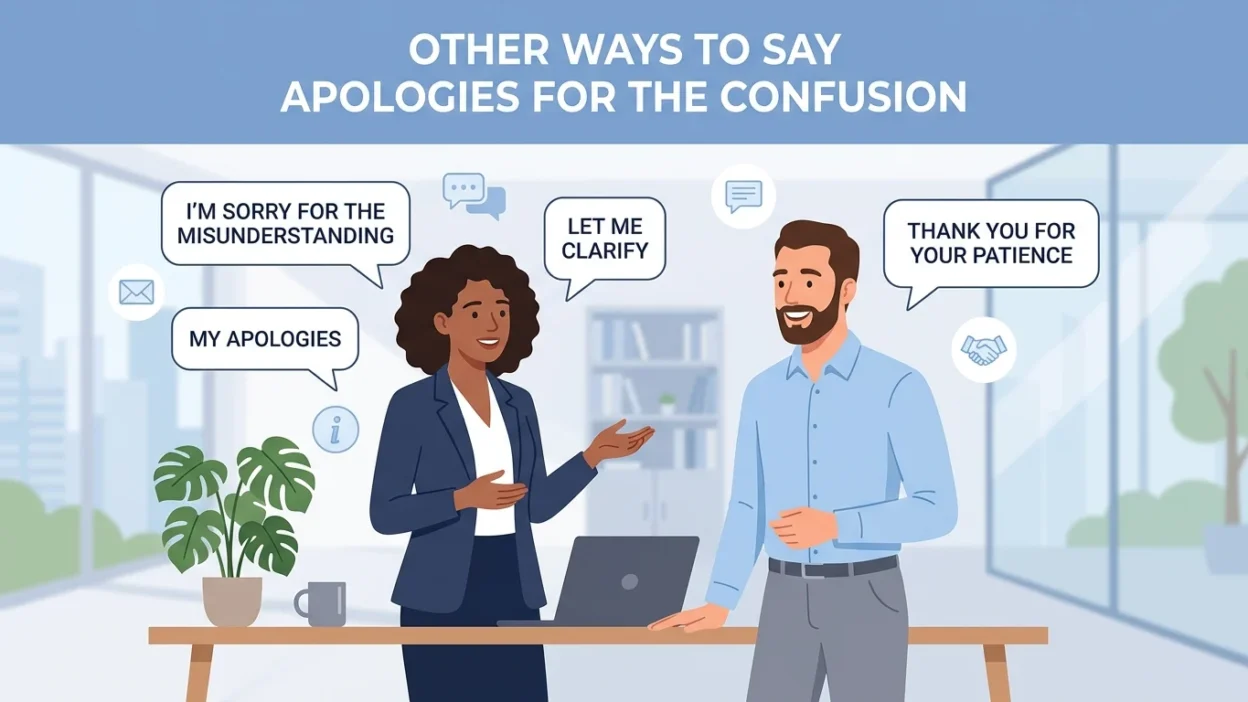
Learning Other Ways to Say Apologies for the Confusion improves communication, creates clearer communication, and helps every apology sound sincere and natural daily. Apologizing does not always require the same familiar phrase. This article will explore 30 diverse ways to use apologies when confusion comes from unclear information, misread expressions, mistakes, or a misunderstanding.
If you send emails, an email, join meetings, attend a meeting, write service messages for customer service, or enjoy everyday conversations, choosing the right phrase, phrases, and language makes your message more effective. A thoughtful language palette adds flavor, helping you convey remorse with clarity, finesse, and useful alternatives for formal, professional, direct, casual, or overly casual situations.
I have learned that it is always better to acknowledge misunderstandings without assigning blame or placing blame on someone else. Keeping a simple table close at hand helps me navigate different situations, choosing the right tone and adjusting my tone for each person.
Instead of repeating the same words in English, I switch my wording while chatting, replying to messages, or having a conversation and other conversations. This simple habit has improved my replies by showing politeness, accountability, and professionalism.
1. Sorry for the Mix-Up
Best for: Casual conversations, friendly emails, workplace misunderstandings.
Alternative: Sorry for the mix-up.
Examples:
- Sorry for the mix-up—I accidentally sent the wrong file.
- Sorry for the mix-up. Everything has been corrected now.
This phrase feels warm and approachable while admitting a simple mistake.
2. I Apologize for Any Misunderstanding
Best for: Formal emails and business communication.
Alternative: I apologize for any misunderstanding.
Examples:
- I apologize for any misunderstanding regarding the meeting schedule.
- I apologize for any misunderstanding caused by my previous message.
A polished alternative that’s ideal for professional settings.
3. Sorry for the Misunderstanding
Best for: Everyday conversations and emails.
Alternative: Sorry for the misunderstanding.
Examples:
- Sorry for the misunderstanding. Let me explain what I meant.
- Sorry for the misunderstanding—we’re actually meeting tomorrow.
Simple, direct, and easy to understand.
4. Thank You for Your Patience
Best for: Customer service and delayed responses.
Alternative: Thank you for your patience.
Examples:
- Thank you for your patience while we sorted everything out.
- Thank you for your patience during this process.
This shifts the focus toward appreciation instead of the mistake.
5. I Appreciate Your Understanding
Best for: Professional emails and client communication.
Alternative: I appreciate your understanding.
Examples:
- I appreciate your understanding as we resolve the issue.
- I appreciate your understanding regarding the recent changes.
A positive way to acknowledge the other person’s cooperation.
6. Sorry for Any Inconvenience
Best for: Business announcements and service updates.
Alternative: Sorry for any inconvenience.
Examples:
- Sorry for any inconvenience caused by the delay.
- Sorry for any inconvenience while we update our system.
Commonly used when a mistake affects others.
7. Please Accept My Apology
Best for: Formal apologies.
Alternative: Please accept my apology.
Examples:
- Please accept my apology for the confusion earlier.
- Please accept my apology for the incorrect information.
A respectful and sincere choice.
8. My Mistake
Best for: Informal conversations.
Alternative: My mistake.
Examples:
- My mistake—I misunderstood your message.
- My mistake. I’ll fix it immediately.
Short, honest, and accountable.
9. I Stand Corrected
Best for: Accepting corrections professionally.
Alternative: I stand corrected.
Examples:
- I stand corrected. Thanks for pointing that out.
- I stand corrected regarding the updated policy.
Shows humility and professionalism.
10. Thanks for Pointing That Out
Best for: Receiving feedback gracefully.
Alternative: Thanks for pointing that out.
Examples:
- Thanks for pointing that out—I appreciate it.
- Thanks for pointing that out. I’ve updated the document.
A polite response that values feedback.
11. Sorry for the Miscommunication
Best for: Workplace discussions.
Alternative: Sorry for the miscommunication.
Examples:
- Sorry for the miscommunication between our teams.
- Sorry for the miscommunication about the deadline.
Useful when both parties contributed to the confusion.
12. I Should Have Been Clearer
Best for: Accepting responsibility.
Alternative: I should have been clearer.
Examples:
- I should have been clearer in my email.
- I should have been clearer about the instructions.
Acknowledges your role in the misunderstanding.
13. Let Me Clarify
Best for: Correcting information.
Alternative: Let me clarify.
Examples:
- Let me clarify what I meant earlier.
- Let me clarify the details before we continue.
Keeps the conversation constructive.
14. Thank You for Bringing This to My Attention
Best for: Professional communication.
Alternative: Thank you for bringing this to my attention.
Examples:
- Thank you for bringing this to my attention.
- Thank you for bringing this issue to my attention.
Shows appreciation for helpful feedback.
15. I Regret the Confusion
Best for: Formal business writing.
Alternative: I regret the confusion.
Examples:
- I regret the confusion surrounding your order.
- I regret the confusion caused by my earlier message.
A polished, professional expression.
16. I Didn’t Mean to Cause Confusion
Best for: Friendly conversations.
Alternative: I didn’t mean to cause confusion.
Examples:
- I didn’t mean to cause confusion with my explanation.
- I didn’t mean to cause confusion about the plans.
Shows good intentions while apologizing.
17. Allow Me to Explain
Best for: Clarifying misunderstandings.
Alternative: Allow me to explain.
Examples:
- Allow me to explain what happened.
- Allow me to explain the updated process.
Helpful when extra context is needed.
18. I Appreciate Your Feedback
Best for: Customer service.
Alternative: I appreciate your feedback.
Examples:
- I appreciate your feedback and have corrected the issue.
- I appreciate your feedback—it helps us improve.
Turns criticism into a positive interaction.
19. Thanks for Your Understanding
Best for: Professional follow-ups.
Alternative: Thanks for your understanding.
Examples:
- Thanks for your understanding while we fix the issue.
- Thanks for your understanding during the transition.
Friendly and appreciative.
20. Sorry About That
Best for: Informal chats.
Alternative: Sorry about that.
Examples:
- Sorry about that—I clicked the wrong button.
- Sorry about that. Everything should work now.
A casual yet sincere apology.
21. I Hope This Clears Things Up
Best for: Ending clarifications.
Alternative: I hope this clears things up.
Examples:
- I hope this clears things up for everyone.
- I hope this clears things up moving forward.
Ends conversations positively.
22. My Apologies
Best for: Professional communication.
Alternative: My apologies.
Examples:
- My apologies for the delayed response.
- My apologies for the confusion earlier.
Short, polite, and versatile.
23. I Appreciate Your Patience
Best for: Delays and corrections.
Alternative: I appreciate your patience.
Examples:
- I appreciate your patience while we investigate.
- I appreciate your patience during the update.
Shows gratitude rather than dwelling on the error.
24. Thank You for Your Flexibility
Best for: Schedule changes.
Alternative: Thank you for your flexibility.
Examples:
- Thank you for your flexibility with the new timeline.
- Thank you for your flexibility regarding today’s meeting.
Perfect when plans change unexpectedly.
25. Please Let Me Correct That
Best for: Fixing mistakes.
Alternative: Please let me correct that.
Examples:
- Please let me correct that information.
- Please let me correct the previous statement.
Signals immediate action.
26. I Appreciate You Letting Me Know
Best for: Feedback and corrections.
Alternative: I appreciate you letting me know.
Examples:
- I appreciate you letting me know about the error.
- I appreciate you letting me know so quickly.
Encourages open communication.
27. Sorry for the Oversight
Best for: Missing details.
Alternative: Sorry for the oversight.
Examples:
- Sorry for the oversight in the report.
- Sorry for the oversight—I missed that attachment.
Ideal for admitting overlooked details.
28. I Take Responsibility
Best for: Serious professional situations.
Alternative: I take responsibility.
Examples:
- I take responsibility for the confusion.
- I take responsibility for the incorrect information.
Demonstrates accountability.
29. I Appreciate Your Cooperation
Best for: Team projects and customer service.
Alternative: I appreciate your cooperation.
Examples:
- I appreciate your cooperation while we resolve this.
- I appreciate your cooperation throughout the process.
Keeps the tone collaborative.
30. Thank You for Your Kindness
Best for: Personal conversations.
Alternative: Thank you for your kindness.
Examples:
- Thank you for your kindness and understanding.
- Thank you for your kindness despite the confusion.
Adds warmth and appreciation to your apology.
Conclusion
Using other ways to say apologies for the confusion helps your communication sound more natural, thoughtful, and appropriate for different situations. If you’re sending a professional email, responding to a customer, or clearing up a misunderstanding with a friend, choosing the right phrase can strengthen relationships and build trust. Instead of relying on the same apology every time, use these alternatives to express sincerity, accountability, and appreciation with confidence.
FAQs:
1. What is another professional way to say “apologies for the confusion”?
Professional alternatives include “I apologize for any misunderstanding,” “My apologies,” “I regret the confusion,” and “Please accept my apology.”
2. Is “sorry for the confusion” better than “apologies for the confusion”?
Both are correct. “Sorry for the confusion” sounds more conversational, while “apologies for the confusion” is slightly more formal.
3. What can I say instead of apologizing in customer service?
You can say “Thank you for your patience,” “I appreciate your understanding,” or “Thank you for bringing this to our attention.”
4. How do I apologize professionally in an email?
Be clear, accept responsibility, briefly explain if needed, and offer a solution. Phrases like “I apologize for any misunderstanding” or “Please accept my apology” work well.
5. Why should I use different apology phrases?
Using varied expressions keeps your communication natural, avoids repetition, and allows you to match the tone to different personal and professional situations.

David Owen is a passionate writer and communication enthusiast dedicated to helping readers craft charming, witty, and thoughtful replies. Through ReplyCorner, he shares creative response ideas that make conversations engaging and memorable.