English has many words that sound alike but have completely different meanings. Who’s and whose are two common examples. They are pronounced similarly, but they are not interchangeable. Knowing the difference can help you write clearer sentences and avoid one of the most common grammar mistakes in English.
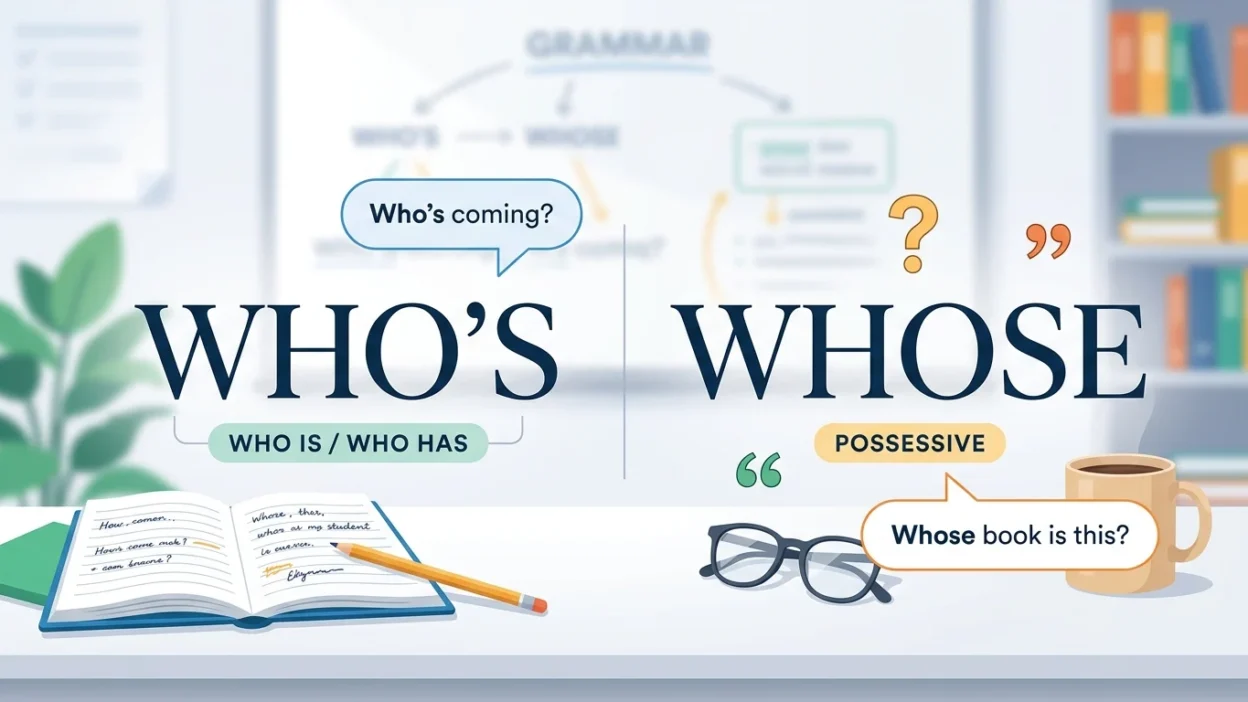
The easiest way to remember the difference is that who’s is a contraction of who is or who has, while whose shows possession or asks about ownership. Once you learn this simple distinction, choosing the correct word becomes much easier. The examples below will help students, ESL learners, and everyday writers understand exactly when to use each one.
Quick Answer
Who’s means “who is” or “who has.” Whose is a possessive word used to ask or tell us who something belongs to. For example, “Who’s coming?” means “Who is coming?” while “Whose phone is this?” asks who owns the phone.
Why Do People Confuse Who’s and Whose?
People often confuse who’s and whose because they sound almost identical when spoken. Their spelling is also very similar, making the difference easy to overlook when writing quickly.
The apostrophe in who’s is the key clue. In this word, the apostrophe indicates that letters have been removed from who is or who has.
By contrast, whose does not contain an apostrophe because it is already a complete possessive word.
Compare these sentences:
- Who’s at the door? = Who is at the door?
- Whose coat is at the door? = Who does the coat belong to?
The first asks about a person or action. The second asks about ownership.
What Does “Who’s” Mean?
Who’s is a contraction. It can replace either who is or who has, depending on the sentence.
Who’s = Who Is
Examples include:
- Who’s your teacher? = Who is your teacher?
- Who’s coming to dinner? = Who is coming to dinner?
- Who’s responsible for this? = Who is responsible for this?
- Who’s ready to leave? = Who is ready to leave?
If you can replace who’s with who is and the sentence still makes sense, who’s is correct.
Who’s = Who Has
Who’s can also mean who has.
For example:
- Who’s finished the assignment? = Who has finished the assignment?
- Who’s taken my pen? = Who has taken my pen?
- Who’s seen my keys? = Who has seen my keys?
A useful clue is that who’s = who has is commonly followed by a past participle such as finished, taken, seen, or completed.
What Does “Whose” Mean?
Whose is a possessive word. It is used when you want to ask or explain who owns something or who something belongs to.
For example:
- Whose bag is this?
- Whose car are you driving?
- Whose idea was it?
- I know whose book this is.
Unlike who’s, whose does not mean who is or who has.
You can think of whose as asking about ownership:
For example, “Whose jacket is this?” means “Who does this jacket belong to?”
Who’s vs Whose: Comparison Table
| Word | Meaning | Main Use | Example |
|---|---|---|---|
| Who’s | Who is / Who has | Contraction | Who’s coming tonight? |
| Whose | Belonging to whom | Possession or ownership | Whose phone is this? |
| Who’s | Who is | Asking about identity or state | Who’s your friend? |
| Who’s | Who has | Asking about an action completed | Who’s finished the work? |
| Whose | Of whom | Possessive relationship | Whose opinion matters? |
The simplest distinction is this: who’s contains an apostrophe because it is a contraction; whose shows possession.
When Should You Use “Who’s”?
Use who’s when you mean who is or who has.
Use “Who’s” for “Who Is”
- Who’s that person?
- Who’s your manager?
- Who’s coming with us?
- Who’s responsible?
- Who’s at the window?
Use “Who’s” for “Who Has”
- Who’s finished the project?
- Who’s already eaten?
- Who’s called you today?
- Who’s taken the last cookie?
- Who’s forgotten their homework?
The substitution test is especially useful. Replace who’s with who is or who has. If the sentence still sounds correct, you have probably chosen the right word.
When Should You Use “Whose”?
Use whose when you are talking about possession, ownership, or a relationship.
Examples:
- Whose shoes are these?
- Whose laptop did you borrow?
- Whose turn is it?
- Whose responsibility is this?
- Do you know whose house that is?
Whose can appear at the beginning of a question or inside a larger sentence.
For example:
- Whose book is on the desk?
- I don’t know whose book is on the desk.
In both cases, whose relates the book to its owner.
10+ Examples of Who’s and Whose
Seeing the two words side by side makes the difference easier to understand.
1. Who’s at the door?
Who’s means who is.
Both sentences have the same meaning.
2. Whose shoes are these?
Whose asks about ownership.
3. Who’s your favorite teacher?
Here, who’s means who is.
4. Whose teacher is she?
Here, whose asks about a relationship or association.
The question asks which person’s teacher she is.
5. Who’s taken my notebook?
Here, who’s means who has.
6. Whose notebook is this?
Here, whose asks who owns the notebook.
7. Who’s going to the party?
Who’s means who is.
8. Whose party is it?
Whose asks about ownership or association.
9. Do you know who’s calling?
Who’s means who is.
10. Do you know whose phone is ringing?
Whose identifies the owner of the phone.
11. Who’s already finished?
Who’s means who has.
12. Whose work is the best?
Whose asks which person’s work it is.
13. Who’s responsible for the mistake?
Who’s means who is.
14. Whose responsibility is it?
Whose shows possession or association.
Common Mistakes With Who’s and Whose
One of the most common mistakes is using who’s whenever you want to show possession.
Incorrect:
Correct:
Another common mistake is leaving out the apostrophe when who is is intended.
Incorrect:
Correct:
You can avoid both errors by asking what the sentence means.
If it means who is or who has, use who’s.
If it asks who owns something or who something belongs to, use whose.
What Is the Best Memory Trick?
Use this simple trick:
Who’s = Who is / Who has
Whose = Ownership
Think of the apostrophe in who’s as a signal that the word is shortened.
For example:
Who’s = Who is
Whose = Possession
You can also remember the relationship between whose and other possessive words:
- my
- your
- his
- her
- our
- their
- whose
These words can all relate to ownership or possession.
Who’s vs Whose in American and British English
The distinction between who’s and whose is essentially the same in both American and British English.
American English uses:
British English also uses:
Likewise, both varieties use:
The spelling and basic grammatical functions do not change simply because the variety of English changes.
What may differ between American and British English are other vocabulary, spelling, pronunciation, or style choices. However, who’s and whose follow the same basic rules in both varieties.
What Words Are Similar to Who’s and Whose?
Several English words create similar confusion because they sound alike or look similar.
Who’s and Whose
- Who’s = who is / who has
- Whose = belonging to whom
It’s and Its
- It’s = it is / it has
- Its = possession
Example:
They’re, Their, and There
- They’re = they are
- Their = possession
- There = a place or existence
Example:
Understanding these patterns can make other commonly confused English words easier to use correctly.
Final Verdict: Who’s vs Whose
The difference between who’s and whose is simple once you focus on their meanings.
Who’s is a contraction of who is or who has. Use it when you can expand the word into one of those phrases.
Whose is a possessive word. Use it when asking or explaining who owns something or who something belongs to.
Remember:
If you are unsure, replace who’s with who is or who has. If the sentence works, use who’s. If the sentence is about ownership, use whose.
FAQs:
Is “who’s” the same as “whose”?
No. Who’s is a contraction meaning who is or who has, while whose is a possessive word used to ask who owns something or who something belongs to.
Is it “who’s book” or “whose book”?
The correct phrase is “whose book.” For example, “Whose book is this?” asks who owns the book.
Is “who’s coming” correct?
Yes. “Who’s coming?” is correct because who’s means who is. You could write, “Who is coming?” without changing the meaning.
Is “whose coming” ever correct?
Usually, no, if you mean “who is coming.” The correct sentence is “Who’s coming?” However, whose can be correct in a different grammatical construction when it shows possession.
Can “who’s” mean “who has”?
Yes. Who’s can mean who has when followed by a suitable verb form. For example, “Who’s finished the task?” means “Who has finished the task?”
Does “whose” always refer to ownership?
Not necessarily physical ownership. Whose can also describe a relationship, responsibility, association, or connection. For example, “Whose idea was this?” asks who the idea belongs to.
Why does “who’s” have an apostrophe?
The apostrophe shows that who’s is a contraction. Letters have been omitted from who is or who has.
How can I quickly remember who’s vs whose?
Remember who’s = who is/who has and whose = possession. If you can replace the word with “who is” or “who has,” choose who’s. Otherwise, if you are asking about belonging, choose whose.
Remember This
Who’s and whose may sound alike, but they perform different jobs.
- Who’s = who is
- Who’s = who has
- Whose = possession
- Who’s normally contains an apostrophe.
- Whose does not contain an apostrophe.
- Use whose for questions about ownership or association.
When in doubt, use the “who is/who has” test. If that expansion works, choose who’s. If the sentence asks who something belongs to, choose whose.
Conclusion
Understanding who’s vs whose does not require memorizing complicated grammar rules. The main difference is straightforward: who’s is short for who is or who has, while whose shows possession or asks who something belongs to. Once you recognize these two functions, the correct choice becomes much more natural.
Keep practicing with everyday sentences such as “Who’s calling?” and “Whose phone is this?” The more often you compare the words in context, the easier it becomes to use them confidently in school, work, conversations, and everyday writing.

Levi Jack is a creative writer and conversation expert passionate about helping people communicate confidently. At ReplyCorner, he shares charming, witty, and engaging reply ideas that make everyday conversations more enjoyable and memorable.