
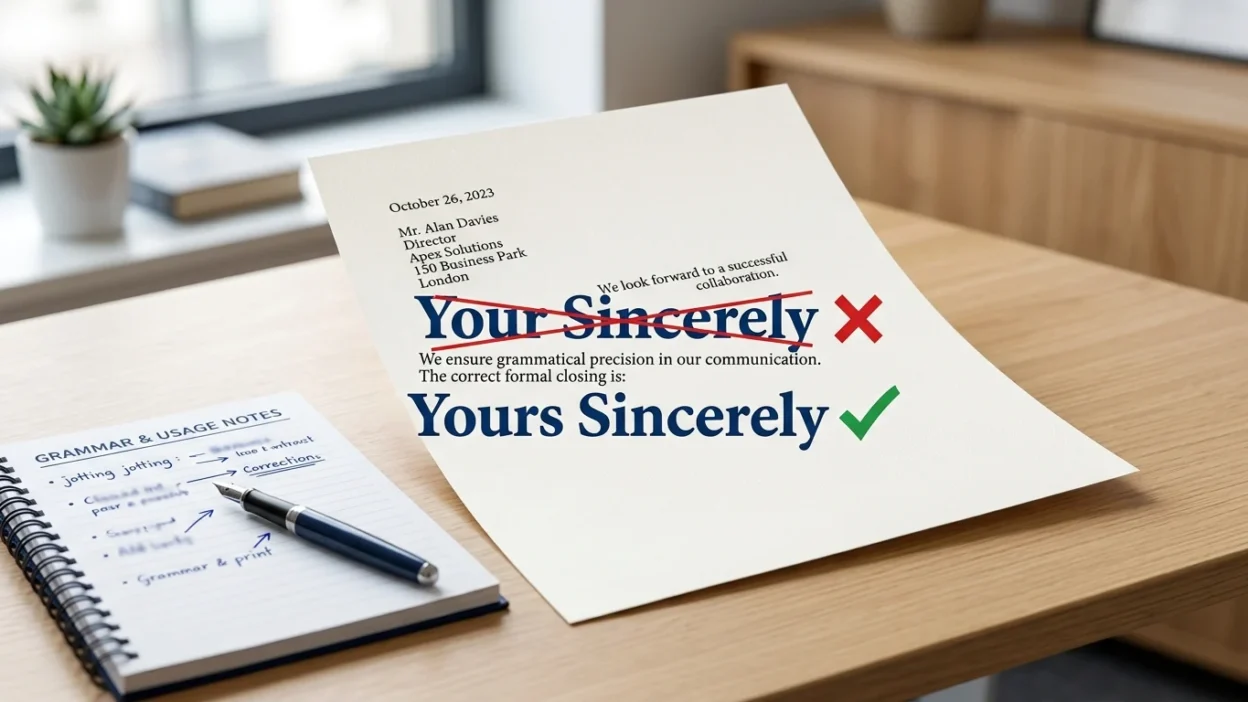
When ending a formal letter or email, the correct expression is “Yours sincerely,” not “Your sincerely.” “Yours sincerely” is a traditional complimentary closing used mainly in British English when you know the recipient’s name. The word “yours” is a possessive pronoun, while “your” is a possessive determiner that normally needs a noun after it.
This small difference causes confusion because both your and yours are possessive forms of “you.” However, they do not work in the same grammatical way. If you are writing a formal letter, job application, business email, or official message, using the correct closing makes your writing sound polished and professional.
This guide explains “your sincerely or yours sincerely,” shows when to use each expression, and gives practical examples to help you remember the difference.
Quick Answer
The correct formal closing is “Yours sincerely,” not “Your sincerely.” Use “Yours sincerely” when you know the recipient’s name, especially in British English. “Your” must normally come before a noun, while “yours” can stand alone. For example: “Dear Mr. Smith … Yours sincerely, James.”
Why Do People Confuse “Your” and “Yours”?
People often confuse these words because both indicate possession.
Your is a possessive determiner. It normally appears before a noun:
- Your letter
- Your application
- Your opinion
- Your sincerely ❌
Yours is a possessive pronoun. It can stand on its own:
- The book is yours.
- The decision is yours.
- Yours sincerely. ✅
In “Yours sincerely,” the word “yours” functions as a standalone possessive form. That is why “Your sincerely” is grammatically incorrect as the conventional letter closing.
What Does “Your” Mean?
Your shows that something belongs to or is connected with the person being addressed. It usually comes directly before a noun.
For example:
- Thank you for your email.
- I received your application.
- Please confirm your address.
- I appreciate your assistance.
Because “your” normally needs a noun after it, “your sincerely” is not the standard expression used to close a formal letter.
Examples With “Your”
- Your message was helpful.
- I received your invitation.
- Thank you for your time.
- Please send your response soon.
- Your application has been received.
What Does “Yours” Mean?
Yours is a possessive pronoun. Unlike “your,” it can be used without a noun immediately after it.
For example:
- This pen is yours.
- The choice is yours.
- The responsibility is yours.
- I hope the final decision is yours.
It is also used in traditional letter closings such as “Yours sincerely” and “Yours faithfully.”
Examples With “Yours”
- This seat is yours.
- The opportunity is yours.
- The final decision is yours.
- The blue folder is yours.
- Yours sincerely.
Your vs. Yours: Comparison Table
| Word/Expression | Grammar | Meaning/Use | Example |
|---|---|---|---|
| Your | Possessive determiner | Shows possession before a noun | Your letter |
| Yours | Possessive pronoun | Shows possession without a following noun | The letter is yours |
| Yours sincerely | Formal closing | Used when the recipient is named | Yours sincerely, John |
| Your sincerely | Incorrect expression | Not the standard formal closing | Your sincerely ❌ |
The easiest distinction is simple: “your” usually needs a noun, while “yours” can stand alone.
When Should You Use “Yours Sincerely”?
Use “Yours sincerely” when you are writing a formal letter or email and you know the recipient’s name.
For example, if your letter begins:
you can normally end it with:
It is especially common in British and other varieties of English influenced by British writing conventions.
Example
When Should You Use “Yours Faithfully”?
In traditional British English letter-writing conventions, “Yours faithfully” is commonly used when you do not know the recipient’s name.
For example:
A useful traditional rule is:
- Dear Mr. Smith → Yours sincerely
- Dear Sir or Madam → Yours faithfully
Modern business emails can be less formal, so alternatives such as Kind regards or Best regards are also widely used.
10+ Examples of “Yours Sincerely”
Here are practical examples showing how “Yours sincerely” works in formal writing.
1. Job Application
2. Business Letter
3. Complaint Letter
4. School Communication
5. Formal Request
6. University Letter
7. Professional Email
8. Follow-Up Letter
9. Formal Invitation
10. Request for Information
11. Reference Letter
12. Official Correspondence
What Are the Common Mistakes?
The most common mistake is writing “Your sincerely” instead of “Yours sincerely.”
Mistake 1: Your sincerely ❌
This is not the standard grammatical form for a formal complimentary closing.
Correct: Yours sincerely ✅
Mistake 2: Mixing “sincerely” With the Wrong Closing
Some writers combine words incorrectly:
- Your sincerely ❌
- Yours sincere ❌
- Yours sincerly ❌
- Yours sincerely ✅
The correct spelling is sincerely, with “ly” at the end.
Mistake 3: Using “Yours sincerely” Automatically
“Yours sincerely” is traditionally associated with a letter where the recipient is known by name. If you are following traditional British conventions and begin with “Dear Sir or Madam,” then “Yours faithfully” is generally preferred.
What Is the Easiest Memory Trick?
Remember this simple rule:
Your + noun
Yours = no noun needed
For example:
- Your book
- Your car
- Your opinion
- The book is yours.
- The car is yours.
Now apply the same idea to a letter:
Yours sincerely ✅
You can also remember:
This quick rule works for many possessive expressions beyond letter closings.
Is “Yours Sincerely” British or American English?
“Yours sincerely” is strongly associated with British English and other formal writing traditions influenced by British English.
In American English, “Sincerely,” is a very common formal closing. American writers may also use “Sincerely yours,” although it is less common in everyday professional communication than simply “Sincerely.”
Here is a useful comparison:
| English variety | Common formal closing |
|---|---|
| British English | Yours sincerely |
| British English, recipient unknown | Yours faithfully |
| American English | Sincerely |
| American English | Sincerely yours |
| Modern international business writing | Kind regards / Best regards |
The exact choice can depend on the organization, country, and level of formality.
What Are Similar Words and Expressions?
Several expressions can be used to close a formal or professional message.
Yours sincerely
Traditional and formal, especially in British English when the recipient is named.
Yours faithfully
Traditionally used in British English when the recipient’s name is unknown.
Sincerely
A standard formal closing, especially common in American English.
Sincerely yours
Another formal American English option.
Kind regards
Polite, professional, and slightly less formal.
Best regards
Common in professional emails and business communication.
Kindest regards
Warm but still professional in many contexts.
Best wishes
Friendly and polite, although generally less formal than “Yours sincerely.”
What Is the Final Verdict: “Your Sincerely” or “Yours Sincerely”?
The correct expression is “Yours sincerely.”
Use “yours” because it is a possessive pronoun that can stand independently. “Your” is a possessive determiner and normally needs a noun after it.
So:
- Your sincerely ❌
- Yours sincerely ✅
If you are writing a formal British-style letter to someone whose name you know, “Yours sincerely” is the traditional choice. In American English, “Sincerely” is often more natural.
FAQs:
Is “your sincerely” correct?
No. “Your sincerely” is not the standard expression used to close a formal letter. The correct traditional form is “Yours sincerely.”
Is it “your sincerely” or “yours sincerely”?
It is “Yours sincerely.” The word “yours” is a possessive pronoun and works independently in this expression.
Should I write “Yours sincerely” in an email?
Yes, you can use “Yours sincerely” in a formal email, particularly when following British English conventions. For less formal professional emails, “Kind regards” or “Best regards” may sound more natural.
Is “Yours sincerely” British English?
Yes. “Yours sincerely” is a traditional British English formal closing, especially when the recipient is addressed by name.
What is the difference between “Yours sincerely” and “Yours faithfully”?
Traditionally, “Yours sincerely” is used when you know the recipient’s name, while “Yours faithfully” is used when you do not know their name.
Can I use “Sincerely” instead of “Yours sincerely”?
Yes. “Sincerely” is particularly common in American English and is also understood internationally as a formal closing.
Is “Yours sincerely” formal?
Yes. It is a formal or traditional complimentary closing. Depending on the situation, modern alternatives such as “Kind regards” may feel more natural in professional emails.
Is “sincerely yours” correct?
Yes. “Sincerely yours” is grammatically correct and is used particularly in American English. However, “Yours sincerely” is the traditional British form.
Remember This
The key point is simple:
Your + noun:
“Thank you for your help.”
Yours alone:
“The decision is yours.”
Formal letter closing:
“Yours sincerely.”
So, whenever you are unsure whether to write “your sincerely” or “yours sincerely,” choose “Yours sincerely.”
Conclusion
The correct expression is “Yours sincerely,” not “Your sincerely.” The difference comes from grammar: “your” is a possessive determiner that normally comes before a noun, while “yours” is a possessive pronoun that can stand alone. That is why the traditional letter closing uses “Yours sincerely.”
If you are writing in British English and know the recipient’s name, “Yours sincerely” is a reliable formal choice. In American English, “Sincerely” is often preferred. Once you remember that “your needs a noun, while yours can stand alone,” choosing the correct form becomes much easier.

Levi Jack is a creative writer and conversation expert passionate about helping people communicate confidently. At ReplyCorner, he shares charming, witty, and engaging reply ideas that make everyday conversations more enjoyable and memorable.