
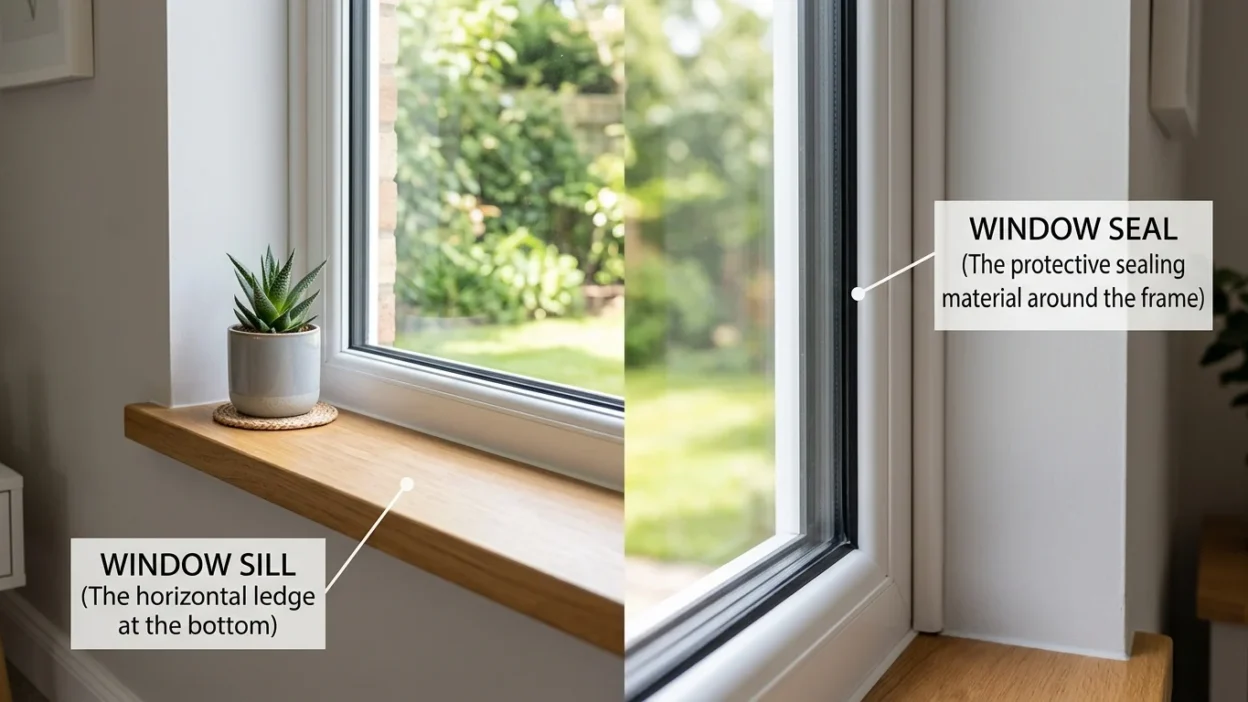
If you are wondering whether the correct term is window seal or sill, the two words refer to completely different parts of a window. A window sill is the horizontal ledge at the bottom of a window, while a window seal is a material or barrier that helps close gaps and prevent air, water, dust, or noise from passing through. Although they are often mentioned together when discussing windows, they have different meanings and functions.
Knowing the difference between window seal and sill is useful when describing home repairs, construction work, cleaning, or window damage. For example, you might replace a damaged window seal, but you might clean, repair, or paint a window sill. Understanding these terms can also help you communicate clearly with contractors, builders, landlords, or hardware-store staff.
Quick Answer
A window sill is the horizontal surface or ledge at the bottom of a window. A window seal is a flexible or protective material that closes gaps around the window and helps prevent drafts, moisture, and air leakage. The sill is a structural or visible part; the seal provides protection and insulation.
Why Do People Confuse “Window Seal” and “Sill”?
People often confuse these terms because both are associated with the lower part of a window and may appear in the same repair or maintenance discussion.
A window may have a sill and a seal close to each other. However, they perform different jobs.
- A sill is a physical ledge or part of the window structure.
- A seal creates a barrier against unwanted movement of air or water.
- A sill can be made from wood, stone, metal, vinyl, or another solid material.
- A seal is commonly made from rubber, silicone, foam, weatherstripping, or another flexible sealing material.
What Is a Window Sill?
A window sill is the horizontal surface at the bottom of a window. Inside a house, it is often the ledge where people place plants, decorations, or small objects.
The sill can also help support the window and direct water away from the wall. In exterior construction, the sill is particularly important because its design can help prevent rainwater from entering the building.
For example:
Here, sill means the physical ledge.
What Is a Window Seal?
A window seal is a material or barrier used to close a gap around a window. Its purpose is generally to reduce the movement of air, water, dust, or other unwanted elements.
Window seals can be found around the edges of window frames, between moving window sections, or in glazing systems.
For example:
Here, seal refers to the protective barrier rather than the window’s ledge.
Window Seal vs. Window Sill: Comparison Table
| Feature | Window Seal | Window Sill |
|---|---|---|
| Basic meaning | A barrier that closes or protects a gap | The horizontal ledge at the bottom of a window |
| Main purpose | Prevents air, water, dust, or drafts from passing through | Supports, finishes, or helps drain water from the window area |
| Typical materials | Rubber, silicone, foam, weatherstripping | Wood, stone, metal, vinyl, composite |
| Can it wear out? | Yes, seals can crack, shrink, or become brittle | Yes, sills can rot, crack, stain, or become damaged |
| Example | “The window seal needs replacing.” | “The vase is on the window sill.” |
| Related verbs | Replace, repair, inspect, seal | Clean, paint, repair, install |
When Should You Use “Window Seal”?
Use window seal when you are talking about a material or barrier that closes a gap or prevents unwanted air or moisture from entering.
Common situations include:
- A draft coming through a window
- Water leaking around a window
- Damaged rubber weatherstripping
- Cracked silicone around a frame
- Poor insulation around a window
- Replacing worn sealing material
Examples
- “The window seal is cracked and needs to be replaced.”
- “A damaged window seal can allow rainwater to enter.”
- “Check the window seal if you feel a cold draft.”
- “The contractor installed a new seal around the frame.”
- “The old rubber window seal has become brittle.”
When Should You Use “Window Sill”?
Use window sill when you mean the horizontal ledge or bottom part of a window.
Common situations include:
- Placing objects on the ledge
- Cleaning the window area
- Painting or repairing the sill
- Describing water damage
- Discussing the design or construction of a window
Examples
- “I left the keys on the window sill.”
- “The wooden window sill needs to be painted.”
- “Rainwater has damaged the exterior window sill.”
- “She placed several plants on the window sill.”
- “The window sill is covered with dust.”
10+ Examples of “Window Seal” and “Window Sill”
The easiest way to understand the difference is to see the words in natural sentences.
Examples With “Window Seal”
- “The window seal is letting in cold air.”
- “We need a new seal for the bathroom window.”
- “The seal around the window has deteriorated.”
- “A good window seal can reduce drafts.”
- “The installer checked the seal for gaps.”
- “Water entered through a damaged window seal.”
Examples With “Window Sill”
- “The cat is sitting on the window sill.”
- “Please wipe the dust from the window sill.”
- “The wooden sill has started to rot.”
- “She put a small plant on the window sill.”
- “The exterior sill directs rainwater away from the wall.”
- “The painter repaired the damaged window sill.”
What Are the Common Mistakes?
One common mistake is using sill when you mean a material that blocks a gap.
Incorrect:
This could be true if the sill itself is damaged, but if the problem is the flexible barrier around the window, seal is more precise.
Another mistake is using seal for the ledge.
Incorrect:
Correct:
A useful rule is to ask yourself what you are describing: a ledge or a barrier?
What Is an Easy Memory Trick?
Remember:
Sill = Surface
Both start with S.
A sill is a surface or ledge where you might place something.
Seal = Stop
A seal helps stop air, water, or drafts from passing through a gap.
So:
- Sill → Surface
- Seal → Stops leaks or drafts
This simple association makes the difference easier to remember.
American vs. British English
The words sill and seal have the same basic meanings in both American and British English.
However, window terminology can vary somewhat depending on the type of window and construction practice.
In both varieties of English:
- Window sill refers to the horizontal bottom ledge.
- Window seal refers to sealing material or a sealing barrier.
- Sill and seal are not interchangeable.
You may also encounter terms such as windowsill, window frame, weather seal, weatherstripping, and window gasket.
The exact terminology can vary among manufacturers and trades, but the basic distinction between a sill and a seal remains useful.
What Are Some Similar Window Words?
Several other window-related terms can cause confusion.
Window Frame
The window frame is the structure that surrounds and supports the window.
Example:
Window Pane
A window pane is a section of glass in a window.
Example:
Window Sash
A window sash is the part of a window that holds the glass and may move when the window opens or closes.
Example:
Weatherstripping
Weatherstripping is material used to seal gaps around doors and windows against drafts and weather.
Example:
Gasket
A gasket is a sealing component placed between surfaces to prevent leakage or create a tight connection.
Example:
Final Verdict: Window Seal or Sill?
The correct word depends on what you mean.
Use window sill for the horizontal ledge at the bottom of a window. Use window seal for the material or barrier that helps close gaps and prevent air, water, or drafts from passing through.
If you can place a plant, book, or decoration on it, you are probably talking about the sill. If you are talking about stopping a draft or leak, you are probably talking about the seal.
Quick rule:
Sill = ledge.
Seal = barrier.
FAQs:
1. Is it called a window sill or window seal?
Both terms are correct, but they describe different things. A window sill is the bottom horizontal ledge, while a window seal is a barrier or sealing material that helps prevent air or water from passing through gaps.
2. What is the sill of a window?
The window sill is the horizontal part at the bottom of a window. It may form a ledge inside the room and can also have an important structural or water-drainage function.
3. What does a window seal do?
A window seal helps close gaps around a window and can reduce drafts, air leakage, water entry, dust, and sometimes noise.
4. Is a windowsill one word or two?
Windowsill is commonly written as one word, especially in American English. Window sill is also used, particularly when the term is treated as a two-word compound.
5. Is a window seal the same as weatherstripping?
Not always. Weatherstripping is one type of material used to seal gaps around windows and doors. The broader term window seal can refer to different sealing components depending on the window design.
6. Can a window sill leak?
A sill itself can be involved in water problems, particularly if it is poorly designed, damaged, or improperly installed. However, water entering around a window may also result from damaged seals, flashing, drainage problems, or other construction issues.
7. What is the difference between a window sill and a window frame?
The window sill is the bottom horizontal portion of the window area. The window frame is the surrounding structure that holds and supports the window components.
Remember This
Window sill = the ledge.
Window seal = the barrier.
A sill is something you can see and often use as a ledge. A seal is designed to close a gap and protect against unwanted air or water movement.
If you remember “sill = surface” and “seal = stop,” you can usually choose the correct term confidently.
Conclusion
Understanding window seal or sill becomes simple once you focus on their functions. A window sill is the horizontal ledge at the bottom of a window, while a window seal is a protective component that helps close gaps and reduce air or water penetration. They may be located near each other, but they are not the same part.
When talking about plants, dust, painting, or a physical ledge, choose sill. When discussing drafts, leaks, if protection, rubber strips, or sealing gaps, choose seal. Keeping this distinction in mind will help you describe windows more accurately in everyday English, home maintenance, and construction conversations.

David Owen is a passionate writer and communication enthusiast dedicated to helping readers craft charming, witty, and thoughtful replies. Through ReplyCorner, he shares creative response ideas that make conversations engaging and memorable.