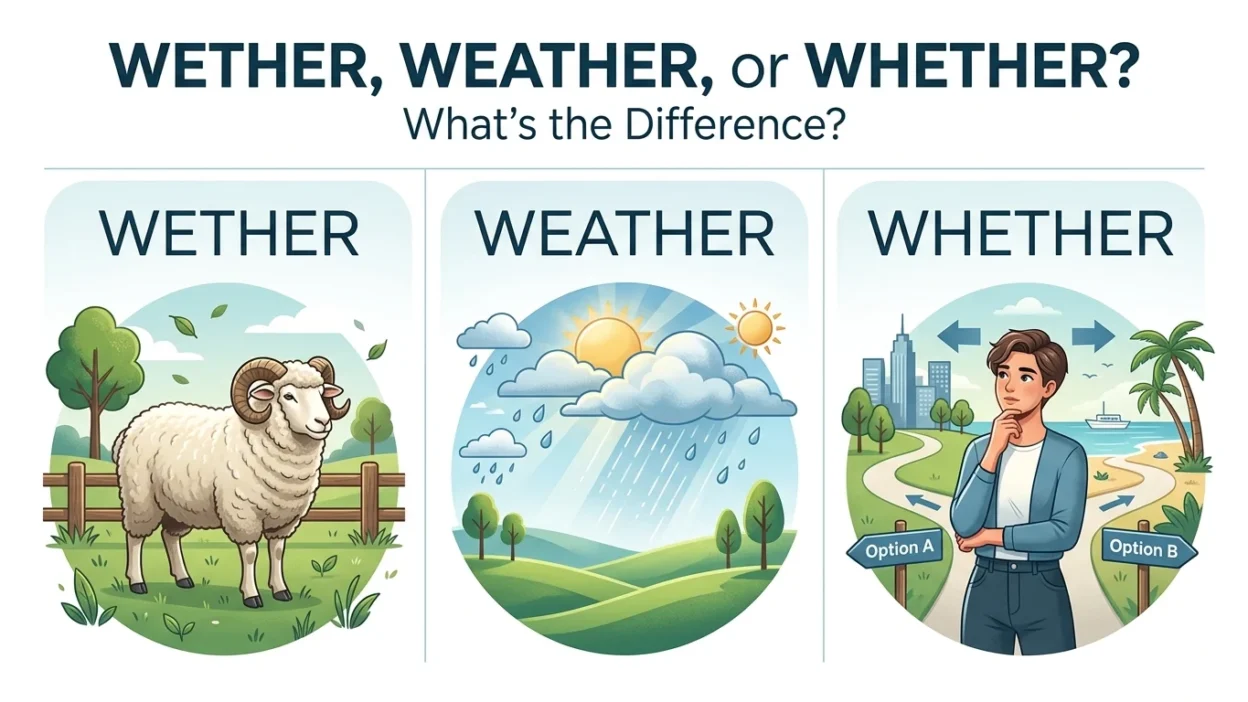
English has many words that sound exactly the same but have completely different meanings and spellings. Wether, weather, and whether are three such words. They are pronounced alike in standard English, but they cannot be used interchangeably.
Weather refers to conditions in the atmosphere, such as rain, sunshine, wind, or snow. Whether is used when talking about alternatives, choices, or uncertainty, usually meaning “if” or introducing two possibilities. Wether is a much less common word that refers to a castrated male sheep.
Understanding wether or weather or whether is important because confusing these words can change the meaning of a sentence or create a spelling mistake. In everyday writing, you will use weather and whether frequently, while wether is mainly found in agricultural, farming, or animal-related contexts.
Quick Answer
Weather means atmospheric conditions, such as rain or sunshine. Whether introduces alternatives or expresses uncertainty, often meaning “if.” Wether means a castrated male sheep. All three words are pronounced alike, but their meanings and spellings are completely different.
Why Do People Confuse Wether, Weather, and Whether?
The main reason is simple: wether, weather, and whether are homophones. They sound the same but have different spellings and meanings.
For example:
- The weather is cold today. → atmospheric conditions
- I don’t know whether he will come. → uncertainty or alternatives
- The farmer owns a wether. → a castrated male sheep
Because pronunciation does not help distinguish these words, you need to understand their meanings and sentence roles.
What Does “Wether” Mean?
Wether is a noun meaning a castrated male sheep.
It is a specialized agricultural term and is much less common than weather or whether.
Examples of “Wether”
- The farmer bought a young wether.
- The wether was kept with the other sheep.
- The shepherd examined each wether carefully.
- The farm has several wethers in the flock.
If you are not discussing sheep or farming, you probably do not need the word wether.
What Does “Weather” Mean?
Weather refers to the conditions of the atmosphere at a particular place and time.
It can include:
- Rain
- Snow
- Wind
- Sunshine
- Clouds
- Temperature
- Storms
- Humidity
Examples of “Weather”
- The weather is beautiful today.
- What will the weather be like tomorrow?
- We canceled the trip because of bad weather.
- The cold weather lasted for several days.
Weather can also be used as a verb meaning to survive or endure something.
- The building weathered the storm.
- She weathered several difficult challenges.
What Does “Whether” Mean?
Whether is generally a conjunction used to introduce alternatives or express uncertainty.
It often appears when there are two possibilities.
Examples of “Whether”
- I don’t know whether he is coming.
- Tell me whether you agree or disagree.
- We need to decide whether to stay.
- I wonder whether she knows the truth.
Whether is often similar to if, especially when introducing an indirect question.
- I don’t know whether he will come.
- I don’t know if he will come.
However, whether is preferred in certain structures, especially when presenting alternatives.
Wether vs Weather vs Whether: Comparison Table
| Word | Part of Speech | Meaning | Example |
|---|---|---|---|
| Wether | Noun | A castrated male sheep | The farmer has a wether. |
| Weather | Noun/Verb | Atmospheric conditions; to endure | The weather is rainy. |
| Whether | Conjunction | Expresses alternatives or uncertainty | I don’t know whether he agrees. |
When Should You Use Each Word?
Use “Wether” for a Castrated Male Sheep
Choose wether only when you are referring to this specific type of sheep.
Example:
Use “Weather” for Atmospheric Conditions
Use weather when discussing rain, sunshine, temperature, wind, storms, and similar conditions.
Example:
Use “Whether” for Alternatives or Uncertainty
Use whether when discussing possibilities, choices, or uncertainty.
Example:
A useful test is to ask yourself:
Am I talking about sheep, atmospheric conditions, or a choice/possibility?
10+ Examples of Wether, Weather, and Whether
Examples with “Wether”
- The farmer raised a healthy wether.
- The wether stayed with the flock.
- They bought a young wether at the market.
- The shepherd checked the wether carefully.
Examples with “Weather”
- The weather is sunny today.
- We stayed home because of the bad weather.
- The weather forecast predicts rain.
- Cold weather can make driving difficult.
Examples with “Whether”
- I don’t know whether she will attend.
- We must decide whether to go.
- He asked whether I needed help.
- I’m not sure whether this is the right choice.
- She couldn’t decide whether to stay or leave.
Common Mistakes
Mistake 1: Using “Whether” for the Weather
Incorrect:
Correct:
You are talking about atmospheric conditions, so weather is correct.
Mistake 2: Using “Weather” for “Whether”
Incorrect:
Correct:
The sentence expresses uncertainty, so whether is needed.
Mistake 3: Using “Wether” for “Weather”
Incorrect:
Correct:
Wether has nothing to do with rain, temperature, or storms.
Mistake 4: Thinking “Wether” Is Just a Misspelling
Sometimes wether is intentionally spelled this way. It is a real English word referring to a castrated male sheep.
Memory Trick
A simple way to remember these words is:
- Wether = sheep 🐑
- Weather = atmosphere 🌦️
- Whether = choice or uncertainty ❓
You can also remember:
Weather has “heat” in it → think about temperature and atmospheric conditions.
Whether contains “he” → think of a sentence such as “Whether he comes or not.”
American vs British English
There is essentially no spelling difference between American and British English for these three words.
Both varieties use:
- wether for a castrated male sheep
- weather for atmospheric conditions
- whether for alternatives or uncertainty
The pronunciation is also generally the same, although individual speakers and accents can vary.
Similar Words
These words belong to a larger group of commonly confused English words.
Weather and Climate
Weather describes atmospheric conditions over a relatively short period.
Climate describes typical weather patterns over a much longer period.
- The weather is rainy today.
- The region has a warm climate.
Whether and If
Whether and if can sometimes introduce uncertainty.
- I don’t know whether he will come.
- I don’t know if he will come.
However, whether is particularly useful when presenting alternatives:
Wether and Ram
A ram is a male sheep, while a wether is a castrated male sheep.
These terms are related to sheep but do not have the same meaning.
Final Verdict
The difference between wether, weather, and whether is based entirely on meaning.
Wether is a castrated male sheep. Weather describes atmospheric conditions such as rain, wind, and sunshine. Whether is used for alternatives, choices, or uncertainty.
Although all three words sound alike, their meanings are easy to separate once you connect each spelling with its specific use.
FAQs:
Is “wether” a real word?
Yes. Wether is a real English noun meaning a castrated male sheep. It is mainly used in farming and agricultural contexts.
What is the difference between weather and whether?
Weather refers to atmospheric conditions, while whether introduces alternatives or expresses uncertainty.
Are wether, weather, and whether homophones?
Yes. In standard English pronunciation, wether, weather, and whether are generally pronounced the same. They have different meanings and spellings.
Is “whether” the same as “if”?
Sometimes. Whether and if can both be used to introduce uncertainty, but whether is especially appropriate when alternatives are involved.
How do you remember weather vs whether?
Remember weather = atmospheric conditions and whether = choice or uncertainty. If you are talking about rain, sunshine, temperature, or storms, use weather.
Is “wether” related to weather?
No. Despite having the same pronunciation, wether and weather have completely different meanings. Wether refers to a type of sheep.
Which word is most commonly used: wether, weather, or whether?
Weather and whether are both common in everyday English. Wether is much less common because it is a specialized farming term.
Remember This
Wether = a castrated male sheep.
Weather = atmospheric conditions.
Whether = alternatives or uncertainty.
If you remember sheep → wether, sky → weather, choice → whether, you can usually choose the correct spelling easily.
Conclusion
The words wether, weather, and whether sound alike, but they serve very different purposes. Wether is a specialized word for a castrated male sheep, weather describes atmospheric conditions, and whether is used to discuss alternatives or uncertainty.
When writing, focus on the meaning rather than the pronunciation. If you are discussing rain or temperature, choose weather. If you are discussing a possibility or choice, choose whether. If you are talking about a particular type of sheep, wether is the correct word.

David Owen is a passionate writer and communication enthusiast dedicated to helping readers craft charming, witty, and thoughtful replies. Through ReplyCorner, he shares creative response ideas that make conversations engaging and memorable.