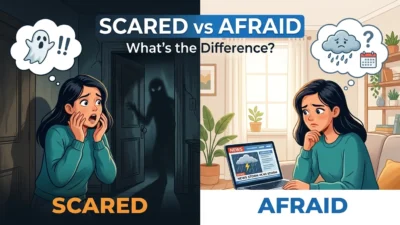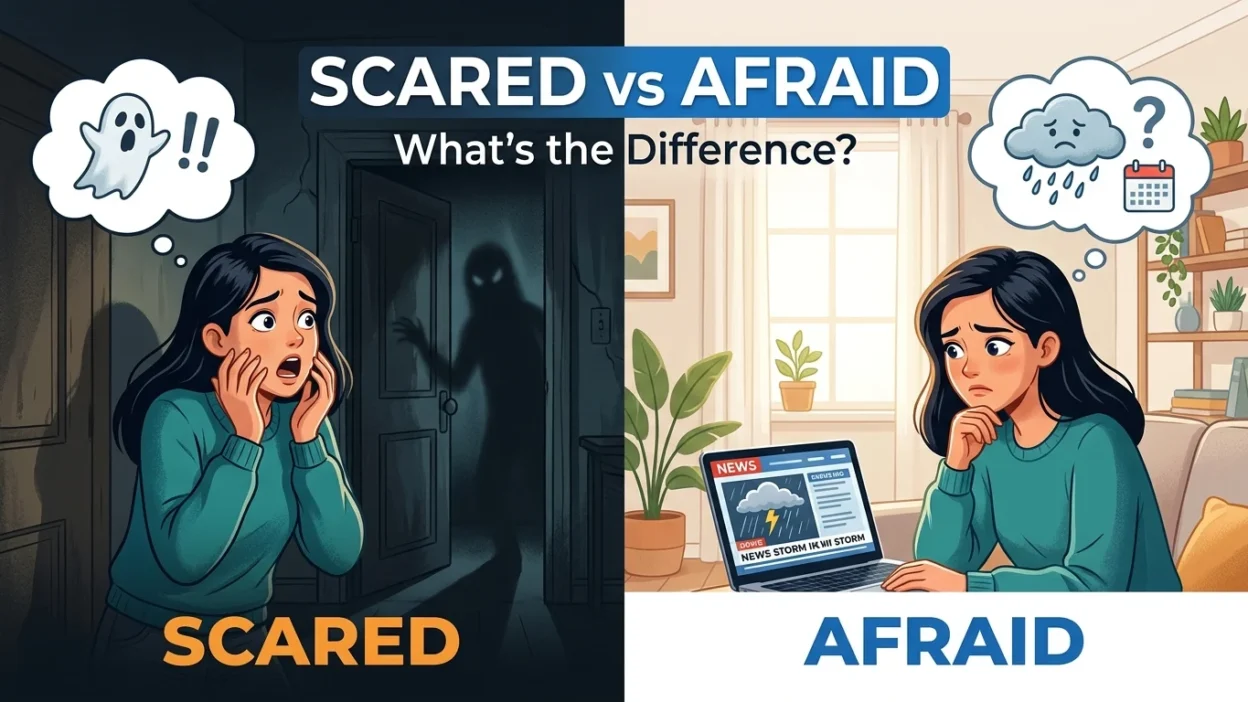
If you are unsure if to say “I’m scared” or “I’m afraid,” you are not alone. Both words describe a feeling of fear and are often interchangeable. For example, “I’m scared of spiders” and “I’m afraid of spiders” are both correct. However, they can differ slightly in tone, context, and meaning.
The main difference is that scared is generally more informal and often sounds more emotional or immediate, while afraid is somewhat more neutral and can also have meanings unrelated to fear. For example, “I’m afraid I can’t help you” is a polite way to give bad news, not an expression of being frightened. Understanding these small differences can help you choose the most natural word in everyday conversations, writing, and formal situations.
Quick Answer
Scared and afraid both mean feeling fear or worry. Scared is more common in casual conversation and often emphasizes an immediate emotional reaction. Afraid is slightly more neutral or formal and can also mean “sorry to say” in expressions such as “I’m afraid I disagree.”
Why Do People Confuse “Scared” and “Afraid”?
People confuse these words because they have almost the same basic meaning: feeling fear.
You can often replace one with the other without changing the main idea:
- I’m scared of dogs.
- I’m afraid of dogs.
Both sentences mean that dogs make you feel fear.
The difference usually becomes clearer when you consider tone and context. “Scared” tends to sound more conversational, while “afraid” can sound more neutral, serious, or polite.
What Does “Scared” Mean?
Scared is an adjective that means feeling frightened, worried, or nervous because something seems dangerous, threatening, or unpleasant.
It is especially common in everyday spoken English.
Examples of “Scared”
- I’m scared of heights.
- She was scared when she heard the noise.
- The child is scared of the dark.
- Don’t be scared.
- He looked scared after the accident.
“Scared” can describe both a temporary reaction and a general fear.
What Does “Afraid” Mean?
Afraid is an adjective meaning frightened, worried, or concerned about something.
It can describe fear just like “scared,” but it has some additional uses.
Examples of “Afraid”
- I’m afraid of flying.
- She was afraid to speak.
- He is afraid of losing his job.
- Don’t be afraid.
- They were afraid that something might go wrong.
“Afraid” can also be used as a polite expression when giving disappointing information:
- I’m afraid we are closed.
- I’m afraid I can’t agree.
- I’m afraid you’re mistaken.
Here, “afraid” does not necessarily mean frightened.
Scared vs Afraid: Comparison Table
| Feature | Scared | Afraid |
|---|---|---|
| Basic meaning | Feeling fear | Feeling fear |
| Tone | Informal and conversational | Neutral, sometimes more formal |
| Common in speech | Very common | Very common |
| Describes immediate fear | Yes | Yes |
| Describes general fear | Yes | Yes |
| Can introduce bad news | Usually no | Yes |
| Can mean “reluctant” | Sometimes in context | Yes, in some constructions |
| Example | I’m scared of dogs. | I’m afraid of dogs. |
When Should You Use “Scared”?
Use scared when you are talking naturally about fear, especially in casual conversation.
Use “scared” for:
- Immediate emotional reactions
- Everyday conversations
- Children’s speech
- Casual descriptions of fear
- Situations where something frightened you
For example:
“I was scared when I heard the explosion.”
This sounds very natural in everyday English.
You can also use scared of + noun:
- I’m scared of spiders.
- She’s scared of water.
- He’s scared of heights.
Or scared to + verb:
- I’m scared to ask.
- She was scared to go outside.
- He is scared to tell the truth.
When Should You Use “Afraid”?
Use afraid when you want a neutral way to describe fear or when the word is part of an expression with another meaning.
Use “afraid” for:
- General or personal fears
- More neutral or serious contexts
- Formal or polite expressions
- Saying that you expect something bad
- Politely refusing or disagreeing
Examples:
- I’m afraid of flying.
- She is afraid to ask questions.
- I’m afraid something went wrong.
- I’m afraid I can’t come.
- I’m afraid that we may be late.
Scared vs Afraid: 12 Examples
1. Fear of animals
I’m scared of dogs.
I’m afraid of dogs.
Both are correct.
2. A sudden noise
She was scared when she heard the noise.
This sounds especially natural because it describes an immediate emotional reaction.
3. Fear of heights
He is afraid of heights.
He is scared of heights.
Both are natural.
4. Being frightened at night
The child was scared of the dark.
This is a very common everyday expression.
5. Fear of asking a question
I’m afraid to ask him.
I’m scared to ask him.
Both work, although “scared” sounds more conversational.
6. Expecting a problem
I’m afraid that we might be late.
Here, “afraid” can express worry or concern rather than direct physical fear.
7. Politely giving bad news
I’m afraid we have no tables available.
This is a polite expression. The speaker does not necessarily feel frightened.
8. Politely disagreeing
I’m afraid I disagree with you.
Again, “afraid” means something like “I’m sorry, but…”
9. Fear of failure
She’s afraid of failing the exam.
You can also say:
She’s scared of failing the exam.
10. A frightening movie
That movie scared me.
This sentence uses scared as part of the verb phrase “scared me.”
11. Fear of the future
He is afraid of what might happen.
This emphasizes worry about a possible future situation.
12. A dangerous situation
They were scared when the car suddenly stopped.
“Scared” works naturally for an immediate emotional reaction.
Common Mistakes
Mistake 1: Thinking only “scared” means frightened
Both words can describe fear.
❌ I’m scared of spiders, so I cannot say “I’m afraid of spiders.”
✅ I’m scared of spiders.
✅ I’m afraid of spiders.
Mistake 2: Assuming “afraid” always means frightened
Not always.
“I’m afraid I can’t help you” is usually a polite way of saying “Unfortunately, I can’t help you.”
Mistake 3: Using “afraid” and “scared” in every expression interchangeably
They are not always interchangeable.
For example:
I’m afraid I disagree. ✅
This is a natural polite expression.
I’m scared I disagree. ❌/unnatural in this meaning.
Mistake 4: Confusing “scared of” and “scared to”
Both can be correct, but their structures differ.
- I’m scared of dogs.
- I’m scared to touch the dog.
Similarly:
- I’m afraid of dogs.
- I’m afraid to touch the dog.
Memory Trick
Think of it this way:
Scared = everyday feeling of fear.
Afraid = fear, worry, or a polite way to introduce bad news.
A simple shortcut is:
When you are talking casually about something frightening, scared is often the easiest choice.
American vs British English
Both scared and afraid are standard in American and British English.
There is no major difference in meaning between the two varieties of English.
For example, both American and British speakers can naturally say:
- I’m scared of heights.
- I’m afraid of heights.
- She was scared.
- She was afraid.
- I’m afraid I can’t come.
Your choice usually depends more on tone, context, and personal preference than on if you are speaking American or British English.
Similar Words
Several other words are related to scared and afraid, but they are not always exact substitutes.
Frightened
Frightened means feeling fear and is very close to “scared.”
- The child was frightened by the noise.
It can sound slightly more formal than “scared.”
Terrified
Terrified means extremely frightened.
- She was terrified during the storm.
It is stronger than “scared” or “afraid.”
Nervous
Nervous usually describes worry or anxiety, especially before something happens.
- I’m nervous about my interview.
You are not necessarily frightened.
Worried
Worried means concerned about a possible problem.
- I’m worried about my exam.
Again, this does not necessarily mean fear.
Fearful
Fearful means experiencing or showing fear and can sound more formal or literary.
- He was fearful of the consequences.
Final Verdict: Scared vs Afraid
Scared and afraid are both correct when you want to talk about fear.
Choose scared for casual, everyday situations and immediate emotional reactions. Choose afraid when you want a neutral expression of fear, worry, or concern—or when using expressions such as “I’m afraid I can’t” or “I’m afraid I disagree.”
In many sentences, either word works naturally:
The meaning is essentially the same.
FAQs:
Is “scared” and “afraid” the same thing?
They are very similar. Both can mean feeling fear. However, “scared” is generally more conversational, while “afraid” has additional uses, including polite expressions such as “I’m afraid I can’t.”
Is it better to say “scared” or “afraid”?
Neither is always better. Use scared for casual conversations and emotional reactions. Use afraid when you want a neutral or slightly more formal expression, or when using special phrases such as “I’m afraid that…”
Is “I am scared” grammatically correct?
Yes. “I am scared” is completely correct. It means that you currently feel frightened or worried.
Is “I am afraid” grammatically correct?
Yes. “I am afraid” can mean “I feel fear.” It can also be used in polite expressions, depending on the context.
Can I say “I’m scared of” and “I’m afraid of”?
Yes. Both structures are correct.
- I’m scared of snakes.
- I’m afraid of snakes.
Is “afraid” more formal than “scared”?
Generally, afraid can sound more neutral or formal, while scared often sounds more casual and conversational. The difference is one of tone rather than strict grammar.
What is stronger: scared or afraid?
Neither word is inherently stronger. If you want to express extreme fear, words such as terrified or petrified are stronger.
Remember This
- Scared = feeling fear, especially in casual or emotional situations.
- Afraid = feeling fear, worry, or concern.
- Both can be followed by of: scared of / afraid of.
- Both can be followed by to + verb: scared to / afraid to.
- Afraid can introduce bad news: I’m afraid we’re late.
- Afraid can politely express disagreement: I’m afraid I disagree.
- Terrified is stronger than both.
Conclusion
The difference between scared and afraid is usually small because both words describe fear. In everyday conversation, scared often feels more natural and emotional, while afraid can sound more neutral. In many situations, either word is completely correct.
The important point is to pay attention to context. Use scared when describing an everyday frightening experience, and remember that afraid has additional uses for expressing worry or politely delivering bad news. Once you understand these patterns, choosing between the two becomes much easier.

John Leo is a skilled writer and communication enthusiast who specializes in crafting charming, witty, and thoughtful replies. Through ReplyCorner, he helps readers improve conversations with creative responses for everyday social interactions.