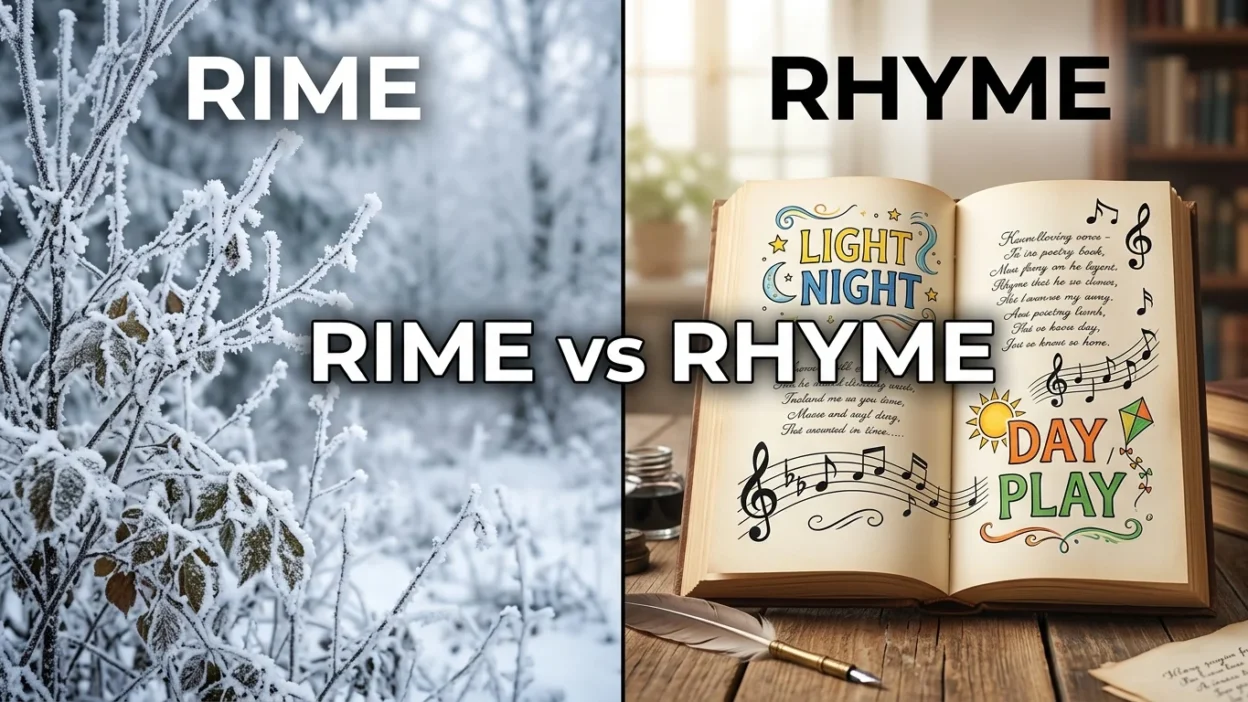
If you are confused by rime vs rhyme, you are not alone. The two words sound exactly alike, but they have different meanings and are used in very different contexts. Rime usually refers to a white, icy coating that forms on cold surfaces, while rhyme refers to words that have matching or similar ending sounds, especially in poetry and songs. In some older or specialized contexts, rime can also be used as a variant spelling related to poetry, but rhyme is the standard modern spelling for that meaning.
Understanding the difference between these homophones can help you avoid spelling mistakes in writing. If you are describing a frosty winter morning or talking about a poem, song, or nursery rhyme, choosing the correct word makes your meaning clear. Let’s look at rime vs rhyme in detail with simple definitions, examples, common mistakes, and an easy memory trick.
Quick Answer
Rime usually means a thin coating of frost or ice that forms on objects in cold conditions. Rhyme means a similarity between sounds, especially at the ends of words, and is commonly used in poetry, songs, and verses. Although they sound the same, their meanings and spellings are different.
Why Do People Confuse Rime and Rhyme?
People confuse rime and rhyme because they are pronounced the same in standard English. Both are generally pronounced like “rime” /raɪm/.
The difference is in their spelling and meaning:
- Rime → frost or ice
- Rhyme → matching sounds in words or poetry
The extra h in rhyme can make the spelling confusing, particularly for English learners.
What Does “Rime” Mean?
Rime is a thin layer of frost or ice that forms on exposed surfaces when water vapor freezes.
It can form on:
- Trees
- Grass
- Roads
- Windows
- Roofs
- Rocks
- Aircraft surfaces
Examples of “Rime”
- The trees were covered with rime after the freezing night.
- A layer of rime covered the branches.
- The hikers noticed thick rime on the rocks.
- The aircraft’s wings had accumulated rime ice.
In weather-related writing, you may also see the expression rime ice, especially when discussing ice formation on objects.
What Does “Rhyme” Mean?
Rhyme refers to words that have the same or similar ending sounds.
For example:
- cat / hat
- light / night
- blue / true
- day / play
The word can also refer to a poem or verse that uses rhyming words.
Examples of “Rhyme”
- The poem uses a simple rhyme scheme.
- “Moon” and “soon” rhyme.
- Children often enjoy songs that rhyme.
- Can you think of a word that rhymes with “cake”?
Rime vs Rhyme: Comparison Table
| Word | Meaning | Common Context | Example |
|---|---|---|---|
| Rime | A coating of frost or ice | Weather and nature | Rime covered the trees. |
| Rhyme | Similar or matching sounds | Poetry, songs, language | “Day” rhymes with “play.” |
| Rime | An older/variant spelling connected with verse | Historical or literary usage | The old text used “rime.” |
| Rhyme | A word or pattern involving matching sounds | Poetry and writing | The poem has a regular rhyme. |
When Should You Use “Rime”?
Use rime when you are talking about frost or ice, particularly a frozen coating that develops on exposed surfaces.
Use “rime” for:
- Frost-covered trees
- Frozen branches
- Ice-covered surfaces
- Weather descriptions
- Certain aviation or meteorological contexts
Example:
Here, rime refers to the frozen coating.
When Should You Use “Rhyme”?
Use rhyme when talking about similar sounds, poetry, songs, or verses.
Use “rhyme” for:
- Poems
- Songs
- Nursery rhymes
- Rhyming words
- Rhyme schemes
- Words with matching sounds
Example:
Here, rhyme describes the similarity between the sounds of the words.
12 Examples of Rime and Rhyme
Examples with “Rime”
- A thick layer of rime covered the fence.
- The branches were white with rime.
- The cold air caused rime to form on the trees.
- The mountain was covered in rime.
- We woke up to a landscape covered with rime.
- The aircraft experienced rime ice during the flight.
Examples with “Rhyme”
- “House” and “mouse” rhyme.
- The children learned a new rhyme at school.
- The poet used rhyme throughout the poem.
- “Star” and “far” rhyme.
- This song has a catchy rhyme.
- Can you find a word that rhymes with “tree”?
Common Mistakes with Rime and Rhyme
Mistake 1: Using “rime” for poetry
Incorrect:
Standard modern English:
Mistake 2: Using “rhyme” for frost
Incorrect:
Correct:
Mistake 3: Assuming “rime” is always wrong
Rime is a real English word. It is not simply a misspelling of rhyme. Its ordinary modern meaning is associated with frost or ice.
It can also appear as an older or variant spelling connected with poetry, although rhyme is the normal spelling for that meaning today.
Memory Trick for Rime vs Rhyme
A simple way to remember the difference is:
Rime = ice.
Think of rime as something you might see on a cold winter morning.
Rhyme = words.
Think of rhyme as something you hear in poems and songs.
You can remember:
The extra h in rhyme can remind you of “hear”, because rhymes involve sounds that you hear.
Rime vs Rhyme in American and British English
The distinction between rime and rhyme is essentially the same in both American and British English.
Both varieties use:
- rime for a coating of frost or ice
- rhyme for matching sounds in poetry and language
Rhyme is the standard modern spelling when discussing poetry, while rime may occur in older literary texts or specialized terminology.
So you do not normally need to choose one spelling based on if you are writing American or British English.
Similar Words to Rime and Rhyme
Several related words can help you understand the distinction.
Words Related to “Rime”
- Frost
- Ice
- Hoarfrost
- Frozen coating
- Ice formation
- Frosting
Words Related to “Rhyme”
- Verse
- Poetry
- Poem
- Rhythm
- Meter
- Rhyme scheme
- Rhyming
Be careful with rhythm. Although it is closely associated with poetry and rhyme, rhythm refers to a pattern of beats or stresses, not simply matching word endings.
Final Verdict: Rime or Rhyme?
The correct choice depends on what you mean.
Use rime when you mean a coating of frost or ice:
Use rhyme when you mean matching or similar sounds in words, especially in poetry:
Although both words sound alike, they are not interchangeable in ordinary modern English.
FAQs:
Is “rime” a correct word?
Yes. Rime is a correct English word. It commonly refers to a coating of frost or ice that forms on surfaces in cold conditions.
Is “rime” another spelling of “rhyme”?
Historically, rime has been used as a spelling associated with verse and poetry. However, rhyme is the standard modern spelling for the poetic meaning.
Do “rime” and “rhyme” sound the same?
Yes. In standard English pronunciation, rime and rhyme are homophones, meaning they sound the same but have different spellings and meanings.
What is the difference between rime and rhyme?
Rime usually means a coating of frost or ice. Rhyme refers to matching or similar sounds between words, especially in poetry and songs.
Is “rhyme” only used in poetry?
No. Rhyme can be used in songs, advertisements, jokes, children’s language, spoken verse, and everyday discussions about words that have similar ending sounds.
What is an example of rime?
Here, rime means a frozen coating.
What is an example of rhyme?
Here, rhyme describes the similarity between the words’ ending sounds.
What is the easiest way to remember rime and rhyme?
Remember rime = frost and rhyme = poetry. If you are talking about ice, use rime. If you are talking about matching sounds, use rhyme.
Remember This
- Rime = frost or ice
- Rhyme = matching or similar sounds
- Rime and rhyme sound the same.
- Rhyme is the normal modern spelling for the poetic meaning.
- Rime can also appear as an older literary spelling or in specialized terms such as rime ice.
Conclusion
The difference between rime vs rhyme is mainly a difference in meaning and spelling. Rime normally describes a thin coating of frost or ice, while rhyme describes matching or similar sounds, especially in poems, songs, and verses. Because they are pronounced alike, they are easy to confuse when writing.
When you need a quick reminder, think “rime is frozen” and “rhyme is poetic.” If you are describing icy branches on a winter morning, choose rime. If you are talking about words such as light and night, choose rhyme.