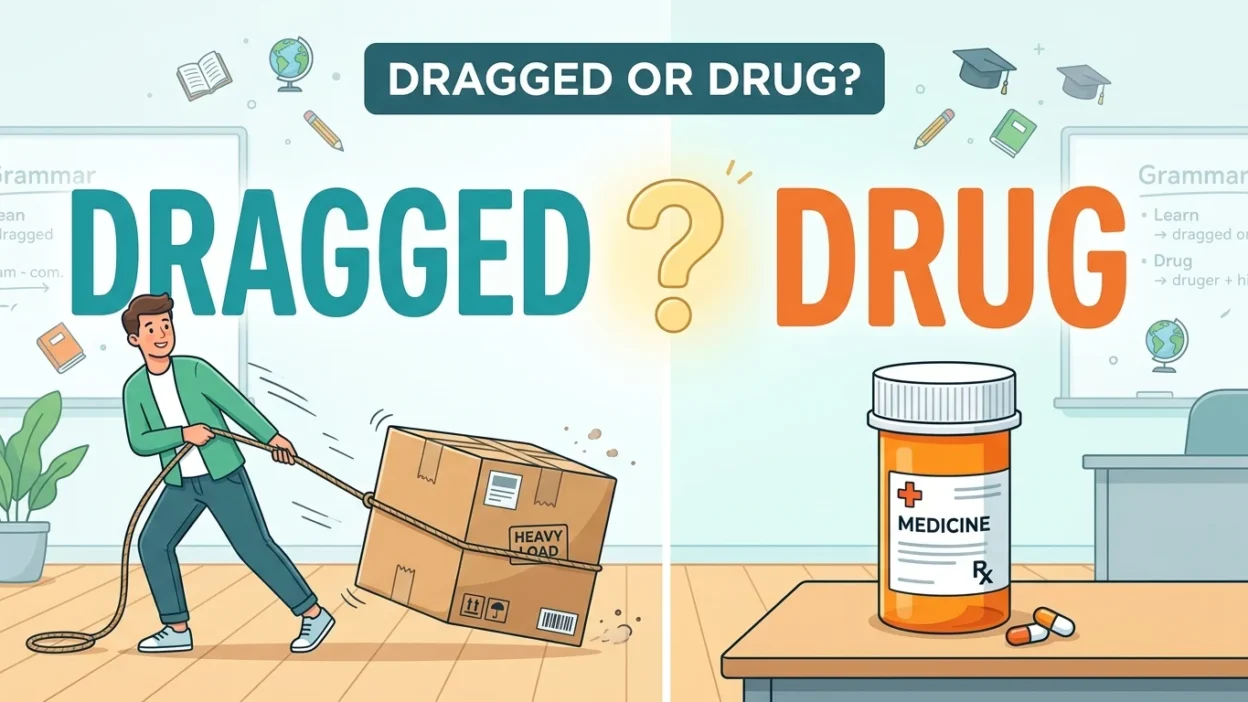
If you are wondering if the correct past tense is dragged or drug, the answer is dragged. The verb drag is a regular verb, so its simple past tense and past participle are both dragged. For example, “She dragged the chair across the room.” Drug is not the standard past tense of drag in formal standard English, although it may appear in some dialects or informal speech.
This confusion often happens because many English verbs have irregular past forms, such as run → ran and sing → sang. However, drag follows the regular pattern of adding -ed, with a spelling change that produces dragged. Learning this pattern can help you avoid a common mistake in writing and everyday communication.
Quick Answer: Dragged or Drug?
Dragged is the standard past tense and past participle of drag. Use dragged when you mean that someone or something was pulled along a surface. Drug is not the standard form in formal English, although it can occur in some regional or nonstandard varieties.
Correct: “He dragged the box.”
Incorrect in standard English: “He drug the box.”
Why Do People Confuse “Dragged” and “Drug”?
People often confuse these words because drug looks like the past tense of an English verb.
For example:
- drag → dragged
- run → ran
- swim → swam
- sing → sang
- drink → drank
Because some common verbs change their vowels in the past tense, learners may assume that drag changes from a to u.
However, drag is a regular verb, so its past form is created with -ed.
What Does “Dragged” Mean?
Dragged is the past tense and past participle of drag.
To drag something means to pull it along a surface, usually with some effort.
Examples
- She dragged the suitcase across the floor.
- He dragged the heavy chair outside.
- The child dragged the blanket behind him.
- They dragged the table into the kitchen.
The word can also be used figuratively.
- The meeting dragged on for hours.
- He dragged the conversation out unnecessarily.
What Does “Drug” Mean?
In standard English, drug is generally not the past tense of drag.
Instead, drug is most commonly a noun referring to a substance used as medicine or another chemical substance.
Examples
- The doctor prescribed a new drug.
- Some drugs require a prescription.
- The researchers tested the drug carefully.
Drug is also the simple past and past participle of the verb drug in some contexts, meaning to administer a drug, but this use is much less common than the noun.
Also, in some regional varieties of English, particularly certain American dialects, drug can be heard as a nonstandard past tense of drag. In formal standard English, however, dragged is the appropriate form.
Dragged vs Drug: Comparison Table
| Word | Standard use | Part of speech | Example |
|---|---|---|---|
| dragged | Past tense of drag | Verb | She dragged the box outside. |
| dragged | Past participle of drag | Verb | The chair was dragged across the room. |
| drug | Medicine or chemical substance | Noun | The doctor prescribed a drug. |
| drug | Past form of drug in some uses | Verb | The animal was drugged before surgery. |
| drug | Regional/nonstandard past of drag | Verb | He drug the chair across the floor. |
When Should You Use “Dragged”?
Use dragged whenever you need the past tense or past participle of drag in standard English.
Use “dragged” for physical movement
- She dragged the suitcase upstairs.
- He dragged the chair toward the door.
- They dragged the broken table outside.
Use “dragged” for figurative meanings
- The class dragged on all afternoon.
- The conversation dragged without any clear purpose.
- The project dragged into the following month.
When Should You Use “Drug”?
Use drug primarily as a noun when talking about medicine or another chemical substance.
Examples
- The drug helped reduce his symptoms.
- The company developed a new drug.
- The doctor explained how the drug works.
Do not normally use drug as the past tense of drag in formal or standard English.
10+ Examples of “Dragged”
- She dragged the suitcase across the airport floor.
- He dragged the heavy box into the garage.
- The dog dragged its toy across the room.
- They dragged the table toward the window.
- I dragged the chair closer to the desk.
- She dragged her feet through the wet grass.
- The workers dragged the equipment outside.
- He dragged the broken branch away from the road.
- The child dragged the blanket behind her.
- We dragged the old sofa into the hallway.
- The meeting dragged on longer than expected.
- The movie dragged during the final hour.
Common Mistakes With “Dragged” and “Drug”
Mistake 1: Using “drug” as the past tense of “drag”
Incorrect in standard English:
“He drug the suitcase across the floor.”
Correct:
“He dragged the suitcase across the floor.”
Mistake 2: Treating “drag” like “run”
Some learners think:
- run → ran
- drag → drug
But these verbs follow different patterns.
Run is irregular, while drag is regular.
Mistake 3: Confusing “drug” with “dragged”
Remember that drug commonly refers to a medicine or chemical substance.
- The doctor prescribed a drug.
- She dragged the suitcase.
The meanings are completely different in standard English.
A Simple Memory Trick
Remember:
Think of the word dragged as drag + ged.
You can also remember:
“You drag something, and you dragged it yesterday.”
For example:
- Today: I drag the box.
- Yesterday: I dragged the box.
American vs British English
In both standard American English and British English, dragged is the standard past tense and past participle of drag.
You may encounter drug as a past form of drag in some regional American speech or informal usage. This does not make it the standard form for formal writing.
For schoolwork, professional writing, exams, and other formal contexts, use dragged.
Similar Words
Understanding a few related verb forms can make the distinction easier.
Drag
Drag is the base form.
- Please drag the chair over here.
Drags
Drags is the third-person singular present form.
- He drags the box across the floor.
Dragged
Dragged is the simple past and past participle.
- She dragged the suitcase upstairs.
- The table was dragged across the room.
Dragging
Dragging is the present participle or gerund.
- He is dragging the chair.
- Dragging the box was difficult.
Final Verdict: Dragged or Drug?
The correct standard English past tense of drag is dragged.
Use:
- drag — present
- drags — third-person singular present
- dragged — past tense
- dragged — past participle
- dragging — present participle
Use drug primarily as a noun meaning a medicine or chemical substance. Although drug may be heard as a regional past tense of drag, dragged is the appropriate choice in standard English.
FAQs:
Is “drug” the past tense of “drag”?
Not in standard English. The standard past tense of drag is dragged. Drug may occur as a regional or nonstandard past form in some varieties of English.
Is it “I dragged the box” or “I drug the box”?
“I dragged the box” is the standard English form.
Why do people say “drug” instead of “dragged”?
Some regional varieties of English use drug as a past form of drag. It can therefore be heard in informal speech, but dragged is the standard form for formal English.
Is “dragged” a regular verb?
Yes. Drag is a regular verb, and its past tense and past participle are dragged.
What is the past participle of “drag”?
The past participle is dragged.
Example: “The heavy table was dragged across the floor.”
What is the difference between “drug” and “dragged”?
Dragged is the standard past form of drag. Drug is most commonly a noun referring to a medicine or chemical substance.
Is “drug” acceptable in American English?
It can occur in some regional American varieties as a past form of drag, but dragged is the standard form used in formal American English.
Remember This
Drag → dragged
If you are talking about pulling something along a surface, use dragged for the past tense.
Correct: “She dragged the chair.”
Standard: “He dragged the suitcase.”
Not standard: “She drug the chair.”
When in doubt, choose dragged.
Conclusion
The difference between dragged and drug is mainly a matter of verb form and standard usage. Dragged is the correct standard past tense and past participle of drag, while drug is most commonly used as a noun for medicine or another chemical substance. Although some speakers use drug as a regional past tense of drag, it is not the preferred form in standard English.
The easiest rule is simple: drag → dragged. If you are writing an email, completing an assignment, taking an English test, or communicating professionally, dragged is the safe and standard choice when describing something that was pulled along a surface.

David Owen is a passionate writer and communication enthusiast dedicated to helping readers craft charming, witty, and thoughtful replies. Through ReplyCorner, he shares creative response ideas that make conversations engaging and memorable.