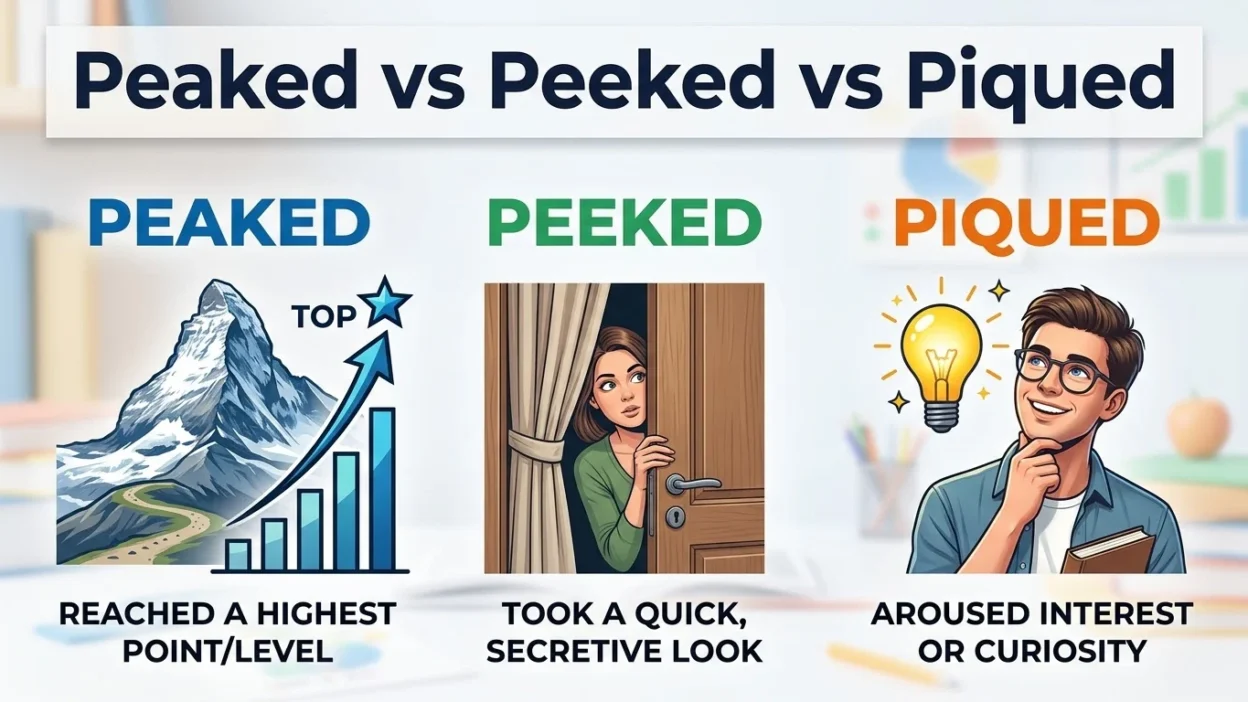
If you have ever wondered if something peaked your interest, peeked your interest, or piqued your interest, you are not alone. These three words sound almost identical, but they have completely different meanings and uses. Peaked relates to reaching a highest point, peeked means taking a quick or secret look, and piqued means stimulated or aroused someone’s interest or curiosity. The correct phrase is “piqued my interest,” not “peaked my interest” or “peeked my interest.”
Understanding peaked vs peeked vs piqued becomes much easier when you connect each spelling with its meaning. Although they are homophones in many varieties of English, their meanings, grammatical uses, and contexts are different. This guide explains each word in simple English, shows how to use them correctly, and gives practical examples so you can avoid common mistakes.
Quick Answer
Peaked means reached the highest point, peeked means took a quick look, and piqued means aroused interest, curiosity, or attention. For example, “Sales peaked in July,” “She peeked through the door,” and “The article piqued my curiosity.” Remember: piqued my interest is the correct expression.
Why Do People Confuse Peaked, Peeked, and Piqued?
The main reason people confuse these words is pronunciation. In many English accents, peaked, peeked, and piqued sound exactly the same or very similar.
However, their meanings are completely different:
- Peaked → reached a highest point
- Peeked → looked quickly or secretly
- Piqued → stimulated interest or curiosity
They are also spelled differently because they come from different words and have different meanings.
What Does “Peaked” Mean?
Peaked is the past tense and past participle of peak. It means reached the highest, greatest, or most successful point.
You can use peaked when talking about numbers, popularity, performance, activity, emotions, or other things that can rise and then reach a maximum.
Examples of “Peaked”
- The company’s profits peaked in December.
- Her popularity peaked after the movie was released.
- Temperatures peaked at 40°C yesterday.
- The singer’s career peaked in the early 2000s.
There is also an adjective peaked meaning looking pale, tired, or unhealthy, especially in British English.
Example:
“She looked a little peaked after being sick.”
What Does “Peeked” Mean?
Peeked is the past tense of peek. It means looked quickly, briefly, or secretly.
A person might peek through a window, peek inside a box, or peek at someone’s screen.
Examples of “Peeked”
- She peeked through the curtains.
- I peeked inside the package before giving it to him.
- He peeked at the answers during the test.
- The child peeked around the corner.
A useful way to remember peeked is to associate it with seeing or looking.
What Does “Piqued” Mean?
Piqued is the past tense of pique, a verb meaning to stimulate, arouse, or increase someone’s interest, curiosity, or attention.
The most common expression is:w
You can also say:
- piqued my curiosity
- piqued her interest
- piqued his attention
- piqued their curiosity
Examples of “Piqued”
- The mysterious story piqued my interest.
- Her unusual answer piqued his curiosity.
- The headline piqued my interest.
- The strange noise piqued her curiosity.
Peaked vs Peeked vs Piqued: Comparison Table
| Word | Meaning | Common Use | Example |
|---|---|---|---|
| Peaked | Reached the highest point | Performance, numbers, popularity | Sales peaked in June. |
| Peeked | Looked quickly or secretly | Looking at something | She peeked through the door. |
| Piqued | Stimulated interest or curiosity | Interest and curiosity | The story piqued my interest. |
When Should You Use Each Word?
Use “Peaked” for a Highest Point
Use peaked when something reaches its maximum level.
Example:
“Demand for the product peaked during the holiday season.”
Think:
Peak = highest point
Use “Peeked” for Looking
Use peeked when someone takes a quick, brief, or secret look.
Example:
“He peeked inside the room.”
Think:
Peek = quick look
Use “Piqued” for Interest or Curiosity
Use piqued when something makes someone interested or curious.
Example:
“The unusual photograph piqued my curiosity.”
Think:
Pique = stimulate interest
12 Examples of Peaked, Peeked, and Piqued
- The athlete’s performance peaked during the final round.
- I peeked through the window to see who was outside.
- The mysterious message piqued my curiosity.
- Housing prices peaked last year.
- She peeked at her phone during the meeting.
- The documentary piqued my interest in history.
- His career peaked after winning the award.
- The little boy peeked behind the curtain.
- The strange headline piqued my interest.
- Visitor numbers peaked during the summer.
- She peeked inside the gift box.
- His unusual explanation piqued everyone’s curiosity.
Common Mistakes With Peaked, Peeked, and Piqued
Mistake 1: “Peaked my interest”
❌ The book peaked my interest.
If you mean that the book made you interested, this is incorrect.
✅ The book piqued my interest.
Mistake 2: “Peeked my interest”
❌ The story peeked my interest.
Peeked means looked quickly, so it does not mean stimulated interest.
✅ The story piqued my interest.
Mistake 3: “Piqued at the window”
❌ She piqued through the window.
If you mean she looked quickly through the window, use peeked.
✅ She peeked through the window.
Mistake 4: “Sales piqued in July”
❌ Sales piqued in July.
If you mean sales reached their highest point, use peaked.
✅ Sales peaked in July.
Memory Trick: How Can You Remember the Difference?
Use these three simple associations:
- Peaked = peak = highest point
- Peeked = peek = quick look
- Piqued = pique = interest or curiosity
A simple sentence can help:
“The sales peaked, she peeked, and the mystery piqued her curiosity.”
Each word has a different job.
American vs British English
The meanings and spellings of peaked, peeked, and piqued are generally the same in American and British English.
The main difference worth noting is the adjective peaked. In British English, peaked can describe someone who looks pale, tired, or unwell.
For example:
This use is less common in everyday American English, where speakers may use expressions such as pale, tired, or unwell instead.
Similar Words
Understanding related words can make these distinctions easier:
Words Related to “Peaked”
- reached a maximum
- topped out
- reached a high point
- climaxed
- hit a peak
Words Related to “Peeked”
- glanced
- looked
- peeped
- sneaked a look
- took a quick look
Words Related to “Piqued”
- interested
- intrigued
- fascinated
- attracted attention
- aroused curiosity
Remember that these alternatives are not always interchangeable. The exact choice depends on the sentence.
Final Verdict: Peaked vs Peeked vs Piqued
The three words may sound alike, but they have very different meanings.
Peaked means reached the highest point.
Peeked means looked quickly or secretly.
Piqued means stimulated someone’s interest or curiosity.
If you are talking about interest, the correct expression is “piqued my interest.” If someone takes a quick look, use “peeked.” If something reaches its maximum level, use “peaked.”
FAQs:
Is it “peaked my interest” or “piqued my interest”?
The correct expression is “piqued my interest.” It means something stimulated or increased your interest. For example: “The mysterious title piqued my interest.”
Is it “peeked my interest” or “piqued my interest”?
It is “piqued my interest.” Peeked means looked quickly or secretly, while piqued means stimulated interest or curiosity.
What is the difference between peaked and peeked?
Peaked means reached the highest point, while peeked means looked quickly or secretly. For example, “Sales peaked in June” and “She peeked through the door.”
What does “piqued my curiosity” mean?
“Piqued my curiosity” means made me curious or increased my desire to know more.
Are peaked, peeked, and piqued pronounced the same?
In many English accents, they are pronounced the same or nearly the same. Their different spellings and meanings distinguish them in writing.
Can “peaked” describe a person?
Yes. In particular, peaked can describe someone who looks pale, tired, or unwell, especially in British English.
Is “piqued” always used with interest?
No. Piqued can be used with words such as interest and curiosity, but the broader meaning is to stimulate or arouse someone’s interest, attention, or curiosity.
Remember This
Peaked = highest point
Peeked = quick look
Piqued = interest or curiosity
When you mean that something made you interested, always remember:
“It piqued my interest.”
Conclusion
Although peaked, peeked, and piqued sound very similar, they should not be used interchangeably. Peaked describes reaching a highest point, peeked describes taking a quick look, and piqued describes stimulating interest or curiosity.
The easiest way to remember them is to connect each spelling with its meaning: peak = highest point, peek = look, and pique = interest. Once you learn these three associations, choosing the correct word becomes much easier in both everyday writing and formal English.

David Owen is a passionate writer and communication enthusiast dedicated to helping readers craft charming, witty, and thoughtful replies. Through ReplyCorner, he shares creative response ideas that make conversations engaging and memorable.