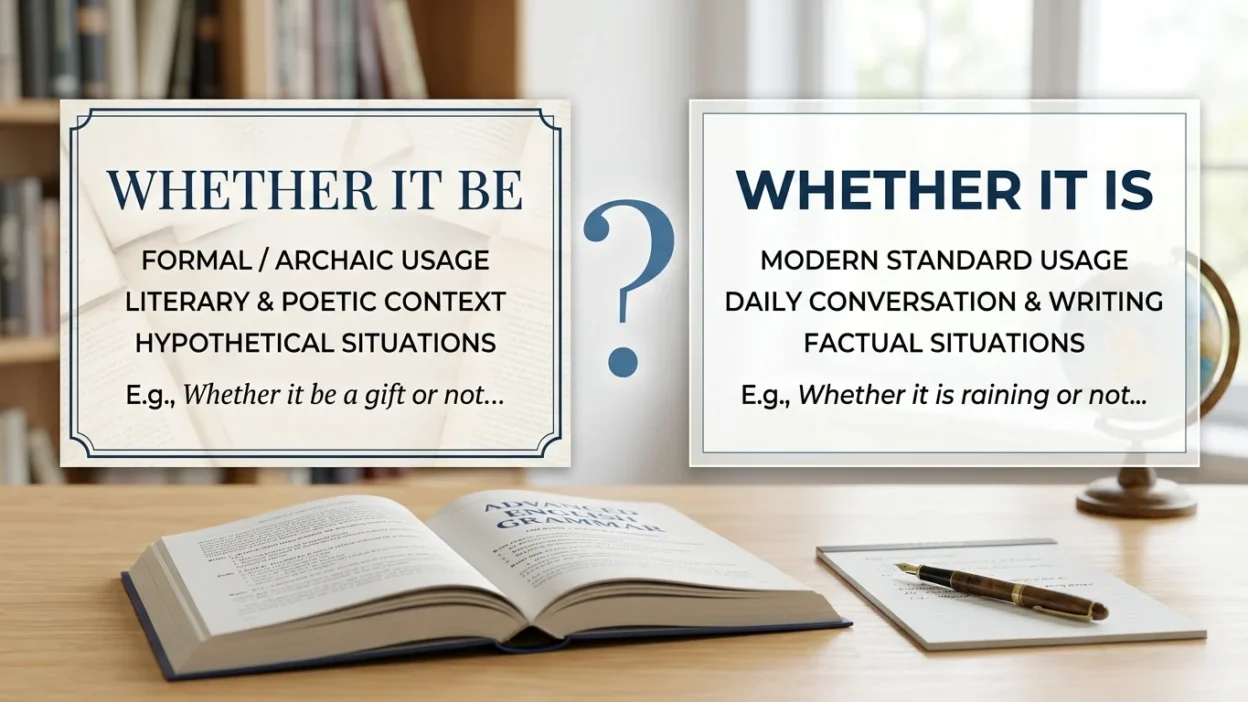
The expressions “whether it be” and “whether it is” are both grammatically possible, but they are used in different ways. “If it is” is the normal, everyday form used to discuss a real or possible situation. “if it be” is more formal, literary, or traditional and commonly appears in structures such as “whether it be X or Y.” Understanding this difference can help you choose the natural expression for conversations, essays, emails, and formal writing.
The key difference comes from the verb “be.” In “whether it is,” is is the present-tense form of be. In “whether it be,” be is the base/subjunctive form. Although “whether it be” may sound unusual in modern everyday English, it remains correct in certain constructions. The choice depends mainly on the grammatical structure and the level of formality you want.
Quick Answer
“Whether it is” is the standard choice for most everyday and modern formal writing. “Whether it be” is also grammatical but sounds more formal, literary, or traditional. Use “whether it be” especially in patterns such as “whether it be X or Y” when presenting alternatives.
Why Do People Confuse “Whether It Be” and “Whether It Is”?
The confusion happens because both expressions can introduce alternatives or possibilities.
For example:
- I don’t know whether it is true.
- I don’t know whether it be true.
The first sentence sounds natural in modern English. The second sounds old-fashioned or literary in this context.
However, “whether it be” has a legitimate use in expressions such as:
Here, be helps create a formal whether…or… construction.
First Word: “Whether”
Whether introduces two or more possibilities or alternatives.
Examples:
- I don’t know whether he will come.
- She asked whether we needed help.
- Whether you agree or disagree, you should listen.
- We must decide whether to stay or leave.
It is often followed by or, although or is not always necessary.
Second Word: “It Be” and “It Is”
“Whether It Is”
“Whether it is” uses the normal present-tense form of the verb be.
Examples:
- I don’t know whether it is possible.
- Tell me whether it is safe.
- She asked whether it is necessary.
- We need to determine whether it is correct.
This is the natural choice in most modern situations.
“Whether It Be”
“Whether it be” uses the base form be. In this construction, it can function as a subjunctive form.
Examples:
- Whether it be true or false, we should investigate.
- Whether it be summer or winter, the shop remains open.
- Whether it be one person or a hundred, everyone is welcome.
This construction is grammatical but generally more formal or literary.
Whether It Be vs Whether It Is: Comparison Table
| Expression | Grammar | Typical Use | Tone | Example |
|---|---|---|---|---|
| Whether it is | Present indicative | Everyday and standard writing | Natural | I don’t know whether it is true. |
| Whether it be | Subjunctive/base form | Formal alternatives and literary writing | Formal | Whether it be true or false, we should check. |
| Whether it is…or… | Standard alternative structure | General writing and speech | Neutral | Whether it is Monday or Tuesday, I’ll be there. |
| Whether it be…or… | Formal alternative structure | Formal/literary contexts | Formal | Whether it be Monday or Tuesday, the work continues. |
When Should You Use “Whether It Is”?
Use “whether it is” when you are talking about a particular possibility, fact, condition, or situation.
1. For Everyday Conversation
2. For Questions About Facts
3. For Academic Writing
4. For Professional Communication
5. When Referring to a Specific Situation
In most modern contexts, “whether it is” is the safer and more natural choice.
When Should You Use “Whether It Be”?
Use “whether it be” when the sentence presents alternatives in a formal, general, or somewhat literary way.
12 Examples of “Whether It Is”
- I don’t know whether it is true.
- Can you tell me whether it is available?
- We need to decide whether it is necessary.
- She asked whether it is safe.
- I’m unsure whether it is the correct answer.
- They want to know whether it is possible.
- Check whether it is working properly.
- He wondered whether it is worth the cost.
- We need to determine whether it is legal.
- Nobody knows whether it is going to rain.
- Please tell me whether it is suitable.
- The question is whether it is practical.
12 Examples of “Whether It Be”
- Whether it be true or false, we need evidence.
- Whether it be large or small, every contribution helps.
- Whether it be day or night, someone is always working.
- Whether it be at home or abroad, she feels comfortable.
- Whether it be intentional or accidental, the mistake matters.
- Whether it be good news or bad news, tell me honestly.
- Whether it be summer or winter, the mountain is beautiful.
- Whether it be one person or many, everyone deserves respect.
- Whether it be work or study, concentration is important.
- Whether it be a friend or a stranger, treat people kindly.
- Whether it be simple or complicated, we can solve it.
- Whether it be today or tomorrow, the decision must be made.
Common Mistakes
Mistake 1: Using “Whether It Be” Everywhere
Incorrect or unnatural for ordinary modern writing:
Better:
Mistake 2: Assuming “Whether It Be” Is Wrong
“Whether it be” is not automatically incorrect. It can be appropriate in formal whether…or… constructions.
Mistake 3: Confusing “Whether” With “If”
In many contexts, whether and if can overlap, but whether is especially useful when alternatives are involved.
Both can be natural, but whether clearly presents a choice or uncertainty.
Mistake 4: Forgetting the “Or” Structure
When using the formal construction, alternatives often follow:
For example:
A Simple Memory Trick
Remember:
“It is” = normal and modern.
“It be” = formal, literary, or alternative-focused.
If you are unsure which one to use, “whether it is” will usually sound more natural in everyday English.
American vs British English
Both American English and British English recognize “whether it is” and the formal construction “whether it be.”
The main difference is not really American versus British grammar. It is more about style, context, and register.
For modern everyday English in either variety:
For a more formal or literary style:
Similar Words and Structures
Whether
Used to introduce alternatives or uncertainty.
Whether…or…
Used to clearly show alternatives.
If
Often introduces a condition.
Whether or Not
Shows that both possibilities are being considered.
Whether It Is
The standard modern form.
Whether It Be
A formal or literary alternative, especially in whether…or… constructions.
Final Verdict: Which One Should You Use?
For most modern English, choose “whether it is.” It is clear, natural, and appropriate for conversations, emails, academic writing, and professional communication.
Use “whether it be” when you deliberately want a formal, literary, or traditional tone, particularly in a structure presenting alternatives such as “whether it be X or Y.”
FAQs:
Is “whether it be” grammatically correct?
Yes. “Whether it be” is grammatically correct in certain constructions, particularly formal or literary whether…or… structures. It is less common in everyday modern English.
Is “whether it is” correct?
Yes. “Whether it is” is completely correct and is generally the more natural choice in modern English.
Which is more common: “whether it be” or “whether it is”?
“Whether it is” is generally more common in ordinary modern English because it uses the standard present-tense form of be.
Can I use “whether it be” in formal writing?
Yes. It can work well in formal or literary writing, especially when introducing alternatives.
Is “whether it be” old-fashioned?
It can sound formal, literary, or somewhat traditional to modern readers. However, it is still a valid grammatical construction.
Should I say “whether it is true” or “whether it be true”?
For normal modern writing, “whether it is true” is the better choice.
Is “whether it be true or false” correct?
Yes. “Whether it be true or false” is a grammatical formal construction. “Whether it is true or false” is also correct and generally more conversational.
Can “whether it be” and “whether it is” always be exchanged?
No. Although they can sometimes express similar meanings, they have different grammatical structures and stylistic effects. “Whether it is” is the normal form, while “whether it be” has a more formal or literary use.
Remember This
- Whether it is = standard, natural, modern English.
- Whether it be = formal, literary, or traditional English.
- Use “whether it is” when discussing a specific possibility or fact.
- Use “whether it be” especially in formal whether…or… constructions.
- When unsure, “whether it is” is usually the safest choice.
Conclusion
The difference between “whether it be” and “whether it is” is mainly grammatical and stylistic. “If it is” uses the ordinary present-tense form is and is the natural choice for most modern English. “if it be” uses the base/subjunctive form be and is commonly found in formal, literary, or traditional constructions.
If you are writing an everyday sentence such as “I don’t know whether it is true,” use “whether it is.” If you are presenting alternatives in a formal style, such as “Whether it be true or false,” “whether it be” can be appropriate.

John Leo is a skilled writer and communication enthusiast who specializes in crafting charming, witty, and thoughtful replies. Through ReplyCorner, he helps readers improve conversations with creative responses for everyday social interactions.