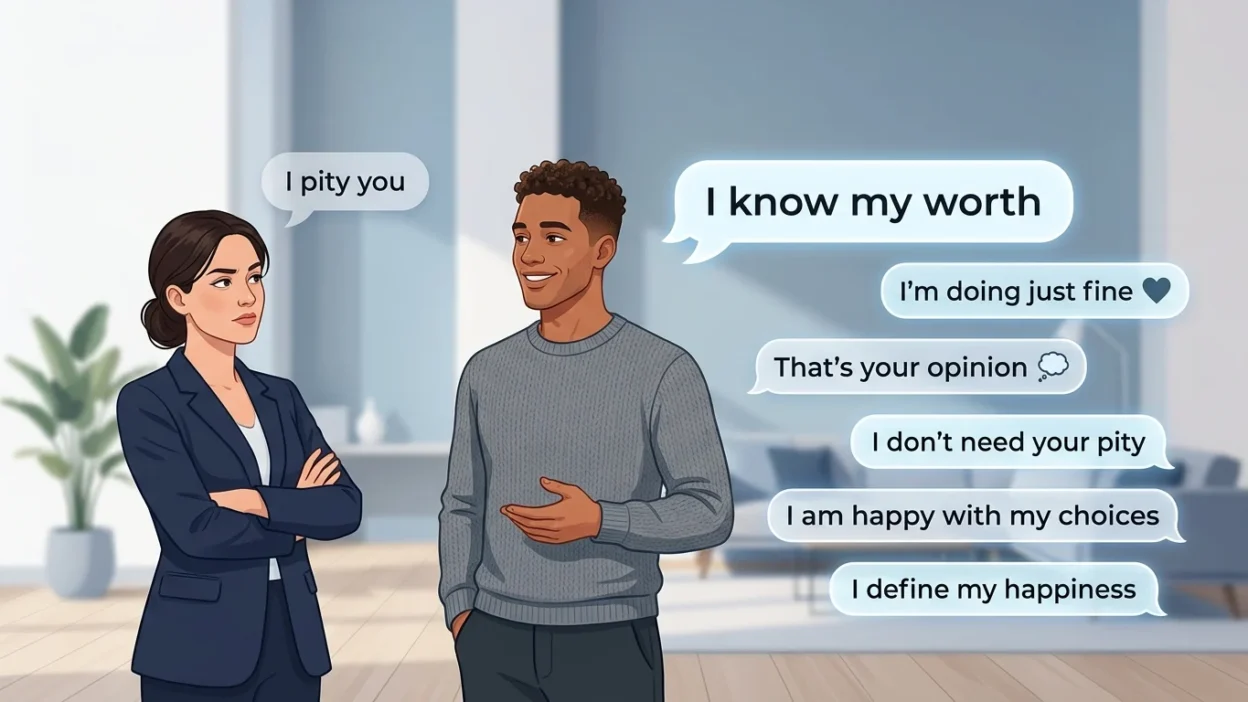
Hearing someone say “I pity you” can feel insulting, dismissive, or even manipulative. Sometimes it’s said during an argument, while other times it’s meant to make you feel inferior. Instead of reacting emotionally, having the right reply can help you stay calm, protect your confidence, and leave a stronger impression.
In this guide, you’ll discover the best replies when someone says I pity you, If you’re looking for witty comebacks, polite responses, sarcastic remarks, or mature ways to end the conversation. These responses are designed to help you stay composed while showing confidence and self-respect.
1. “That’s your opinion, and you’re entitled to it.”
Best for: Staying calm and mature.
Alternative: “Everyone sees things differently.”
Examples:
“That’s your opinion, and you’re entitled to it.”
“I respect your view, even if I don’t share it.”
This reply avoids conflict while showing emotional intelligence.
2. “I’m doing just fine, thanks.”
Best for: Showing confidence.
Alternative: “I appreciate your concern.”
Examples:
“I’m doing just fine, thanks.”
“I don’t need pity, but thanks anyway.”
It sends the message that you’re comfortable with yourself.
3. “Save your pity for someone who needs it.”
Best for: Assertive conversations.
Alternative: “I’ll pass on the sympathy.”
Examples:
“Save your pity for someone who actually needs it.”
“I think someone else could use it more.”
A firm response without sounding overly aggressive.
4. “Confidence looks different from your perspective.”
Best for: Handling judgment.
Alternative: “We’re clearly seeing different things.”
Examples:
“Confidence looks different from your perspective.”
“I guess we have different definitions of success.”
This reminds them that perspectives vary.
5. “I’m happy with my life.”
Best for: Positive attitude.
Alternative: “Life’s going well for me.”
Examples:
“I’m genuinely happy with where I am.”
“My life isn’t perfect, but it’s mine.”
Simple confidence often speaks louder than arguments.
6. “That’s kind of an odd thing to say.”
Best for: Calling out rude behavior.
Alternative: “Why would you say that?”
Examples:
“That’s a strange comment.”
“What made you think that was helpful?”
It shifts attention back to their behavior.
7. “Thanks for sharing.”
Best for: Ending conversations quickly.
Alternative: “Noted.”
Examples:
“Thanks for sharing your opinion.”
“I’ll keep that in mind.”
Short, polite, and difficult to argue with.
8. “I’m not looking for anyone’s pity.”
Best for: Setting boundaries.
Alternative: “I don’t need sympathy.”
Examples:
“I’m doing okay without pity.”
“I’d rather have respect than sympathy.”
Shows healthy self-respect.
9. “Interesting perspective.”
Best for: Neutral responses.
Alternative: “That’s one way to see it.”
Examples:
“Interesting perspective.”
I hadn’t thought of it that way.”
Keeps emotions out of the discussion.
10. “I’m stronger than you think.”
Best for: Showing resilience.
Alternative: “I’ve overcome worse.”
Examples:
“I’m stronger than you realize.”
“I’ve handled bigger challenges.”
Demonstrates quiet confidence.
11. “Don’t worry about me.”
Best for: Deflecting criticism.
Alternative: “I’ll be okay.”
Examples:
“Don’t worry about me.”
“I’ve got things under control.”
Simple and reassuring.
12. “I’m proud of who I am.”
Best for: Self-confidence.
Alternative: “I like the person I’ve become.”
Examples:
“I’m proud of my journey.”
“I wouldn’t trade my experiences.”
Confidence discourages negativity.
13. “That’s generous of you.”
Best for: Light sarcasm.
Alternative: “How thoughtful.”
Examples:
“That’s generous of you.”
“Such kindness.”
Use only when playful sarcasm fits.
14. “I’m not offended.”
Best for: Staying emotionally detached.
Alternative: “Nice try.”
Examples:
“I’m not offended.”
“That doesn’t bother me.”
Shows emotional control.
15. “I’d rather focus on solutions.”
Best for: Workplace discussions.
Alternative: “Let’s move forward.”
Examples:
“I’d rather solve the problem.”
“Let’s focus on what matters.”
Keeps conversations productive.
16. “I don’t define myself by your opinion.”
Best for: Personal confidence.
Alternative: “Your opinion doesn’t define me.”
Examples:
“I know who I am.”
“I’m comfortable with myself.”
A powerful self-respecting reply.
17. “Everyone has challenges.”
Best for: Compassionate responses.
Alternative: “Life isn’t easy for anyone.”
Examples:
“We all face struggles.”
“Everyone’s carrying something.”
Adds perspective.
18. “You don’t know my story.”
Best for: Personal situations.
Alternative: “There’s more than meets the eye.”
Examples:
“You only know part of it.”
“My story is bigger than you think.”
Encourages empathy.
19. “I’m learning every day.”
Best for: Growth mindset.
Alternative: “I’m improving constantly.”
Examples:
“I’m always growing.”
“Every challenge teaches me something.”
Shows maturity.
20. “I’ll take that as motivation.”
Best for: Turning negativity into fuel.
Alternative: “Challenge accepted.”
Examples:
“I’ll prove you wrong.”
“Thanks for the motivation.”
Transforms criticism into confidence.
21. “Pity isn’t necessary.”
Best for: Respectful conversations.
Alternative: “Respect is enough.”
Examples:
“I’d rather have understanding.”
“I appreciate respect more.”
Encourages healthier communication.
22. “I’m exactly where I need to be.”
Best for: Self-assurance.
Alternative: “I’m on my own path.”
Examples:
“I’m growing at my own pace.”
“My journey is different.”
Reminds others success isn’t one-size-fits-all.
23. “Your assumptions are interesting.”
Best for: Responding to judgment.
Alternative: “That’s quite an assumption.”
Examples:
“Interesting conclusion.”
“You don’t have all the facts.”
A calm challenge to unfair assumptions.
24. “Let’s agree to disagree.”
Best for: Ending arguments.
Alternative: “We see things differently.”
Examples:
“I think we’ll leave it there.”
“We’re not going to agree.”
Keeps the peace.
25. “I wish you well.”
Best for: Graceful exits.
Alternative: “Take care.”
Examples:
“I genuinely wish you the best.”
“Have a great day.”
A classy way to end tension.
26. “That’s not how I see myself.”
Best for: Healthy self-esteem.
Alternative: “I have a different view.”
Examples:
“I see my strengths.”
“I know my worth.”
Keeps confidence intact.
27. “Actions speak louder than words.”
Best for: Proving yourself.
Alternative: “Time will tell.”
Examples:
“I’ll let my actions answer.”
“You’ll see eventually.”
Shows quiet confidence.
28. “Why do you pity me?”
Best for: Seeking clarification.
Alternative: “Can you explain that?”
Examples:
“What makes you say that?”
“I’m curious about your reasoning.”
Sometimes questions reveal more than replies.
29. “I’m too busy living to worry about that.”
Best for: Positive mindset.
Alternative: “I’m focused on my goals.”
Examples:
“I’m enjoying my journey.”
“I’ve got bigger priorities.”
Keeps attention on personal growth.
30. “Thank you—but I’ll choose confidence instead.”
Best for: Ending with dignity.
Alternative: “I’ll stick with self-belief.”
Examples:
“I appreciate your concern, but I’m confident.”
“I’ll choose confidence every time.”
A respectful and empowering closing response.
Conclusion
Knowing the best replies when someone says I pity you helps you respond with confidence instead of emotion.If you choose a polite response, a clever comeback, a sarcastic remark, or a mature statement, the key is to remain calm and protect your self-respect.
Remember, your worth isn’t determined by someone else’s opinion. Choose replies that reflect your personality, maintain your dignity, and keep the conversation on your terms.
FAQs:
1. What does “I pity you” usually mean?
It often means someone feels sorry for you, although it can also be used sarcastically or as an insult to make you feel inferior.
2. What is the best reply when someone says “I pity you”?
A calm response like “I’m doing just fine, thanks.” or “That’s your opinion.” usually works best because it avoids unnecessary conflict.
3. Should I respond with sarcasm?
Sarcasm can work with friends or playful conversations, but in serious situations, respectful and confident replies are generally more effective.
4. How do I stay calm after hearing “I pity you”?
Take a moment before responding, avoid reacting emotionally, and choose a reply that reflects confidence rather than anger.
5. Can ignoring the comment be the best response?
Yes. Sometimes silence or simply walking away is the strongest response, especially if the person is trying to provoke you.

Levi Jack is a creative writer and conversation expert passionate about helping people communicate confidently. At ReplyCorner, he shares charming, witty, and engaging reply ideas that make everyday conversations more enjoyable and memorable.