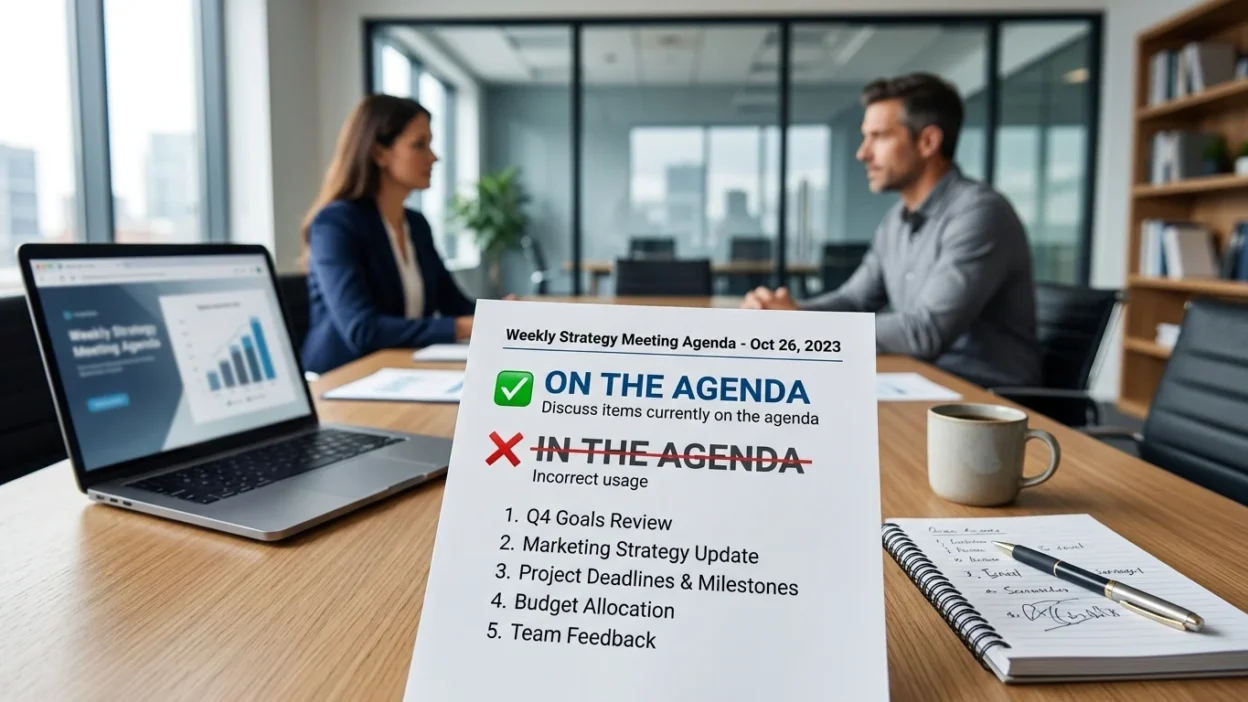
When talking about plans, meetings, schedules, or topics that need attention, you may wonder if to say “in the agenda” or “on the agenda.” The correct and natural expression in standard English is usually “on the agenda.” For example, you can say, “The budget is on the agenda for today’s meeting.” Here, on means that a topic, item, or issue is included in the list of things to discuss or consider.
Although “in the agenda” may seem logical because an item is contained within an agenda, it is not normally the idiomatic choice when referring to a listed topic. Understanding this small preposition difference can make your English sound more natural, especially in professional, academic, and workplace communication.
Quick Answer
“On the agenda” is the standard and natural phrase when something is included as a topic or item for discussion. For example, “The new project is on the agenda.” “In the agenda” is generally not used in this meaning, although in the agenda can occasionally refer to something literally written within an agenda document.
Why Do People Confuse “In the Agenda” and “On the Agenda”?
The confusion comes from the different ways English uses prepositions for lists and documents.
An agenda is a document or list containing topics, activities, or matters to be discussed. Because something can physically appear inside a document, learners may naturally choose in.
However, English traditionally uses on when referring to something that appears as an item on a list.
Compare:
- The issue is on the agenda.
- Her name is on the list.
- The topic is on the schedule.
- The appointment is on the calendar.
So, when you mean that something is scheduled for discussion or consideration, use on the agenda.
What Does “On the Agenda” Mean?
“On the agenda” means that a subject, issue, task, or decision is included among the matters to be discussed or dealt with.
Examples:
- The budget proposal is on the agenda.
- Climate policy is on the agenda for tomorrow’s meeting.
- We have several important issues on the agenda.
The phrase can also be used figuratively to describe something that is being considered or planned.
Common Meaning
If someone asks:
they are asking:
What Does “In the Agenda” Mean?
“In the agenda” is uncommon when you mean that something is a scheduled topic.
Native speakers normally say “on the agenda.”
However, in the agenda can sometimes be used when talking about the actual contents or wording of an agenda document, especially when emphasizing something contained within the document.
For example:
- There is a spelling error in the agenda.
- I noticed a missing date in the agenda.
- The information appears in the agenda document.
Here, in focuses on the physical or written contents of the document rather than an item scheduled for discussion.
In the Agenda or On the Agenda: Comparison Table
| Phrase | Common? | Main Meaning | Example |
|---|---|---|---|
| on the agenda | Yes | Included as a topic for discussion | The proposal is on the agenda. |
| in the agenda | Less common | Located within the written document | There is an error in the agenda. |
| on our agenda | Yes | Something we plan to discuss or address | The issue is on our agenda. |
| in our agenda | Usually unnatural | Not normally used for scheduled topics | The issue is in our agenda. |
When Should You Use “On the Agenda”?
Use on the agenda when you are talking about a subject that is scheduled for discussion, consideration, or action.
1. For Meetings
- The sales report is on the agenda.
- Staff changes are on the agenda for Monday.
2. For Business Discussions
- The new contract is on the agenda.
- Marketing costs will be on the agenda.
3. For Government or Public Discussions
- Housing policy is on the agenda.
- Several important issues are on the agenda.
4. For Personal Plans
The expression can also be used more broadly.
- Cleaning the garage is on my agenda this weekend.
- Finding a new apartment is on my agenda.
10+ Examples of “On the Agenda”
Here are practical examples showing how the phrase works naturally:
- The new budget is on the agenda for today’s meeting.
- We have three important issues on the agenda.
- Is the hiring plan on the agenda?
- The manager said the topic would be on the agenda.
- Employee benefits are on the agenda this week.
- What is on the agenda for tomorrow?
- The committee has several proposals on the agenda.
- We should make sure the safety issue is on the agenda.
- The project deadline is on the agenda for discussion.
- The board will discuss the proposal because it is on the agenda.
- Several environmental concerns are on the agenda.
- Training plans are on the agenda for the next meeting.
Common Mistakes
Mistake 1: Using “In the agenda” for a discussion topic
❌ The budget is in the agenda.
✅ The budget is on the agenda.
Mistake 2: Confusing “agenda” with a container
An agenda is technically a document, but when you refer to an item listed for discussion, English uses on.
❌ The issue is in the agenda for tomorrow’s meeting.
✅ The issue is on the agenda for tomorrow’s meeting.
Mistake 3: Forgetting the article
When referring to a specific meeting agenda, the agenda is usually appropriate.
- The proposal is on the agenda.
- The topic is on today’s agenda.
However, possessives can replace the:
- The proposal is on our agenda.
- The issue is on their agenda.
Memory Trick
Think of an agenda as a list.
You put something on a list, so you put something on the agenda.
List → on the list
Agenda → on the agenda
Schedule → on the schedule
Calendar → on the calendar
A simple rule to remember is:
American vs. British English
Both American and British English commonly use “on the agenda” when referring to topics scheduled for discussion.
For example:
- American English: The proposal is on the agenda.
- British English: The proposal is on the agenda.
There is no major American-versus-British difference in the standard expression.
“On the agenda” is therefore a safe choice in international English, including business, academic, and professional communication.
Similar Words and Expressions
Several expressions are closely related to on the agenda.
On the list
Means that something is included in a list.
On the schedule
Means that something has been scheduled.
On the calendar
Means that an event or appointment has been recorded on a calendar.
Up for discussion
Means something is going to be discussed.
Under consideration
Means something is currently being considered.
On the table
Means that something is being formally considered or discussed.
Final Verdict
When you mean that a topic, issue, proposal, or task is included for discussion or consideration, “on the agenda” is the correct and natural choice.
“In the agenda” is generally not the idiomatic expression for a scheduled topic. It may be appropriate when referring to something literally written or contained within the agenda document.
Correct: The proposal is on the agenda.
Less natural: The proposal is in the agenda.
FAQs:
Is it correct to say “in the agenda”?
It can be grammatically possible when referring to something contained within an agenda document, but “on the agenda” is the normal expression for a topic scheduled for discussion.
Is it “on the agenda” or “in the agenda”?
Use “on the agenda” when something is listed as a topic, issue, or item to be discussed.
What does “on the agenda” mean?
“On the agenda” means that something is included among the topics or matters planned for discussion or consideration.
Can I say “on my agenda”?
Yes. “On my agenda” can refer to something you plan to deal with, discuss, or accomplish.
Is “on the agenda” formal English?
Yes. “On the agenda” is standard English and is widely used in professional, academic, organizational, and everyday contexts.
What is the difference between “on the agenda” and “in the agenda”?
“On the agenda” refers to an item listed for discussion. “In the agenda” focuses more literally on something contained within the written agenda document.
What does “What’s on the agenda?” mean?
It means “What are we going to discuss, consider, or deal with?”
Remember This
Use “on the agenda” when something is a planned topic or item.
- ✅ on the agenda = scheduled for discussion
- ⚠️ in the agenda = something contained within the written document
The easiest way to remember it is to connect agenda with list: something is on a list, so it is on the agenda.
Conclusion
The correct phrase for a topic scheduled for discussion is “on the agenda.” It is the natural expression used in meetings, workplaces, academic settings, organizations, and everyday conversations. For example, “The budget is on the agenda for tomorrow’s meeting” clearly tells the reader that the budget will be discussed.
Although “in the agenda” may occasionally appear when referring to something written inside an agenda document, it is not normally used to describe a scheduled discussion item. When in doubt, choose “on the agenda” for topics, issues, proposals, and tasks that are included for discussion or action.

John Leo is a skilled writer and communication enthusiast who specializes in crafting charming, witty, and thoughtful replies. Through ReplyCorner, he helps readers improve conversations with creative responses for everyday social interactions.