If you are unsure if to say “John and I,” “John and me,” or “me and John,” you are not alone. These expressions can be confusing because the correct choice depends on the grammatical role of the pronouns in the sentence. The important question is not simply which phrase sounds more natural, but if the pronoun is acting as a subject or an object.
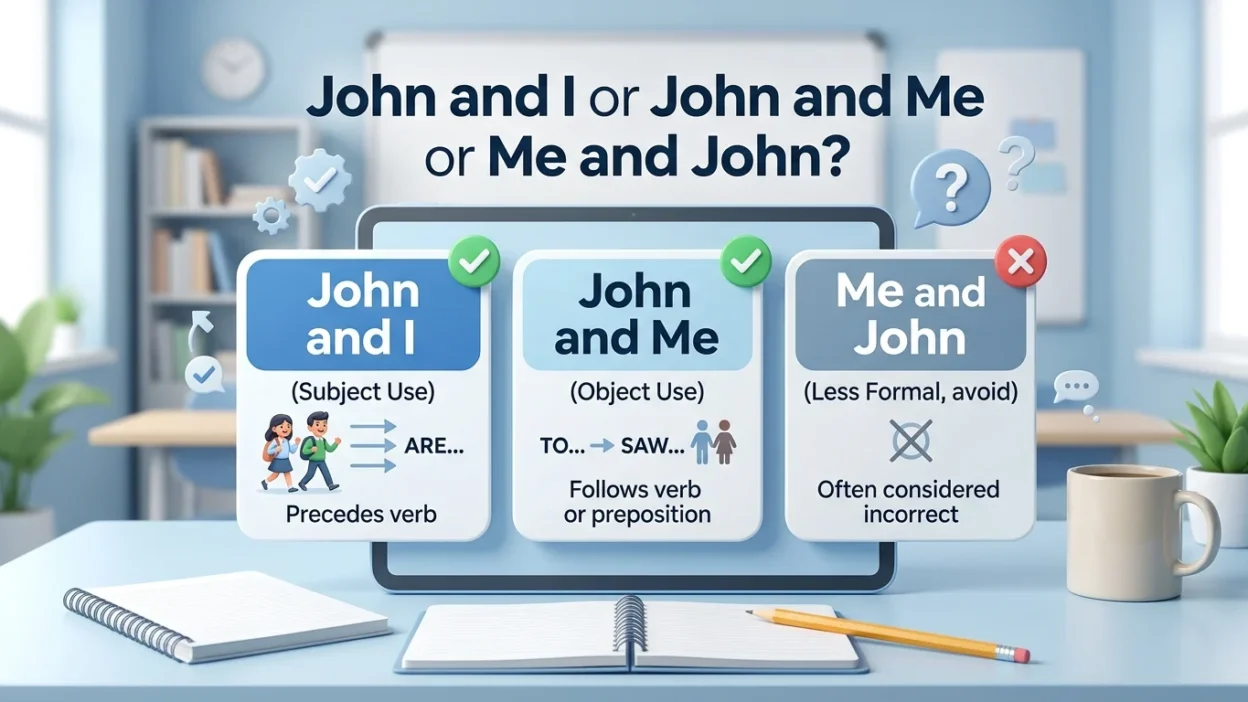
In standard English, “John and I” is used when the pair performs the action, while “John and me” is used when the pair receives the action or follows a preposition. “Me and John” can occur in informal speech, but it is generally less appropriate in formal or careful writing. Learning this simple distinction will help you choose the right expression confidently.
Quick Answer
Use “John and I” when the pair is the subject of the sentence: “John and I went home.” Use “John and me” when the pair is the object: “She invited John and me.” “Me and John” is common in casual speech but is usually avoided in formal English.
Why Do People Confuse “John and I” and “John and Me”?
The confusion usually comes from trying to remember a rule such as “always use I” or “always put yourself last.”
Neither rule works in every situation.
The correct pronoun depends on its grammatical function:
- I = subject pronoun
- Me = object pronoun
For example:
Here, John and I perform the action of going, so I is correct.
Here, Sarah performs the action, while John and me receive it. Therefore, me is correct.
A useful way to check the answer is to temporarily remove “John.”
“John and I”: When Is It Correct?
“John and I” is correct when the phrase functions as the subject of a sentence.
The subject is the person or people performing the action.
Examples
- John and I went to the library.
- John and I are working on the project.
- John and I watched the movie.
- John and I need to leave early.
- John and I were classmates.
In each sentence, John and I are doing something.
Simple Test
Remove “John” from the sentence.
Because “I” works by itself, “John and I” is correct.
“John and Me”: When Is It Correct?
“John and me” is correct when the phrase functions as an object.
An object receives an action or follows a preposition.
Examples
- She invited John and me.
- The teacher spoke to John and me.
- They gave John and me some advice.
- He called John and me yesterday.
- This gift is for John and me.
Try removing “John”:
That tells you that “John and me” is the appropriate form.
Comparison Table
| Expression | Grammatical role | When to use it | Example |
|---|---|---|---|
| John and I | Subject | When the pair performs the action | John and I went home. |
| John and me | Object | When the pair receives the action | She called John and me. |
| Me and John | Informal subject/object wording | Mostly casual speech | Me and John went out. |
When Should You Use “John and I”?
Use “John and I” when the pair is the subject.
Common patterns include:
- John and I + verb
- John and I are…
- John and I were…
- John and I have…
- John and I went…
Examples
- John and I went to the restaurant.
- John and I are good friends.
- John and I finished the assignment.
- John and I discussed the problem.
- John and I have similar interests.
- John and I were waiting outside.
When Should You Use “John and Me”?
Use “John and me” when the phrase is an object.
Common patterns include:
- someone called John and me
- someone invited John and me
- someone helped John and me
- something is for John and me
- someone spoke to John and me
Examples
- She invited John and me to dinner.
- The manager spoke to John and me.
- They helped John and me with the project.
- This message is for John and me.
- He asked John and me a question.
- The teacher congratulated John and me.
What About “Me and John”?
“Me and John” is often heard in casual conversation, especially when people speak informally.
For example:
In standard formal English, the preferred version is:
There is an additional issue with “me and John”: it uses the object pronoun me where the subject pronoun I is normally required.
However, “me and John” can appear naturally in some informal speech and certain dialects. That does not make it the preferred choice for formal writing, academic work, professional communication, or careful standard English.
Common Mistakes
Mistake 1: Using “I” Everywhere
Some people think I always sounds more correct.
The correct form is:
Mistake 2: Using “Me” as the Subject
Better:
Mistake 3: Ignoring the Verb
“John and me” is the subject here, so use I:
Mistake 4: Choosing Based on Which Sounds Polite
Putting the other person’s name first is a common courtesy:
But politeness does not determine if I or me is grammatically correct. The grammatical role does.
Memory Trick
Use this simple trick:
Remove the other person’s name.
If the sentence needs I, use John and I.
If the sentence needs me, use John and me.
You can remember it as:
Doing the action → I
Receiving the action → me
American vs. British English
The basic distinction between I and me is the same in both American and British standard English.
Both varieties use:
And:
Informal speech can vary by region, social group, and dialect, so forms such as “me and John” may be heard in both varieties. However, standard formal writing generally follows the subject/object distinction.
Similar Words and Expressions
Understanding related pronouns can make this rule easier.
I vs. Me
- I = subject
- Me = object
He vs. Him
The same pattern applies:
She vs. Her
Again:
We vs. Us
And:
So John and I vs. John and me is part of a much larger subject-and-object pronoun pattern.
Final Verdict
“John and I” is correct when the pair is the subject:
“John and me” is correct when the pair is the object:
“Me and John” may occur in informal conversation, but “John and I” is the standard choice when the pair is the subject, especially in formal writing.
The easiest test is to remove “John.” If the sentence needs I, choose John and I. If it needs me, choose John and me.
FAQs:
Is “John and I” grammatically correct?
Yes. “John and I” is correct when the phrase is the subject of the sentence.
Is “John and me” grammatically correct?
Yes. “John and me” is correct when the phrase is an object.
Is “me and John” correct English?
“Me and John” occurs in informal speech, but it is generally not preferred in formal standard English when the phrase is the subject. Use “John and I” instead.
Should I say “John and I” or “John and me”?
It depends on the sentence. Use “John and I” as the subject and “John and me” as the object.
Is “between John and I” correct?
No, in standard English the correct expression is “between John and me.”
The preposition between requires an object pronoun.
Is “for John and I” correct?
Usually no. After the preposition for, use the object pronoun me:
Why do people put “John” before “I” or “me”?
In English, people commonly mention the other person first in coordinated phrases as a matter of courtesy or convention. This does not change the grammatical rule governing I and me.
Remember This
- John and I → subject
- John and me → object
- Me and John → informal and generally avoided in formal standard English
- Remove the other person’s name to test the sentence.
- I performs the action.
- Me receives the action or follows a preposition.
Conclusion
Choosing between “John and I,” “John and me,” and “me and John” becomes much easier once you focus on the grammatical role of the pronoun. Use “John and I” when the two people perform the action, and use “John and me” when they receive the action or follow a preposition.
When you are unsure, use the removal test: take out “John” and see if the sentence requires I or me. This quick method works in everyday conversation, professional writing, school assignments, and most other situations where standard English is expected.

David Owen is a passionate writer and communication enthusiast dedicated to helping readers craft charming, witty, and thoughtful replies. Through ReplyCorner, he shares creative response ideas that make conversations engaging and memorable.