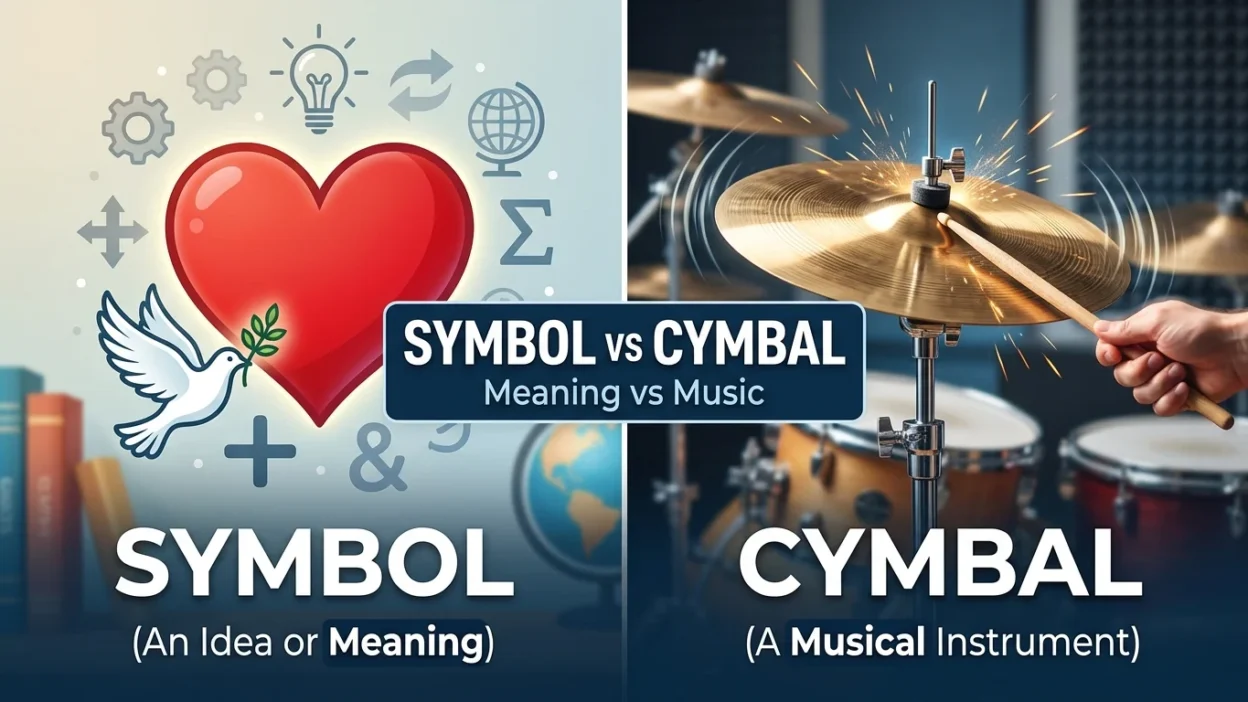
If you have ever seen symbol and cymbal in writing, you may wonder if they mean the same thing. Although these two words sound somewhat similar, they have completely different meanings and uses. Symbol is usually a sign, image, object, or word that represents an idea, meaning, or concept. Cymbal, on the other hand, is a musical instrument made of metal that is played by striking it.
The confusion mainly comes from their similar pronunciation. However, once you connect each word with its meaning, the difference becomes easy to remember. In this guide, we will explain symbol vs cymbal, show how each word is used in everyday English, and provide practical examples so you can confidently choose the correct word.
Quick Answer
Symbol means something that represents an idea, concept, object, or meaning, such as a heart representing love. Cymbal is a round metal percussion instrument used to produce a loud, ringing sound in music. They sound similar but have different meanings and spellings.
Why Do People Confuse “Symbol” and “Cymbal”?
People often confuse these words because symbol and cymbal can sound similar when spoken quickly.
Their meanings, however, are completely different:
- Symbol → something that represents another idea or meaning.
- Cymbal → a metal musical instrument used in percussion.
For example:
- The dove is a symbol of peace.
- The drummer hit the cymbal.
The first sentence is about representation, while the second is about music.
What Does “Symbol” Mean?
Symbol is a noun that refers to something used to represent an idea, quality, object, group, or concept.
A symbol can be a:
- Sign
- Image
- Object
- Character
- Letter
- Number
- Gesture
For example, a heart is commonly used as a symbol of love.
Examples of “Symbol”
- The dove is a symbol of peace.
- A red light is a symbol that means stop.
- The national flag is a symbol of a country.
- The dollar sign is a symbol for a currency.
- The wedding ring can be a symbol of commitment.
The word can also refer to a character used in mathematics, science, or writing.
For example:
- “+” is a mathematical symbol.
- “H” is the chemical symbol for hydrogen.
What Does “Cymbal” Mean?
Cymbal is a noun referring to a round, usually metal percussion instrument.
Cymbals are commonly used in:
- Drum kits
- Orchestras
- Marching bands
- Rock music
- Jazz
- Pop music
A drummer produces sound by hitting a cymbal with a drumstick or another cymbal.
Examples of “Cymbal”
- The drummer struck the cymbal.
- One of the cymbals was damaged.
- The loud cymbal crash ended the song.
- She learned how to play the drums and cymbals.
The plural form is cymbals.
Symbol vs Cymbal: Comparison Table
| Feature | Symbol | Cymbal |
|---|---|---|
| Meaning | Something that represents an idea or concept | A metal percussion instrument |
| Part of speech | Usually a noun | Noun |
| Main context | Signs, meanings, mathematics, science, culture | Music and percussion |
| Example | A heart is a symbol of love. | He hit the cymbal. |
| Plural | Symbols | Cymbals |
| Related word | Symbolic | Percussion |
When Should You Use “Symbol”?
Use symbol when you are talking about something that represents another meaning or idea.
Common uses of “symbol”
Representation
Mathematics
Science
Culture
Communication
If something stands for, represents, or indicates something else, symbol is usually the word you need.
When Should You Use “Cymbal”?
Use cymbal when you are talking about a musical percussion instrument.
For example:
A useful clue is the word music. If your sentence is about a drum kit, drummer, percussion, or musical sound, cymbal is probably correct.
12 Examples of “Symbol” and “Cymbal”
- The heart is a symbol of love.
- The drummer hit the cymbal loudly.
- The dove is often considered a symbol of peace.
- The cymbal produced a sharp crash.
- The national flag is a symbol of the country.
- She bought two new cymbals for her drum set.
- The mathematical symbol represents addition.
- The drummer struck the cymbal at the end of the song.
- The color white can be a symbol of purity in some cultures.
- The band needs another cymbal for its performance.
- The chemical symbol for gold is Au.
- He accidentally dropped the cymbal on the floor.
Common Mistakes with Symbol and Cymbal
One common mistake is using cymbal when you mean symbol.
Incorrect:
Correct:
Another mistake is using symbol when referring to the musical instrument.
Incorrect:
Correct:
Remember that symbol is connected to meaning and representation, while cymbal is connected to music.
Memory Trick: Symbol vs Cymbal
A simple way to remember the difference is:
Symbol = stands for something.
Think:
Cymbal = makes a musical sound.
Think:
If you are talking about an idea or representation, choose symbol.
If you are talking about an instrument, choose cymbal.
Symbol vs Cymbal in American and British English
There is no major difference in meaning between symbol and cymbal in American and British English.
Both varieties use:
- symbol for something that represents an idea or concept.
- cymbal for the musical percussion instrument.
The spelling and basic meanings remain the same.
Similar Words to Symbol and Cymbal
Several words are related to symbol, depending on the context:
- Sign
- Representation
- Emblem
- Mark
- Token
- Icon
- Signifier
Words related to cymbal include:
- Drum
- Percussion
- Hi-hat
- Crash cymbal
- Ride cymbal
- Instrument
- Drum kit
Be careful, however, because these related words are not always interchangeable.
For example, a cymbal is a type of percussion instrument, while a drum is a different instrument.
Final Verdict: Symbol or Cymbal?
The correct word depends entirely on what you mean.
Use symbol when you are talking about something that represents an idea, meaning, object, or concept.
Use cymbal when you are talking about a metal percussion instrument.
So, although symbol and cymbal sound similar, they are not interchangeable. Symbol belongs to the language of representation and meaning, while cymbal belongs to the world of music.
FAQs:
Is a cymbal a symbol?
No. A cymbal is a musical percussion instrument. A symbol is something that represents an idea, meaning, or concept.
What is the difference between symbol and cymbal?
A symbol represents something, while a cymbal is a metal musical instrument that produces sound when struck.
Are symbol and cymbal homophones?
They can be considered homophones or near-homophones depending on the speaker and pronunciation because they can sound very similar, but their spellings and meanings are different.
What is an example of a symbol?
A heart can be a symbol of love, while a dove can be a symbol of peace.
What is an example of a cymbal?
Here, cymbal refers to the metal percussion instrument.
How do you remember symbol vs cymbal?
Remember symbol = meaning and cymbal = music. If something represents an idea, use symbol. If it makes a musical crash, use cymbal.
What is the plural of cymbal?
The plural of cymbal is cymbals.
What is the plural of symbol?
The plural of symbol is symbols.
Remember This
Symbol = something that represents an idea, meaning, or concept.
Cymbal = a metal percussion instrument.
Think “symbol = meaning” and “cymbal = music.”
Conclusion
The difference between symbol and cymbal is simple once you focus on their meanings. A symbol represents something else, such as an idea, concept, sign, or quality. A cymbal is a musical instrument used to create percussion sounds.
Although the two words can sound similar, they belong to completely different contexts. When discussing signs, representation, mathematics, or ideas, use symbol. When discussing drummers, drum kits, or percussion instruments, use cymbal.