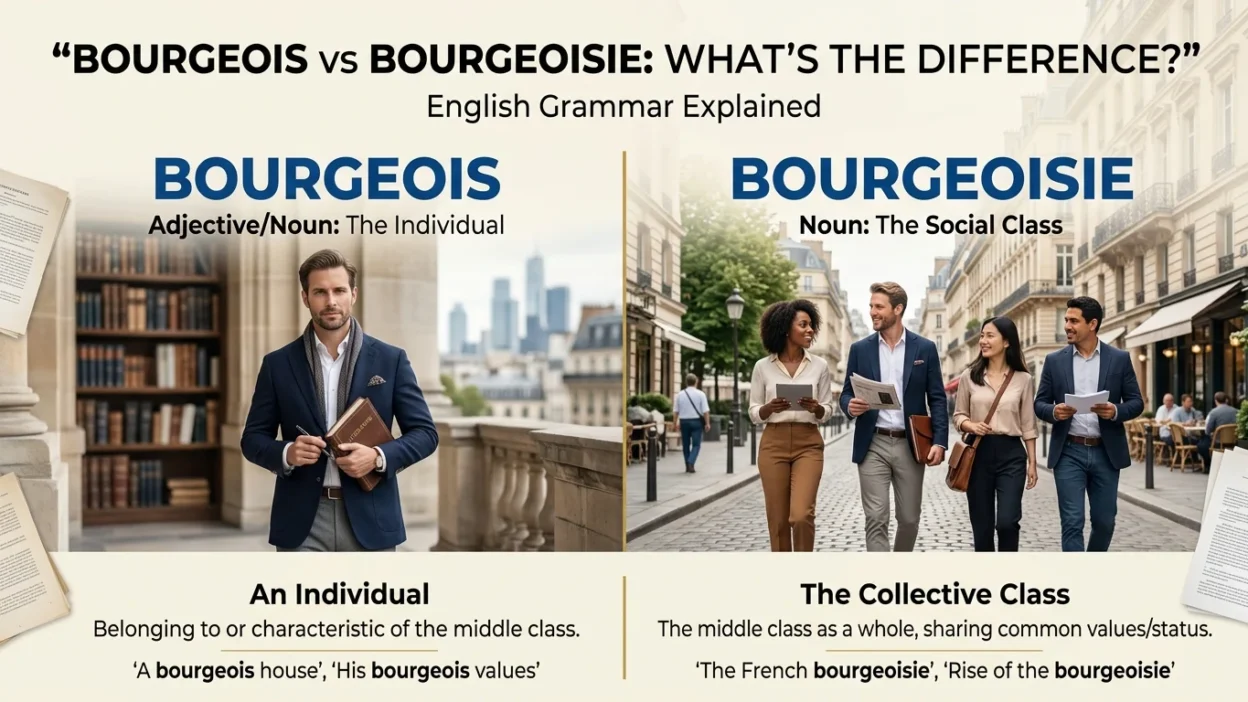
If you have ever seen the words bourgeois and bourgeoisie, you may have wondered if they mean the same thing. They are closely related, but they are not interchangeable. Bourgeois is usually an adjective describing something associated with the middle class, or a noun referring to a person from that social class. Bourgeoisie is a noun referring to the social class itself, especially the middle or property-owning class in historical and political discussions.
The two words come from French and are especially common in discussions of society, economics, history, literature, and politics. Understanding the difference between bourgeois vs bourgeoisie is easier when you remember that one can describe a person or thing, while the other names a group or social class. This guide explains their meanings, pronunciation, grammar, examples, and common mistakes so you can use both words correctly.
Quick Answer
Bourgeois can be a noun or adjective meaning a middle-class person or something associated with the middle class. Bourgeoisie is a noun referring to the middle-class or property-owning social group as a whole. In simple terms, bourgeois describes an individual or characteristic, while bourgeoisie describes the class or group.
Why Do People Confuse Bourgeois and Bourgeoisie?
People often confuse these words because they are related in meaning and come from the same French root.
Both words are connected with the idea of the middle class, particularly a socially or economically established class. However, they perform different grammatical roles.
Think about the difference between:
- a student → one person
- students → a group of people
Similarly:
- bourgeois → an individual or a description
- bourgeoisie → the social class or group
There is another reason for the confusion: both words are pronounced differently from how many English learners might expect.
What Does Bourgeois Mean?
Bourgeois can be used as both an adjective and a noun.
As an adjective, it describes something associated with the middle class, conventional middle-class values, or material concerns.
For example:
Here, bourgeois describes the lifestyle.
As a noun, bourgeois can refer to a person belonging to the bourgeois class.
In modern everyday English, the adjective is often more useful than the noun.
Bourgeois as an Adjective
As an adjective, bourgeois may describe:
- a middle-class lifestyle
- middle-class values
- conventional attitudes
- materialistic tastes
- social habits associated with the middle class
For example:
This means the neighborhood is associated with a comfortable middle-class lifestyle.
Bourgeois as a Noun
As a noun, bourgeois can mean a member of the bourgeoisie.
In historical or Marxist discussions, the noun can have a more specific meaning connected with people who own capital or productive property.
What Does Bourgeoisie Mean?
Bourgeoisie is a noun. It refers to a social class, traditionally associated with the middle class and, in Marxist terminology, the class that owns capital and the means of production.
For example:
Here, bourgeoisie refers to a social group rather than one particular person.
The word is generally used when discussing a class collectively.
Bourgeoisie in History
Historically, the meaning of bourgeoisie has changed depending on the period and context.
In European history, the term became associated with urban middle and property-owning groups. Merchants, business owners, professionals, and property holders could be associated with this class.
In Marxist theory, however, bourgeoisie has a more specific meaning. It generally refers to the capitalist class that owns the means of production, such as businesses, factories, and other productive assets.
Therefore, the exact meaning depends on the context.
Bourgeois vs Bourgeoisie: Comparison Table
| Feature | Bourgeois | Bourgeoisie |
|---|---|---|
| Part of speech | Adjective or noun | Noun |
| Basic meaning | Middle-class; a middle-class person | The middle-class or property-owning class |
| Refers to | A person, thing, attitude, or lifestyle | A social class or group |
| Singular/plural | Can refer to one person | Collective group |
| Common use | Describing people, lifestyles, tastes, values | Discussing society, economics, and history |
| Example | “They have bourgeois tastes.” | “The bourgeoisie gained wealth.” |
| Origin | French | French |
When Should You Use Bourgeois?
Use bourgeois when you want to describe a person, lifestyle, attitude, taste, or object associated with the middle class.
Common patterns include:
- bourgeois lifestyle
- bourgeois values
- bourgeois family
- bourgeois culture
- bourgeois society
- bourgeois attitudes
- bourgeois tastes
- bourgeois individual
Examples
The word can be neutral, descriptive, or critical depending on context.
When Should You Use Bourgeoisie?
Use bourgeoisie when you are referring to the social class as a group.
It commonly appears in discussions about:
- history
- economics
- capitalism
- social classes
- sociology
- political theory
- literature
Examples
Notice that bourgeoisie refers to the group, not normally to one individual.
10+ Examples of Bourgeois and Bourgeoisie
Here are practical examples showing the difference.
1. Bourgeois as an adjective
The word describes the lifestyle.
2. Bourgeois as an adjectiv
The word describes his attitudes.
3. Bourgeois as an adjective
The word describes the family’s social background.
4. Bourgeois as an adjective
The word describes the type of society.
5. Bourgeois as a noun
Here, bourgeois refers to a person.
6. Bourgeoisie as a social class
The word refers to a class of people.
7. Bourgeoisie in history
The word describes a broader social group.
8. Bourgeoisie in political theory
Here, bourgeoisie refers to the capitalist class.
9. Comparing individuals and groups
Bourgeois describes the family, while bourgeoisie names the social class.
10. Literature
Here, bourgeois functions as an adjective.
11. Sociology
Here, bourgeoisie refers to a social class.
12. Everyday description
Here, bourgeois describes his taste.
Common Mistakes with Bourgeois and Bourgeoisie
Mistake 1: Using bourgeoisie as an adjective
Incorrect:
Correct:
Bourgeois is the adjective.
Mistake 2: Using bourgeois for the entire class
You may sometimes see:
If you mean the social class as a whole, bourgeoisie is usually the appropriate noun:
Mistake 3: Treating bourgeoisie as a person
Incorrect:
Better:
Or:
Bourgeoisie refers to the group, not normally to an individual.
Mistake 4: Assuming the words are completely interchangeable
Although they are closely related, their grammatical functions are different.
Compare:
with:
The first describes something. The second identifies a social class.
A Simple Memory Trick
Remember:
Bourgeois = describes a person or thing.
Bourgeoisie = describes the group.
You can also think:
Bourgeois → individual
Bourgeoisie → society/class
For example:
But:
This simple distinction will help you avoid most mistakes.
Bourgeois vs Bourgeoisie in American and British English
The meanings of bourgeois and bourgeoisie are broadly the same in American and British English.
The difference is not mainly between American and British usage. Instead, the meaning can change depending on the subject being discussed.
In everyday writing, bourgeois may describe middle-class tastes, lifestyles, or attitudes.
In academic writing, bourgeoisie is more likely to appear in discussions of social class, capitalism, history, sociology, or Marxist theory.
Both varieties of English use the terms, although they may appear more frequently in formal, academic, historical, or cultural contexts than in ordinary conversation.
Similar Words
Several words are related to bourgeois and bourgeoisie, but they are not exact synonyms.
Middle class
A broad term for a social class between the working class and upper class. Its exact definition varies by country and context.
Capitalist
A person or system connected with capitalism. In Marxist theory, the capitalist class overlaps significantly with the concept of the bourgeoisie, but the terms are not identical in every context.
Working class
A social class traditionally associated with wage labor rather than ownership of productive capital.
Upper class
A social class generally associated with substantial wealth, property, influence, or social status.
Proletariat
A term especially associated with Marxist theory for the working class, particularly workers who sell their labor.
Middle-class
The standard English adjective or noun phrase used in many everyday contexts when talking about the middle class.
What Is the Main Difference Between Bourgeois and Bourgeoisie?
The main difference is grammar and reference.
Bourgeois can describe an individual or something connected with the middle class.
Bourgeoisie names the social class itself.
Compare these sentences:
Here, bourgeois describes his tastes.
Here, bourgeoisie refers to the social class.
The words are related, but replacing one with the other can make a sentence grammatically incorrect or change its meaning.
Final Verdict
The easiest way to remember bourgeois vs bourgeoisie is to focus on what each word refers to.
Bourgeois is usually an adjective meaning associated with the middle class or its values. It can also be a noun referring to an individual member of that class.
Bourgeoisie is a noun referring to the social class as a whole, especially in historical, economic, and political contexts.
So, if you are describing something, choose bourgeois. If you are naming the social class, choose bourgeoisie.
FAQs:
Is bourgeois the same as bourgeoisie?
No. They are related but have different grammatical uses. Bourgeois can be an adjective or noun, while bourgeoisie is a noun referring to a social class.
Is bourgeois a person or a class?
Bourgeois can refer to an individual person, especially a member of the bourgeois class. It can also be an adjective describing something associated with that class.
What is the plural of bourgeois?
In English, bourgeois can be used as a plural noun in some contexts, although bourgeois people or members of the bourgeoisie may be clearer. The word bourgeoisie refers collectively to the class.
Is bourgeoisie singular or plural?
Bourgeoisie is a collective noun referring to a social class. It represents a group rather than one individual.
Can bourgeois be an adjective?
Yes. This is one of its most common uses. For example: “They live a bourgeois lifestyle.”
Can you say “a bourgeoisie”?
Generally, no. Bourgeoisie refers to the class as a whole rather than one person. For an individual, use a bourgeois or say a member of the bourgeoisie.
What is the opposite of bourgeoisie?
In Marxist terminology, the proletariat is commonly presented as the opposing class to the bourgeoisie. More generally, the appropriate contrasting term depends on the historical or social context.
How do you pronounce bourgeois and bourgeoisie?
Both words come from French and have pronunciations that may surprise English learners. Bourgeois is commonly pronounced roughly like “BOOR-zhwah,” while bourgeoisie is commonly pronounced roughly like “boor-zhwah-ZEE.” Pronunciation can vary somewhat by speaker and accent.
Remember This
Bourgeois = a description or an individual.
Bourgeoisie = the social class.
When you remember “bourgeois describes, bourgeoisie groups,” the difference becomes much easier.
Conclusion
The difference between bourgeois vs bourgeoisie is simple once you understand their grammatical roles. Bourgeois can describe a person, lifestyle, attitude, taste, or other characteristic associated with the middle class. Bourgeoisie, on the other hand, refers to the social class as a collective group.
Both terms are particularly useful in historical, social, economic, and literary discussions. If you are describing something as middle-class or associated with middle-class values, use bourgeois. If you are talking about the social class itself, use bourgeoisie. With this distinction in mind, you can use both words more accurately and confidently.

David Owen is a passionate writer and communication enthusiast dedicated to helping readers craft charming, witty, and thoughtful replies. Through ReplyCorner, he shares creative response ideas that make conversations engaging and memorable.