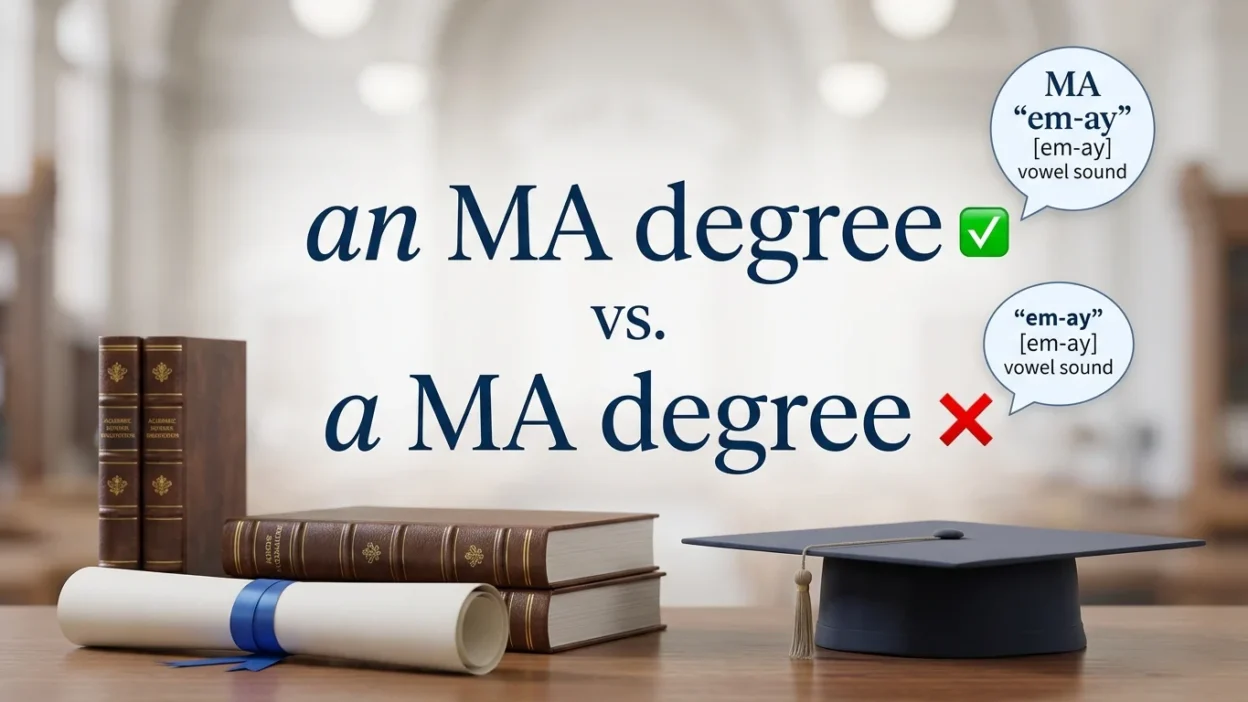
When you write about a master’s qualification, you may wonder if the correct phrase is “a MA degree” or “an MA degree.” The answer depends on how the abbreviation MA is pronounced, not simply on the letter you see first. Since MA is normally pronounced “em-ay,” it begins with a vowel sound.
Therefore, “an MA degree” is the standard and grammatically correct form. The same rule applies when MA is used by itself: “She has an MA in English.” Understanding this rule can help you avoid a common mistake in academic writing, applications, résumés, and everyday English. The key is to listen to the sound of the abbreviation rather than look at its first written letter.
Quick Answer
The correct phrase is “an MA degree,” because MA is pronounced “em-ay,” beginning with a vowel sound. We use an before vowel sounds. For example: “She earned an MA degree in English.” You can also simply say “She earned an MA in English.”
Why Do People Confuse It?
The confusion happens because MA begins with the written letter M, which is a consonant. However, the name of the letter M is pronounced “em.”
The word em starts with a vowel sound, so we use an:
- an MA
- an MA degree
- an MBA
- an MSc
- an MP
The choice between a and an is based on pronunciation, not spelling.
What Is the First Word: “A”?
A is used before a word or abbreviation that begins with a consonant sound.
Examples:
- a university
- a student
- a PhD
- a BA
- a European country
Notice that BA is pronounced “bee-ay.” The first sound is /b/, a consonant sound, so we say “a BA.”
What Is the Second Word: “An”?
An is used before a word or abbreviation that begins with a vowel sound.
Examples:
- an apple
- an engineer
- an MA
- an MBA
- an hour
Since MA is pronounced “em-ay,” the first sound is a vowel sound. Therefore, “an MA” is correct.
A MA or an MA Degree: Comparison Table
| Phrase | Correct? | Reason |
|---|---|---|
| a MA degree | ❌ No | “MA” begins with a vowel sound |
| an MA degree | ✅ Yes | “MA” is pronounced “em-ay” |
| a MA | ❌ No | The abbreviation starts with /e/ |
| an MA | ✅ Yes | “M” is pronounced “em” |
| an MA in English | ✅ Yes | Correct article before MA |
| a BA degree | ✅ Yes | “BA” starts with /b/ |
When Should You Use Each?
Use “an MA degree”
Use “an MA degree” when referring to a Master of Arts degree.
Use “a” with abbreviations beginning with consonant sounds
Use a when the abbreviation starts with a consonant sound.
Although PhD contains a vowel in its written form, it is pronounced “pee-aych-dee,” beginning with a /p/ sound.
10+ Examples of “An MA Degree”
- She earned an MA degree in English.
- He is studying for an MA degree in history.
- Sarah completed an MA in education.
- I am considering an MA degree after graduation.
- She holds an MA in psychology.
- He applied for an MA program at the university.
- They offered her an MA degree in linguistics.
- My sister has an MA in English literature.
- He plans to pursue an MA degree next year.
- She completed an MA program in communication.
- An MA degree can be useful for certain academic careers.
- He listed an MA in History on his résumé.
Common Mistakes
Mistake 1: Using “a” because MA starts with M
❌ She has a MA degree.
The letter M is written as a consonant, but it is pronounced “em.”
✅ She has an MA degree.
Mistake 2: Choosing the article based only on spelling
The spelling of an abbreviation does not always determine the article.
For example:
- an MA → “em-ay”
- an MBA → “em-bee-ay”
- a BA → “bee-ay”
- a PhD → “pee-aych-dee”
Always consider the first sound.
Mistake 3: Thinking “degree” changes the article
The word degree does not affect the choice.
The article belongs to the abbreviation:
So the correct phrase remains “an MA degree.”
Memory Trick
Remember:
If M sounds like “em,” use “an.”
Think:
This same pattern works with:
- an MA
- an MBA
- an MSc
- an MP
- an MD
American vs. British English
The basic article rule is the same in both American and British English.
Both varieties normally use:
For example:
- American English: “She earned an MA in English.”
- British English: “She earned an MA in English.”
The pronunciation of the abbreviation may vary slightly depending on the speaker, but MA normally begins with the vowel sound in “em,” so an is standard.
Similar Words and Abbreviations
The same pronunciation-based rule applies to many academic abbreviations.
| Abbreviation | Pronunciation starts with | Correct article |
|---|---|---|
| MA | vowel sound | an MA |
| MBA | vowel sound | an MBA |
| MSc | vowel sound | an MSc |
| MD | vowel sound | an MD |
| BA | consonant sound | a BA |
| PhD | consonant sound | a PhD |
| BSc | consonant sound | a BSc |
| JD | consonant sound | a JD |
Final Verdict
“An MA degree” is correct.
The reason is simple: MA is pronounced “em-ay,” and the first sound is a vowel sound. Therefore, use an, not a.
You can also avoid the slightly redundant phrase “MA degree” and simply say “an MA.”
For example:
FAQs:
Is it “a MA” or “an MA”?
It is “an MA.” The abbreviation MA is pronounced “em-ay,” which begins with a vowel sound.
Is “a MA degree” grammatically correct?
No. In standard English, the usual form is “an MA degree.”
Why do we say “an MA”?
We use an because the letter M is pronounced “em,” beginning with a vowel sound.
Is “an MA in English” correct?
Yes. “An MA in English” is grammatically correct and natural.
Is it “a BA” or “an BA”?
It is “a BA” because BA is pronounced “bee-ay,” which begins with a consonant sound.
Is it “an MBA” or “a MBA”?
It is “an MBA.” MBA begins with the sound “em,” so an is used.
Can I say “an MA degree”?
Yes. “An MA degree” is grammatically correct, although “an MA” is often more concise.
Remember This
Use “an MA” because M is pronounced “em.”
The rule is based on sound, not the written letter:
- an MA → “em-ay”
- a BA → “bee-ay”
- an MBA → “em-bee-ay”
- a PhD → “pee-aych-dee”
When choosing between a and an, listen to the first sound of the word or abbreviation.
Conclusion
If you are unsure if to write “a MA degree” or “an MA degree,” choose “an MA degree.” The abbreviation MA begins with the vowel sound /e/ when pronounced “em-ay,” so an is the appropriate indefinite article.
This pronunciation rule also helps with other academic abbreviations such as MBA, MSc, BA, and PhD. Rather than looking only at the first written letter, say the abbreviation aloud and identify its first sound. That simple habit will help you choose the correct article naturally and confidently.

David Owen is a passionate writer and communication enthusiast dedicated to helping readers craft charming, witty, and thoughtful replies. Through ReplyCorner, he shares creative response ideas that make conversations engaging and memorable.