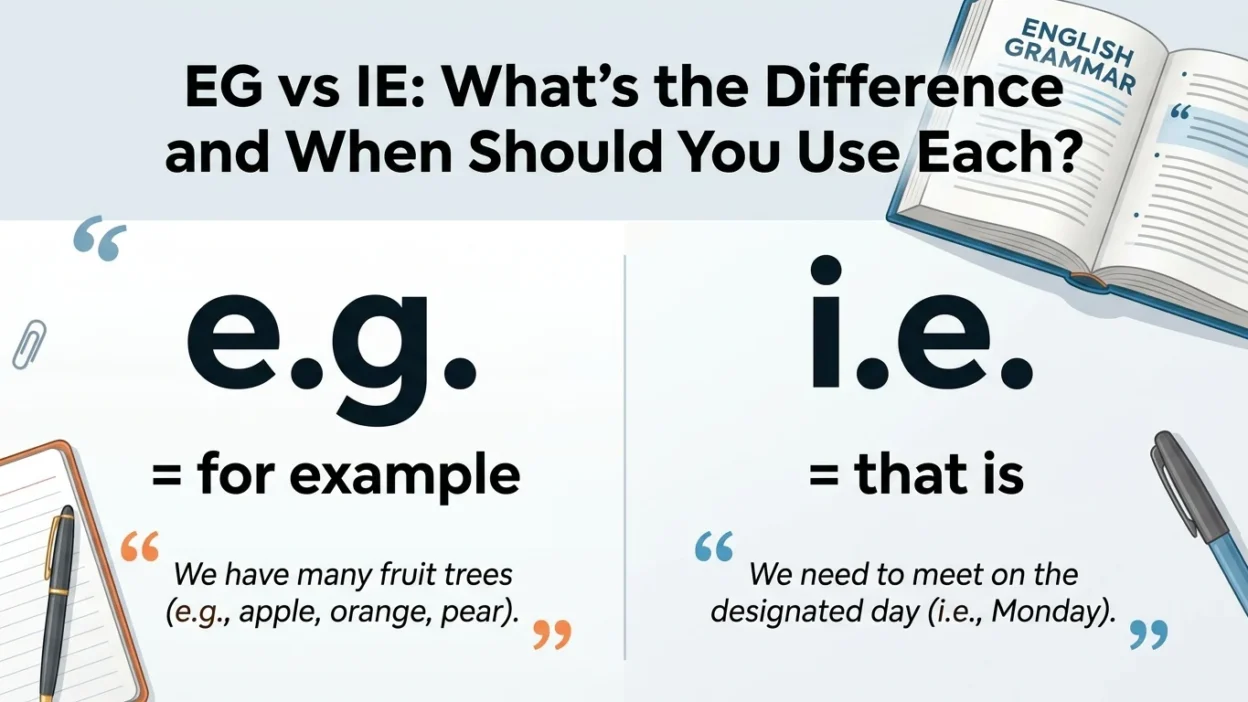
If you have ever wondered about eg vs ie, you are not alone. These two abbreviations are common in English writing, especially in essays, emails, academic work, and professional documents. Although they look similar, they have different meanings and should not be used interchangeably. e.g. means “for example,” while i.e. means “that is” or “in other words.”
The main difference is simple: use e.g. when you want to give one or more examples of something, and use i.e. when you want to clarify, explain, or restate exactly what you mean. Understanding this distinction can make your writing clearer and more precise. This guide explains eg vs ie, where these abbreviations come from, how to punctuate them, and how to use them correctly in everyday and formal English.
Quick Answer
E.g. means “for example” and introduces one or more examples. I.e. means “that is” or “in other words” and introduces a clarification or more exact explanation. Use e.g. when giving possibilities; use i.e. when narrowing or defining your meaning.
Why Do People Confuse E.g. and I.e.?
People often confuse e.g. and i.e. because both abbreviations come from Latin and are frequently used in similar sentences.
Their meanings, however, are different:
- e.g. = exempli gratia = for example
- i.e. = id est = that is
The easiest way to distinguish them is to ask yourself what comes next.
If you are giving an example, use e.g.
If you are explaining exactly what you mean, use i.e.
The first sentence gives examples of outdoor activities. The second identifies exactly which activity the writer means.
What Does E.g. Mean?
E.g. is short for the Latin phrase exempli gratia, meaning “for example.”
Use e.g. when you want to mention one or more examples without suggesting that the examples are the only possibilities.
Examples of E.g.
In each case, the words after e.g. represent examples rather than a complete list.
What Does I.e. Mean?
I.e. comes from the Latin phrase id est, which means “that is.”
It is used when you want to clarify, specify, or restate something more precisely.
Examples of I.e.
The information after i.e. explains or specifies what came before it.
E.g. vs I.e.: Comparison Table
| Feature | E.g. | I.e. |
|---|---|---|
| Meaning | For example | That is / in other words |
| Latin | Exempli gratia | Id est |
| Main purpose | Gives examples | Clarifies or specifies |
| Meaning after abbreviation | One of several possibilities | An explanation or exact meaning |
| Example | Bring fruit, e.g., apples or bananas. | Bring one citrus fruit, i.e., an orange. |
| Memory clue | Example | In essence / in other words |
When Should You Use E.g.?
Use e.g. when you want to provide examples.
1. When listing possible examples
2. When giving examples in academic writing
3. When explaining a broad categoy
Remember that the examples you provide do not necessarily represent the entire category.
When Should You Use I.e.?
Use i.e. when you want to make your meaning more specific.
1. When clarifying a statement
2. When restating an idea
3. When specifying exactly what you mean
The phrase following i.e. should make the original statement clearer or more precise.
E.g. vs I.e.: 10+ Examples
Example 1
Here, mangoes and pineapples are examples.
Example 2
Here, the writer specifies exactly what they want.
Example 3
The items are examples of office supplies.
Example 4
The passport identifies exactly which document is meant.
Example 5
Football and tennis are examples.
Example 6
The second part clarifies what “weekend” means in this context.
Example 7
Spanish and French are possible examples.
Example 8
The second phrase explains the exact meaning of “immediate supervisor.”
Example 9
These countries are examples rather than a complete list.
Example 10
The second part defines what is meant by “vegetarian meal.”
Example 11
These are examples of web browsers.
Example 12
The second phrase specifies exactly what is required.
Common Mistakes With E.g. and I.e.
Mistake 1: Using E.g. for clarification
Incorrect:
If the passport is the exact document meant, i.e. is more appropriate.
Better:
Mistake 2: Using I.e. before examples
Incorrect:
If football and tennis are merely examples, use e.g.
Mistake 3: Treating them as interchangeable
Although both abbreviations introduce additional information, their purposes are different. Always ask if you are giving an example or clarifying your exact meaning.
Mistake 4: Forgetting punctuation
In American English, these abbreviations are commonly written with periods:
- e.g.
- i.e.
They are also often followed by a comma:
Style guides differ on punctuation, so follow the conventions required by your school, workplace, or publication.
Memory Trick for E.g. vs I.e.
A simple way to remember the difference is:
E.g. = Example Given
Think of the E in e.g. as Example.
I.e. = In Explanation
Think of i.e. as introducing an explanation or clarification.
Another useful shortcut is:
If you can replace the abbreviation with “for example,” use e.g.
If you can replace it with “that is” or “in other words,” use i.e.
American vs British English
The basic meanings of e.g. and i.e. are the same in both American and British English.
The main differences you may notice involve punctuation and style.
American English commonly uses:
British English also uses these abbreviations, but punctuation practices can vary depending on the publication or style guide.
For formal writing, consistency is more important than trying to apply one universal punctuation rule. If you are writing for a particular institution, publication, or academic course, follow its preferred style guide.
Similar Words and Expressions
Instead of e.g., you can often use:
- for example
- for instance
- such as
- including
- like
Instead of i.e., you can often use:
- that is
- in other words
- namely
- specifically
- more precisely
However, these alternatives are not always exact replacements. Choose the expression that best matches the relationship between the two parts of your sentence.
Final Verdict: E.g. or I.e.?
The difference between e.g. and i.e. comes down to examples versus clarification.
Use e.g. when you mean “for example.”
Use i.e. when you mean “that is” or “in other words.”
If the information after the abbreviation gives you some possibilities, choose e.g. If it tells you exactly what the previous statement means, choose i.e.
FAQs:
Is e.g. the same as for example?
Yes. E.g. is a Latin abbreviation meaning “for example.” It is used to introduce one or more examples.
Is i.e. the same as that is?
Yes. I.e. comes from the Latin id est, meaning “that is.” It is used to clarify or restate something more precisely.
Should I use e.g. or i.e. before a list?
Use e.g. if the list contains examples rather than every possible item.
Use i.e. when the information after it specifies exactly what you mean.
What is an easy way to remember e.g. vs i.e.?
Remember e.g. = example and i.e. = in other words. If you are providing an example, choose e.g. If you are clarifying your meaning, choose i.e.
Should there be a comma after e.g. and i.e.?
In many common style systems, especially American English, a comma follows the abbreviation when it introduces a phrase:
Style preferences can vary, so check the style guide you are following.
Can I use e.g. and i.e. in formal writing?
Yes. Both abbreviations are widely used in formal and academic writing. However, spelling out “for example” or “that is” can sometimes make your writing easier for general readers.
Can e.g. and i.e. be used at the beginning of a sentence?
They can be, but many writers prefer to avoid starting a sentence with these abbreviations. Writing “For example” or “That is” is often clearer.
Remember This
- E.g. = for example
- I.e. = that is
- Use e.g. to give examples.
- Use i.e. to clarify or specify.
- E.g. does not usually introduce a complete list.
- I.e. narrows or explains the meaning of the preceding statement.
- When unsure, try replacing the abbreviation with “for example” or “that is.”
Understanding this small difference can make your English writing much clearer. The key is to focus on the purpose of the information that follows: e.g. adds an example, while i.e. explains exactly what you mean.
Once you remember “e.g. = example” and “i.e. = in other words,” choosing between the two becomes much easier. Use them consistently in emails, essays, reports, and everyday writing, and your sentences will be more precise and natural.

John Leo is a skilled writer and communication enthusiast who specializes in crafting charming, witty, and thoughtful replies. Through ReplyCorner, he helps readers improve conversations with creative responses for everyday social interactions.