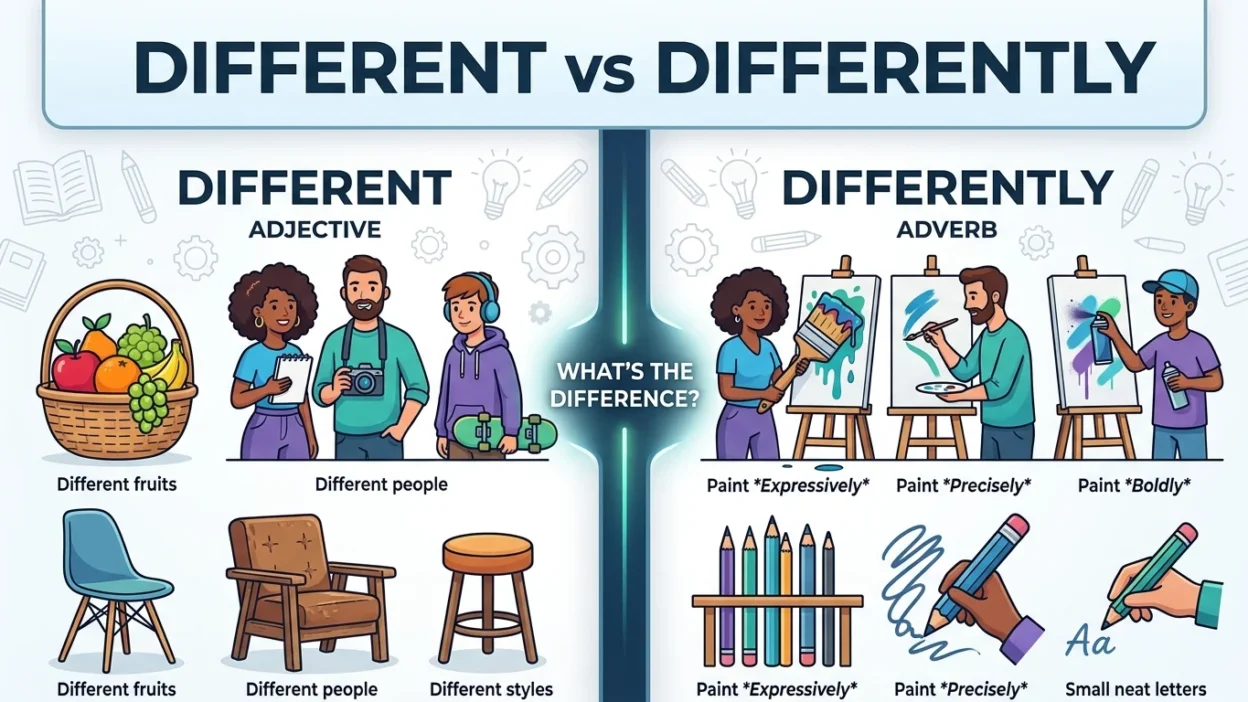
If you are unsure if to say “different” or “differently,” the key is to look at the job the word does in the sentence. Different is usually an adjective that describes a noun, while differently is an adverb that describes how an action happens. For example, “This book is different” and “She thinks differently.”
Although the two words come from the same root, they cannot always be exchanged. English learners often confuse them because both relate to things that are not the same. Understanding if you are describing a person, thing, or idea or explaining how someone does something will help you choose the correct word. This guide explains different vs differently with clear rules, examples, common mistakes, and practical tips.
Quick Answer
Different is an adjective used to describe a noun or pronoun: “We have different opinions.” Differently is an adverb used to describe an action or verb: “We think differently.” Use different when describing what something is like and differently when describing how something happens or is done.
Why Do People Confuse Different and Differently?
People confuse these words because different and differently have the same basic meaning: not the same.
The main difference is grammatical:
- Different = adjective
- Differently = adverb
Compare:
- “They have different ideas.”
- “They think differently.”
In the first sentence, different describes the noun ideas. In the second, differently describes the verb think.
What Does “Different” Mean?
Different is an adjective meaning not the same as another person or thing.
It normally describes a noun or pronoun.
Examples
- We have different opinions.
- She bought a different dress.
- This problem is different.
- They come from different countries.
- His approach is different from mine.
Different in a Sentence
A common structure is:
different + noun
Another common structure is:
be + different
You can also use:
different from + noun
What Does “Differently” Mean?
Differently is an adverb meaning in a different way.
It usually describes a verb or action.
Examples
- She thinks differently.
- He dresses differently.
- They handled the situation differently.
- We approached the problem differently.
- People learn differently.
Here, differently tells us how an action is performed.
Differently in a Sentence
A useful pattern is:
verb + differently
You can also say:
verb + differently from + person/thing
Different vs Differently: Comparison Table
| Word | Part of Speech | Main Function | Example |
|---|---|---|---|
| Different | Adjective | Describes a noun or pronoun | We have different ideas. |
| Differently | Adverb | Describes an action or verb | We think differently. |
| Different | Adjective | Means not the same | This one is different. |
| Differently | Adverb | Means in a different way | She answered differently. |
When Should You Use “Different”?
Use different when you are describing a person, thing, idea, situation, or other noun.
Use “different” for:
- different people
- different ideas
- different opinions
- different methods
- different situations
- different choices
- different results
For example:
Here, different describes goals.
When Should You Use “Differently”?
Use differently when you are describing how an action is performed.
Use “differently” with:
- think differently
- act differently
- behave differently
- speak differently
- work differently
- look at something differently
- approach something differently
For example:
Differently explains how she approaches problems.
10+ Examples of Different vs Differently
1. Different opinions
Different describes the noun opinions.
2. Think differently
Differently describes the verb think.
3. Different methods
The word different describes methods.
4. Work differently
Differently tells us how the machines work.
5. Different answers
Different describes answers.
6. Answer differently
Differently describes how they answered.
7. Different approach
Different describes approach.
8. Approach it differently
Differently describes the way we approach it.
9. Different cultures
Here, different describes cultures.
10. Behave differently
Differently describes behave.
11. Different results
Different describes results.
12. Do it differently
Differently describes how the action should be performed.
Common Mistakes
Mistake 1: Using “differently” before a noun
❌ She has differently ideas.
✅ She has different ideas.
Because ideas is a noun, you need the adjective different.
Mistake 2: Using “different” to describe an action
❌ He thinks different.
✅ He thinks differently.
Because different does not normally function as the adverb modifying thinks in standard modern English.
Mistake 3: Confusing “different” with “different from”
In standard usage, different from is the safest choice.
You may sometimes hear different than or different to, depending on variety and context, but different from is widely accepted and clear.
Mistake 4: Saying “do different”
❌ We should do it different.
✅ We should do it differently.
Here, differently describes how the action is done.
Memory Trick
Remember this simple rule:
Think of the ending -ly as a useful clue. Many adverbs ending in -ly describe how something happens.
- different → describes what
- differently → describes how
Compare:
American vs British English
The basic distinction between different and differently is the same in American and British English.
Both varieties use different as an adjective and differently as an adverb.
For example, speakers in both varieties can say:
and:
There can be differences between varieties in expressions such as different from, different than, and different to, but these do not change the fundamental difference between different and differently.
Similar Words
Several words are closely related to different and differently.
Different
Similar words include:
- distinct
- unlike
- separate
- contrasting
- dissimilar
- varied
Example:
Differently
Related expressions include:
- in a different way
- in another way
- otherwise
- separately
- distinctively
Example:
Final Verdict
Different and differently are both correct words, but they have different grammatical roles.
Use different when you are describing a noun or pronoun:
Use differently when you are describing how an action happens:
The easiest test is to ask yourself: Am I describing a thing, or am I describing an action? If you are describing a thing, choose different. If you are describing how something is done, choose differently.
FAQs:
Is it “different” or “differently”?
It depends on the sentence. Use different as an adjective and differently as an adverb.
Is “think different” grammatically correct?
In standard English, think differently is the normal grammatical expression when differently modifies the verb think. “Think different” can also appear as a deliberate slogan-style expression, but it is not the usual grammatical pattern.
Is it “do it different” or “do it differently”?
Do it differently is the standard choice when you mean “do it in a different way.”
Is “different” an adjective or an adverb?
Different is primarily an adjective.
Differently is the corresponding adverb.
Can “different” describe a verb?
In standard usage, different normally does not modify a verb directly. Use differently when you need an adverb.
What is the difference between “different” and “differently”?
Different describes something that is not the same. Differently means “in a different way.”
Is “different from” correct?
Yes. Different from is a standard and widely accepted construction.
Remember This
Different = not the same
Differently = in a different way
When you are describing a noun, use different. When you are describing how an action happens, use differently
Understanding this small grammatical distinction can make your English sound clearer and more natural. Instead of memorizing every sentence separately, focus on the role of the word. Ask if you are describing a person, object, idea, or situation—or explaining the way an action is performed.
Once you connect different with things and differently with actions, the choice becomes much easier. Remember the simple pattern: different ideas, different people, different results, but think differently, act differently, work differently, and behave differently.

Levi Jack is a creative writer and conversation expert passionate about helping people communicate confidently. At ReplyCorner, he shares charming, witty, and engaging reply ideas that make everyday conversations more enjoyable and memorable.