When describing a person’s body shape, thick, fat, and chubby can all relate to having more body weight or a fuller appearance, but they do not mean exactly the same thing. The biggest differences involve body shape, amount of body fat, age, tone, and the speaker’s attitude. Some words are neutral, while others can sound blunt, rude, affectionate, or judgmental depending on context.
Understanding these differences is especially important for English learners because choosing the wrong word can unintentionally offend someone. Fat directly describes having a larger amount of body fat, while chubby usually suggests a pleasantly or noticeably round, soft appearance. Thick often describes a fuller, curvier body shape and is frequently used positively or neutrally, especially in informal American English.
Quick Answer
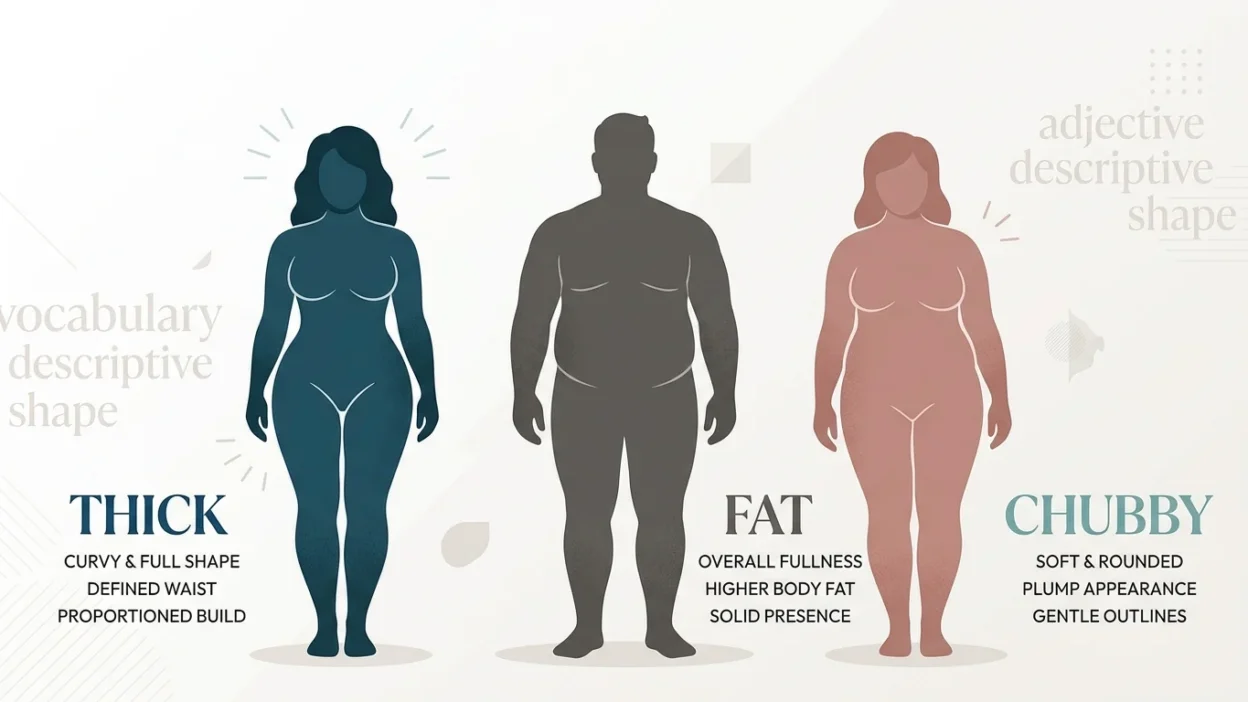
Thick usually describes a full or curvy body, especially with noticeable hips, thighs, or buttocks. Fat directly describes a body with a larger amount of body fat and can sound blunt or negative. Chubby means pleasantly or noticeably plump, often referring to children or softer body features.
Why Do People Confuse Thick, Fat, and Chubby?
People confuse these words because they can all describe someone who does not have a thin or slim body.
However, they focus on different characteristics:
- Thick → fuller, often curvy or broad body shape
- Fat → larger amount of body fat
- Chubby → soft, rounded, or plump appearance
The words also carry different emotional meanings. Fat can sound harsh when used about a person, while chubby may sound softer. Thick is often used as a compliment, particularly in casual speech.
Context matters greatly. A word that sounds acceptable in one situation may be inappropriate in another.
What Does “Thick” Mean?
Thick can describe someone with a fuller, often curvy body. It commonly suggests that a person has substantial hips, thighs, buttocks, or overall body mass.
For example:
In modern informal English, thick can be positive or complimentary. It does not necessarily mean that someone has a high level of body fat.
Examples of “Thick”
- She has a thick waist and strong legs.
- She is short and thick.
- That dress looks great on her thick, curvy figure.
- He has a thick build from years of training.
What Does “Fat” Mean?
Fat is the most direct of the three words. It describes a person, animal, or body part that contains a relatively large amount of body fat.
For example:
When fat is used to describe a person directly, however, it can sound blunt, insensitive, or insulting.
More neutral alternatives may include:
- higher
- plus-size
- larger-bodied
- having a higher body-fat level
The appropriate choice depends on the situation and what exactly you are trying to communicate.
What Does “Chubby” Mean?
Chubby means pleasantly or noticeably plump, round, or soft.
It is especially common when describing children, babies, cheeks, arms, and other rounded features.
For example:
When used for adults, chubby can sound affectionate in some contexts but patronizing or insulting in others.
Thick vs Fat vs Chubby: Comparison Table
| Word | Basic Meaning | Common Impression | Usually Positive? | Typical Context |
|---|---|---|---|---|
| Thick | Full, substantial, often curvy | Curvy or solid | Often | Informal descriptions |
| Fat | Having a large amount of body fat | Larger-bodied | Often neutral in factual contexts, but can sound harsh personally | Direct/factual descriptions |
| Chubby | Soft, round, or plump | Cute, soft, or slightly higher | Sometimes | Children, cheeks, informal speech |
When Should You Use Each Word?
Use “thick” for a fuller or curvier body
Use thick when the main idea is body shape rather than simply body fat.
Use “fat” for direct or factual descriptions
Fat is appropriate when discussing body fat as a physical or medicl characteristic, but be careful when directly labeling another person.
Use “chubby” for a soft or rounded appearance
Chubby works especially naturally for babies and children.
For adults, consider the context and relationship before using it.
Thick vs Fat vs Chubby: 12 Examples
- She is thick and curvy.
→ Her body has a fuller, curvier shape. - The baby has chubby cheeks.
→ The cheeks are soft and round. - The doctor discussed his body-fat percentage.
→ This is a factual health-related context. - She has a thick build.
→ Her body is substantial or solid. - The child looks chubby.
→ The child has a soft, rounded appearance. - The word “fat” can sound rude when directed at someone.
→ The issue is the social tone, not the basic dictionary meaning. - He has thick thighs.
→ His thighs are relatively large or substantial. - Her baby has chubby arms.
→ Her arms look soft and rounded. - The study examined body fat.
→ “Fat” is being used in a scientific context. - She describes herself as thick.
→ She may be using the word positively to describe her body shape. - The child had chubby fingers.
→ The fingers looked short, soft, and rounded. - He has a thick, muscular build.
→ “Thick” refers to substantial body structure rather than necessarily excess fat.
Common Mistakes
Mistake 1: Assuming “thick” always means higher
It does not.
Someone can be thick and muscular, thick and curvy, or simply have a broad build.
Mistake 2: Treating “chubby” as a synonym for “fat”
They overlap, but chubby usually has a softer meaning.
A chubby child, for example, may simply have a round, soft appearance.
Mistake 3: Using “fat” casually to describe another person
Although fat is a legitimate English word, calling someone “fat” can sound offensive.
Instead, choose a more precise and appropriate description when possible.
Mistake 4: Assuming “thick” is always complimentary
In modern informal English, thick is often positive, but not everyone interprets it that way. Context and tone matter.
A Simple Memory Trick
Remember:
- Thick = fuller shape
- Fat = more body fat
- Chubby = soft and round
Think of THICK as shape, FAT as body composition, and CHUBBY as soft roundness.
American vs British English
These three words exist in both American and British English, but their everyday associations can vary.
In American English, thick is commonly used in informal speech to describe a curvy or fuller body, especially in social and popular culture.
Chubby is also common in both varieties and is frequently used for children or specific rounded body parts.
Fat is widely understood in both American and British English. However, directly calling a person “fat” can sound blunt or offensive in either variety.
Similar Words
Depending on your meaning, you may also encounter:
- Plump — pleasantly or moderately full
- higher— weighing more than what is considered healthy or typical for a particular context
- Curvy — having noticeable curves in the body
- Plus-size — commonly used for larger clothing sizes or body types
- Stocky — short and solidly built
- Heavyset — having a large, solid body
- Plump — somewhat rounded or full
- Slim — relatively thin
- Broad — having considerable width, especially in the shoulders or chest
These words are not perfect substitutes because each emphasizes something different.
Final Verdict
Thick, fat, and chubby are related but not interchangeable.
- Thick focuses mainly on a full or curvy body shape.
- Fat directly refers to a larger amount of body fat and can sound blunt when used as a personal label.
- Chubby describes a soft, rounded, or plump appearance, especially in children.
If you are talking about another person, choose your words carefully because the social tone can be just as important as the dictionary meaning.
FAQs:
Is “thick” the same as “fat”?
No. Thick usually emphasizes a fuller or curvier body shape, while fat directly refers to having a larger amount of body fat.
Is “chubby” nicer than “fat”?
Often, chubby sounds softer than fat, especially when describing children. However, it can still be unwelcome when used about an adult.
Does “thick” mean higher?
Not necessarily. A person can be thick because of their natural body shape, muscle mass, or curves without simply being described as higher.
Can “thick” be a compliment?
Yes. In informal English, particularly American English, thick is often used positively to describe an attractive, fuller, or curvier body.
Is it rude to call someone fat?
It can be. Although fat is a normal descriptive word, directly calling another person “fat” may sound insulting or insensitive.
Is “chubby” only used for children?
No. Chubby can describe adults, children, babies, cheeks, arms, fingers, and other rounded features. However, its appropriateness depends strongly on context.
What is a polite alternative to “fat”?
Depending on the situation, you could use higher, plus-size, larger-bodied, or a more specific description of someone’s build. In many situations, it is best not to comment on someone’s body at all.
Remember This
Thick = fuller or curvier shape.
Fat = larger amount of body fat.
Chubby = soft, rounded, or plump appearance.
The three words overlap, but their meanings and emotional tones are different. When describing people, always consider context, politeness, and the listener’s feelings.
Understanding these distinctions will help you choose the right word and avoid accidentally making a description sound rude or judgmental.
Conclusion
Thick, fat, and chubby can all describe fuller bodies, but they emphasize different ideas. Thick commonly focuses on a substantial or curvy shape, fat directly refers to body fat, and chubby suggests a softer, rounded appearance. Knowing these differences makes your English more precise and natural.
When speaking about people, remember that dictionary meaning is only part of the story. Tone and context matter too. If you are unsure if a body-related word could sound offensive, choose a neutral description or avoid commenting on someone’s body altogether.

David Owen is a passionate writer and communication enthusiast dedicated to helping readers craft charming, witty, and thoughtful replies. Through ReplyCorner, he shares creative response ideas that make conversations engaging and memorable.