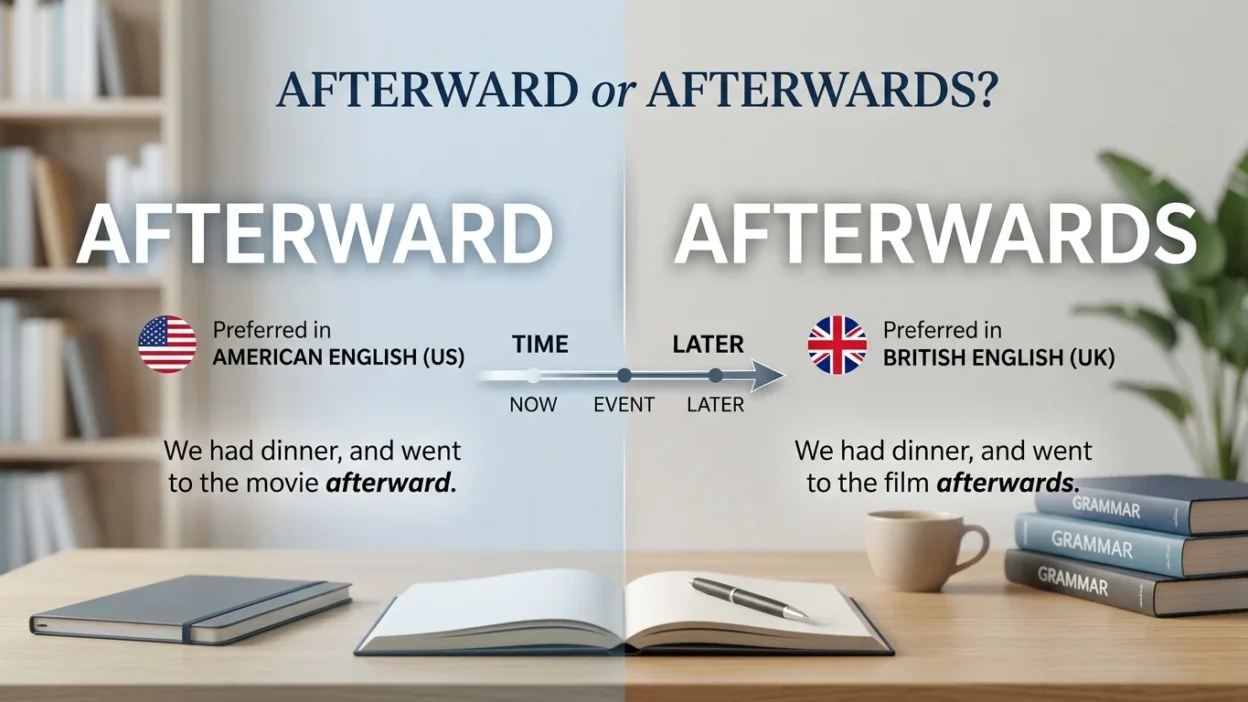
If you are wondering if afterward or afterwards is correct, the answer is simple: both are correct. They have the same meaning and are both used as adverbs to mean “later” or “at a later time.” The main difference is regional preference. Afterward is more common in American English, while afterwards is more common in British English and other varieties of English.
For most learners, there is no need to worry about a major difference in meaning or grammar. You can use either form when talking about something that happens later.
For example, “We went for coffee afterward” and “We went for coffee afterwards” mean essentially the same thing. Understanding this small difference can help you choose the form that sounds most natural for your audience.
Quick Answer
Afterward and afterwards are both correct and mean “later” or “after that.” Afterward is especially common in American English, while afterwards is especially common in British English. Neither form is grammatically wrong, so choose the one that fits your variety of English.
Why Do People Confuse “Afterward” and “Afterwards”?
People often hesitate between these words because they look almost identical. The only difference is the final -s, but that small difference can make learners wonder if one version is incorrect.
The good news is that both forms function as adverbs and generally have the same meaning.
Compare:
- We talked about it afterward.
- We talked about it afterwards.
Both sentences are grammatically correct.
The choice is mainly influenced by regional English usage and personal style.
The First Word: Afterward
Afterward is an adverb meaning later or after something has happened.
It is particularly common in American English.
Examples
- We had dinner and went for a walk afterward.
- She called me afterward to explain what happened.
- I felt tired afterward.
- They discussed the problem afterward.
In each example, afterward refers to something happening later.
The Second Word: Afterwards
Afterwards is also an adverb meaning later or after that.
It is especially common in British English.
Examples
- We went home afterwards.
- She apologized afterwards.
- They had coffee afterwards.
- I realized my mistake afterwards.
The meaning is essentially the same as afterward.
Afterward vs Afterwards: Comparison Table
| Feature | Afterward | Afterwards |
|---|---|---|
| Part of speech | Adverb | Adverb |
| Meaning | Later; after that | Later; after that |
| Grammar | Correct | Correct |
| American English | Very common | Also used |
| British English | Used | Very common |
| Meaning difference | None in normal use | None in normal use |
| Example | We talked afterward. | We talked afterwards. |
When Should You Use Afterward?
Use afterward when you want to say that something happens later, particularly if you are writing in American English.
Examples
- I’ll explain everything afterward.
- We can discuss the details afterward.
- She went home afterward.
- What happened afterward surprised everyone.
- I was exhausted afterward.
If your writing is aimed primarily at an American audience, afterward is a natural choice.
When Should You Use Afterwards?
Use afterwards when you want to express the same idea, especially if you are following British English usage.
Examples
- We’ll have lunch afterwards.
- He felt better afterwards.
- They went shopping afterwards.
- She regretted it afterwards.
- I’ll call you afterwards.
There is no change in meaning simply because you add the -s.
10+ Examples of Afterward and Afterwards
Here are examples showing how naturally both forms can be used.
- We went to the restaurant afterward.
- We went to the restaurant afterwards.
- She felt much better afterward.
- She felt much better afterwards.
- I’ll tell you about it afterward.
- I’ll tell you about it afterwards.
- They talked about the meeting afterward.
- They talked about the meeting afterwards.
- He apologized afterward.
- He apologized afterwards.
- I realized what had happened afterward.
- I realized what had happened afterwards.
Notice that changing afterward to afterwards does not change the basic meaning of any sentence.
Common Mistakes
Mistake 1: Thinking “afterwards” is incorrect
Some learners assume that afterwards is wrong because afterward looks simpler.
Correct: We went home afterwards.
Mistake 2: Thinking the words have different meanings
In ordinary usage, afterward and afterwards do not express different time periods.
Both mean something like later or after that.
Mistake 3: Mixing regional styles unnecessarily
Neither form is wrong, but consistency can make your writing feel more natural.
For example, if you are writing for a British audience, afterwards may sound more familiar. For an American audience, afterward may be the more natural choice.
Mistake 4: Confusing them with “after”
After can function in several ways, while afterward/afterwards specifically functions as an adverb.
- We went home after dinner.
- We went home afterward.
Memory Trick
A simple way to remember the difference is:
Afterward = American preference
Afterwards = British preference
Think of the extra s in afterwards as a feature commonly seen in British English adverbs such as towards.
Remember, though, that this is a preference rather than a strict grammatical rule.
American vs British English
The clearest distinction between the two forms is regional frequency.
American English commonly uses afterward:
British English commonly uses afterwards:
However, both forms can occur in both varieties of English. Therefore, it is inaccurate to say that afterward is only American or afterwards is only British.
The difference is better understood as a matter of usage preference rather than correctness.
Similar Words
Several words and phrases can express a similar idea.
Later
Later means at a subsequent time.
- I’ll call you later.
After that
After that directly refers to the event just mentioned.
- We finished dinner. After that, we went home.
Subsequently
Subsequently means afterward or later and is more formal.
- The company subsequently changed its policy.
Then
Then can refer to a later point in a sequence.
- We had lunch and then went shopping.
Thereafter
Thereafter means from that time onward and is more formal.
- He moved to London and lived there thereafter.
Final Verdict
Afterward and afterwards are both correct. They have the same basic meaning and perform the same grammatical function.
Choose afterward if you prefer the common American English form, and choose afterwards if you prefer the common British English form. In most situations, either one will communicate your meaning clearly.
The important thing is not to treat one as grammatically correct and the other as grammatically incorrect.
FAQs:
Is “afterward” or “afterwards” correct?
Both afterward and afterwards are correct. They are adverbs meaning “later” or “after that.” The choice often depends on regional preference.
Is “afterwards” British or American?
Afterwards is particularly common in British English, although it is also used in American English.
Is “afterward” American English?
Afterward is particularly common in American English, although British speakers also use it.
Do afterward and afterwards mean the same thing?
Yes. In normal usage, afterward and afterwards have the same meaning: “later” or “after that.”
Can I use “afterwards” in American English?
Yes. Afterwards is grammatically acceptable in American English, even though afterward is often preferred.
Can I use “afterward” in British English?
Yes. Afterward is also used in British English. It is not grammatically incorrect.
Which is better for formal writing?
Neither is inherently more correct or formal. Choose according to the variety of English you are using and maintain consistency.
Remember This
- Afterward = later; after that
- Afterwards = later; after that
- Both are grammatically correct.
- Afterward is especially common in American English.
- Afterwards is especially common in British English.
- The difference is mainly regional preference, not meaning.
Conclusion
When choosing between afterward or afterwards, you do not need to worry about choosing the “correct” word because both forms are standard English. They function as adverbs and normally mean “later” or “after that.” The main difference is that afterward is more strongly associated with American English, while afterwards is more strongly associated with British English.
For everyday writing, simply choose the version that matches your preferred variety of English. If you are writing for an American audience, afterward may sound more natural; for a British audience, afterwards may be more familiar. Most importantly, remember that both forms are correct and clear.

Levi Jack is a creative writer and conversation expert passionate about helping people communicate confidently. At ReplyCorner, he shares charming, witty, and engaging reply ideas that make everyday conversations more enjoyable and memorable.