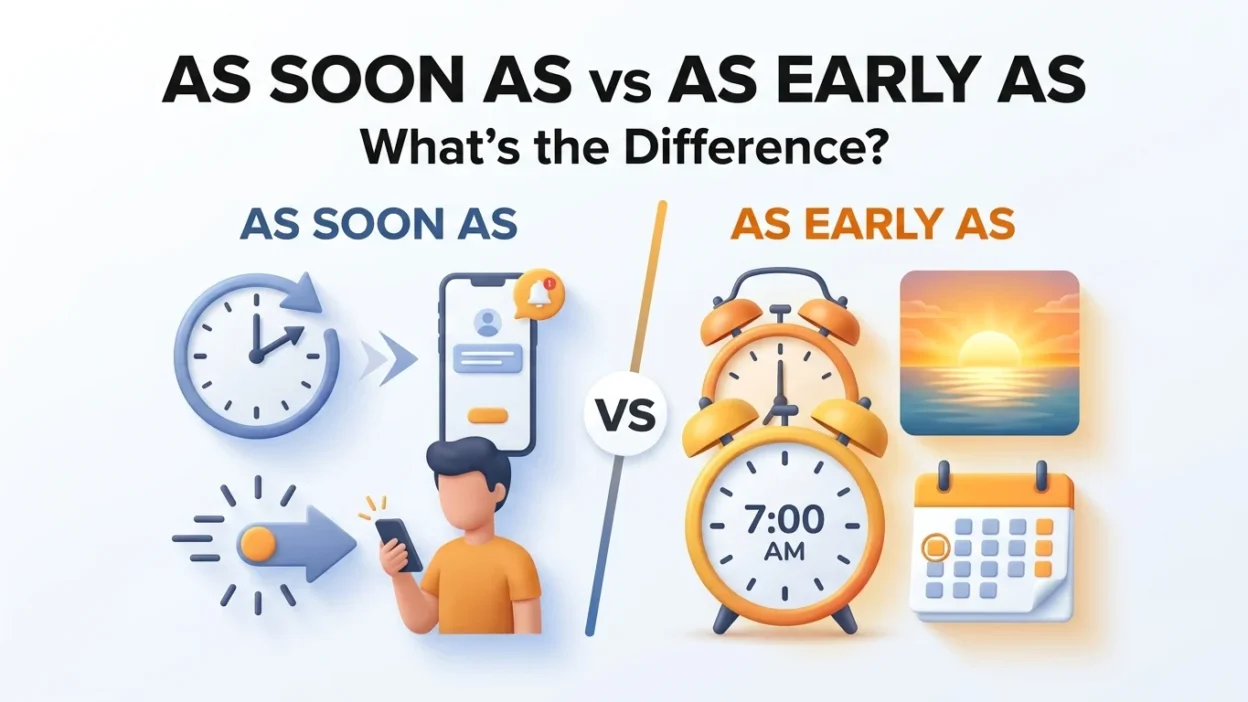
If you are confused about “as soon as” or “as early as,” the two phrases are both correct, but they express different ideas. As soon as means immediately or shortly after something happens, while as early as means at an early time, sometimes earlier than expected. For example, “Call me as soon as you arrive” focuses on immediacy, while “You can arrive as early as 7 a.m.” focuses on the earliest possible time.
Although the phrases look similar, they cannot always replace each other. Understanding the difference will help you choose the right expression in everyday conversations, emails, schedules, instructions, and formal writing. The key is to ask yourself if you are talking about what happens immediately or how early something can happen.
Quick Answer
As soon as means “immediately when” or “right after,” while as early as means “at an early time” or “no earlier than a specified time.” Use as soon as for sequence and immediacy, and as early as for an early time, date, age, or possible starting point.
Why Do People Confuse “As Soon As” and “As Early As”?
People often confuse these phrases because both begin with “as” and can describe timing.
However, they answer different questions:
- As soon as → When should something happen after another event?
- As early as → What is the earliest time something can happen?
Compare these sentences:
- I will call you as soon as I get home.
- I can call you as early as 6 a.m.
The first sentence tells us that the call will happen immediately after the speaker gets home. The second tells us the speaker is available from 6 a.m. onward.
First Word: “As Soon As”
As soon as is a conjunction that connects two events. It means immediately after something happens or at the first possible moment following an event.
Common pattern
As soon as + event, main clause
Examples:
- As soon as I finish work, I will call you.
- I will let you know as soon as I hear anything.
- She left as soon as the meeting ended.
It can also appear after the main clause:
- I will call you as soon as I arrive.
- He went home as soon as he finished his work.
The important idea is immediate sequence.
Second Word: “As Early As”
As early as means at an early time or date, often referring to the earliest possible point.
It is commonly followed by a specific time, date, age, or period.
Examples:
- The store opens as early as 6 a.m.
- You can apply as early as Monday.
- Children as early as five years old can participate.
- The product could arrive as early as tomorrow.
Here, the focus is not on what happens immediately after another event. Instead, the phrase identifies how early something may happen.
As Soon As vs As Early As: Comparison Table
| Phrase | Meaning | Main Focus | Common Use | Example |
|---|---|---|---|---|
| As soon as | Immediately after | Sequence and immediacy | Events | I will call as soon as I arrive. |
| As early as | At an early time | Earliest possible point | Times, dates, ages, periods | You can arrive as early as 7 a.m. |
A simple way to remember the distinction is:
Soon = immediately after something.
Early = before a later or expected time.
When Should You Use “As Soon As”?
Use as soon as when one action or event happens immediately after another.
1. To talk about immediate action
- Call me as soon as you get home.
- Please reply as soon as possible.
2. To describe a sequence of events
- She left as soon as the meeting ended.
- We started eating as soon as everyone arrived.
3. To give instructions
- Submit the form as soon as you finish it.
- Tell your teacher as soon as you notice the problem.
4. To talk about future events
- I will send the documents as soon as I receive them.
- We will start as soon as the manager arrives.
When Should You Use “As Early As”?
Use as early as when you want to emphasize an early time, date, age, or point.
1. With a specific time
- You can come as early as 8 a.m.
- The office may open as early as 7:30 a.m.
2. With a date
- The package could arrive as early as Monday.
- Registration may begin as early as next week.
3. With an age
- Children as early as six can join the program.
- Some students begin learning another language as early as age four.
4. With an expected period
- The new version could be released as early as this summer.
- The repairs may be completed as early as tomorrow.
10+ Examples of “As Soon As” and “As Early As”
Examples with “As Soon As”
- I will call you as soon as I arrive.
- Let me know as soon as you hear the news.
- She went to bed as soon as she finished studying.
- We will leave as soon as the rain stops.
- He answered as soon as the phone rang.
- Please send the report as soon as possible.
Examples with “As Early As”
- You can arrive as early as 7 a.m.
- The store may open as early as Monday.
- The train can leave as early as 5:30 a.m.
- Some children start school as early as age four.
- We could finish the project as early as next week.
- The doctor may see you as early as tomorrow.
Notice that the first group focuses on what happens immediately, whereas the second group focuses on the earliest possible time.
Common Mistakes
Mistake 1: Using “as early as” for immediate action
Incorrect:
Call me as early as you get home.
Better:
Call me as soon as you get home.
The speaker means “immediately after you get home,” so as soon as is required.
Mistake 2: Using “as soon as” for an earliest time
Incorrect:
You can arrive as soon as 7 a.m.
If you mean that 7 a.m. is the earliest permitted arrival time, use:
You can arrive as early as 7 a.m.
Mistake 3: Thinking “soon” and “early” mean the same thing
They do not.
Soon relates to a short amount of time or immediate sequence.
Early relates to a point that occurs before a later, expected, or usual time.
Mistake 4: Confusing “as soon as possible” with “as early as possible”
These expressions are related but slightly different.
- As soon as possible = at the earliest opportunity, emphasizing promptness.
- As early as possible = at the earliest time, emphasizing an early starting point.
For example:
Please reply as soon as possible.
This asks for a prompt response.
Please arrive as early as possible.
This asks the person to arrive at the earliest suitable time.
Memory Trick
Use this simple trick:
SOON = sequence
Think: “What happens immediately after?”
EARLY = earliest point
Think: “What is the earliest time?”
If there is another event that triggers the next action, as soon as is usually the phrase you need.
If there is a clock time, date, age, or period showing the earliest point, as early as is usually appropriate.
American vs British English
Both as soon as and as early as are standard expressions in both American and British English.
There is no major difference in meaning between American and British English for these phrases.
For example, both varieties commonly use:
- I will call you as soon as I arrive.
- You can arrive as early as 8 a.m.
- The meeting may start as early as Monday.
The choice depends on the intended meaning rather than the variety of English.
Similar Words and Expressions
Several expressions are related to as soon as and as early as, but their meanings are not identical.
Similar to “as soon as”
- immediately
- right after
- once
- when
- the moment
- at the earliest opportunity
- as quickly as possible
Example:
I will contact you as soon as I know.
Similar:
I will contact you immediately after I know.
Similar to “as early as”
- at the earliest
- from
- starting as early as
- at an early stage
- before
- by
Example:
The service is available as early as 6 a.m.
Similar:
The service is available from 6 a.m.
However, these alternatives are not always interchangeable because their exact meanings and grammatical structures can differ.
Final Verdict: As Soon As or As Early As?
Both as soon as and as early as are correct, but they serve different purposes.
Use as soon as when you mean immediately after something happens:
Use as early as when you mean at an early or earliest possible time:
The easiest distinction is sequence versus earliest timing. If one event triggers another, choose as soon as. If you are identifying an early time, date, age, or starting point, choose as early as.
FAQs:
Is “as soon as” or “as early as” correct?
Both are correct. As soon as means immediately after an event, while as early as refers to an early or earliest possible time, date, age, or period.
What is the difference between “as soon as” and “as early as”?
As soon as focuses on immediacy and sequence. As early as focuses on how early something can happen.
Can I say “as early as tomorrow”?
Yes. As early as tomorrow means that tomorrow is the earliest possible or expected time something could happen.
Can I say “as soon as tomorrow”?
Yes, but it has a different emphasis. As soon as tomorrow means that tomorrow could be the first time something happens, with emphasis on how soon it could occur.
Is “as soon as possible” the same as “as early as possible”?
Not exactly. As soon as possible emphasizes prompt action or the earliest opportunity. As early as possible emphasizes choosing an early time.
Is “as early as” used with times?
Yes. It is commonly used with clock times.
Is “as soon as” used for future events?
Yes. It is very common when discussing future actions.
Which phrase should I use for “immediately after”?
Use as soon as.
Remember This
- As soon as = immediately after
- As early as = at an early or earliest time
- Soon focuses on immediacy.
- Early focuses on timing before something later or expected.
- Use as soon as for sequences of events.
- Use as early as with times, dates, ages, and possible starting points.
Conclusion
Understanding as soon as or as early as becomes much easier when you focus on the meaning of soon and early. As soon as connects two events and shows that the second event happens immediately after the first. As early as identifies an early or earliest possible time, date, age, or period.
When you are writing or speaking, ask yourself one simple question: Am I describing what happens immediately after something, or am I identifying the earliest time something can happen? Choose as soon as for the first meaning and as early as for the second. This small distinction can make your English more precise and natural.

John Leo is a skilled writer and communication enthusiast who specializes in crafting charming, witty, and thoughtful replies. Through ReplyCorner, he helps readers improve conversations with creative responses for everyday social interactions.