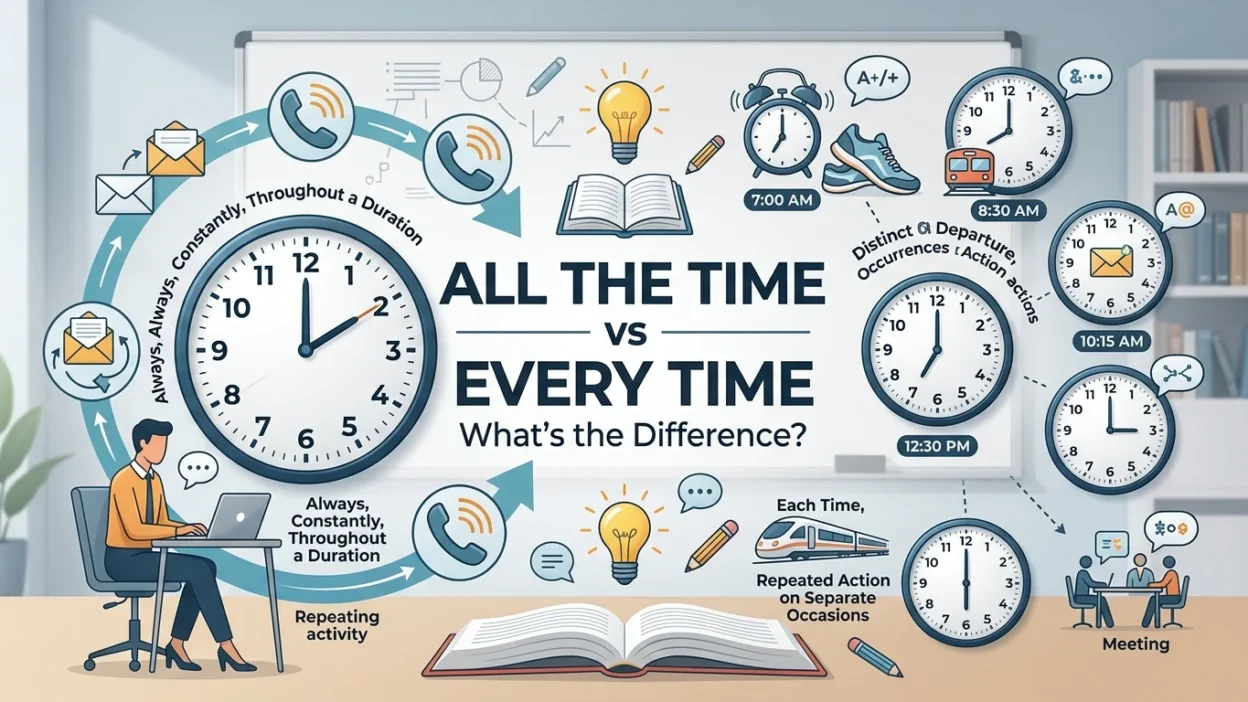
If you are unsure if to say “all the time” or “every time,” you are not alone. These phrases look similar, but they describe different ideas. “All the time” usually means continuously, very often, or on a regular basis. “Every time” means each time something happens or whenever a particular situation occurs.
For example, “She talks on the phone all the time” means she talks on the phone very frequently. However, “She smiles every time she sees her friend” means she smiles on each occasion when she sees her friend. Understanding this small difference can help you choose the right phrase in everyday conversation and writing.
Quick Answer
“All the time” means continuously, frequently, or very often, while “every time” means on each occasion or whenever something happens. Use all the time for repeated or ongoing behavior and every time when you mean each individual occurrence.
Why Do People Confuse “All the Time” and “Every Time”?
People confuse these expressions because both describe repeated actions or events. They can appear in similar sentences, but their meanings are not identical.
The main difference is frequency versus individual occasions:
- All the time = continuously or very frequently
- Every time = each time something happens
Compare these examples:
- My brother plays video games all the time.
- My brother gets excited every time he wins.
The first sentence describes frequent behavior. The second refers to each individual occasion on which he wins.
What Does “All the Time” Mean?
“All the time” is an adverbial phrase meaning continuously, constantly, frequently, or very often, depending on the context.
It does not always mean something literally happens every second.
For example:
This usually means she complains very frequently, not that she complains without stopping.
Examples of “All the Time”
- I think about that song all the time.
- He is busy all the time.
- They argue all the time.
- We see each other all the time.
What Does “Every Time” Mean?
“Every time” means each time something happens or whenever a particular event occurs.
It focuses on individual occasions.
For example:
This means that whenever you visit her, she makes coffee.
Examples of “Every Time”
- Every time I call him, he is busy.
- She laughs every time she hears that joke.
- Every time it rains, the road floods.
- He checks his phone every time he hears a notification.
All the Time vs Every Time: Comparison Table
| Phrase | Meaning | Main idea | Example |
|---|---|---|---|
| All the time | Constantly, frequently, or very often | General frequency | She studies all the time. |
| Every time | Each time or whenever | Individual occasions | She smiles every time I see her. |
The simplest way to remember the difference is that all the time describes how frequently something happens, while every time identifies each occasion when it happens.
When Should You Use “All the Time”?
Use all the time when you want to say that something happens very frequently, repeatedly, or almost constantly.
When Should You Use “Every Time”?
Use every time when you mean each occasion or whenever a specific event occurs.
All the Time vs Every Time: 12 Examples
- I watch television all the time.
This means I watch television very frequently. - I watch that show every time it is on.
This means I watch it on each occasion when it is broadcast. - She talks about her new job all the time.
She talks about it very frequently. - She calls me every time she has a problem.
She calls on each occasion when she has a problem. - They are traveling all the time.
They travel very frequently. - Every time they travel, they take lots of photos.
This happens on each trip. - He checks his email all the time.
He checks it very frequently. - He checks his email every time he gets a notification.
He does it whenever a notification arrives. - We eat out all the time.
Eating out is very common for us. - Every time we eat out, we order dessert.
Ordering dessert happens on each occasion. - My dog follows me all the time.
The dog follows me very frequently or almost constantly. - My dog barks every time someone comes to the door.
The barking happens whenever someone comes to the door.
Common Mistakes
Mistake 1: Using “every time” to mean “very often”
Incorrect:
If you mean that you go to the gym very frequently, all the time may be more appropriate:
However, every time can be correct if you provide an event or condition:
Mistake 2: Assuming “all the time” means literally every second
This normally means she talks very frequently or seems to talk constantly. It does not necessarily mean she speaks without stopping.
Mistake 3: Confusing “every time” with “everytime”
Every time is written as two words.
Correct:
Incorrect:
Memory Trick
Think of the words this way:
ALL = the whole period or frequent behavior
EVERY = each individual occasion
So:
Ask yourself:
“Am I talking about frequent behavior?” → all the time
“Am I talking about each occasion?” → every time
American vs British English
Both all the time and every time are standard expressions in both American and British English.
There is no major American-versus-British difference in their basic meanings:
- all the time = constantly, frequently, or very often
- every time = each time or whenever
For example, these sentences are natural in both varieties:
The important issue is meaning, not regional variety.
Similar Words and Expressions
Several expressions are related to all the time and every time, but they are not always interchangeable.
Similar to “All the Time”
- constantly
- continually
- frequently
- often
- regularly
- repeatedly
- always
- very often
For example:
can become:
Similar to “Every Time”
- each time
- whenever
- on every occasion
- each occasion
For example:
can also be expressed as:
Final Verdict
All the time and every time are both correct expressions, but they serve different purposes.
Use all the time when you mean constantly, frequently, or very often. Use every time when you mean each time something happens or whenever a particular situation occurs.
A useful comparison is:
The first focuses on frequency. The second focuses on each specific occasion.
FAQs:
Is “all the time” the same as “every time”?
No. All the time usually means constantly or very frequently, while every time means each time something happens.
Is “every time” one word or two?
Every time is written as two words. “Everytime” is not standard English.
Can I say “I do it all the time”?
Yes. This is a natural expression meaning that you do something very frequently or regularly.
Can I say “I do it every time”?
Yes, but every time generally needs a context that identifies the occasions.
For example:
Does “all the time” mean always?
Sometimes it can have a similar meaning, but all the time often means very frequently rather than literally without interruption.
Is “every time” formal English?
Yes. Every time is standard English and can be used in both casual and formal contexts.
Which is correct: “all time” or “all the time”?
The usual expression meaning “constantly” or “very frequently” is all the time.
Remember This
All the time = frequently, constantly, or very often.
Every time = each time or whenever.
If you are describing how often something generally happens, choose all the time. If you are talking about each individual occasion, choose every time.
Conclusion
The difference between all the time vs every time becomes much easier once you focus on what each phrase emphasizes. All the time describes frequent or continuous behavior, while every time refers to each occurrence of a particular event.
Remember the simple rule: all the time = frequent/constant behavior; every time = each occasion. Use this distinction when speaking and writing, and your sentences will sound clearer and more natural.