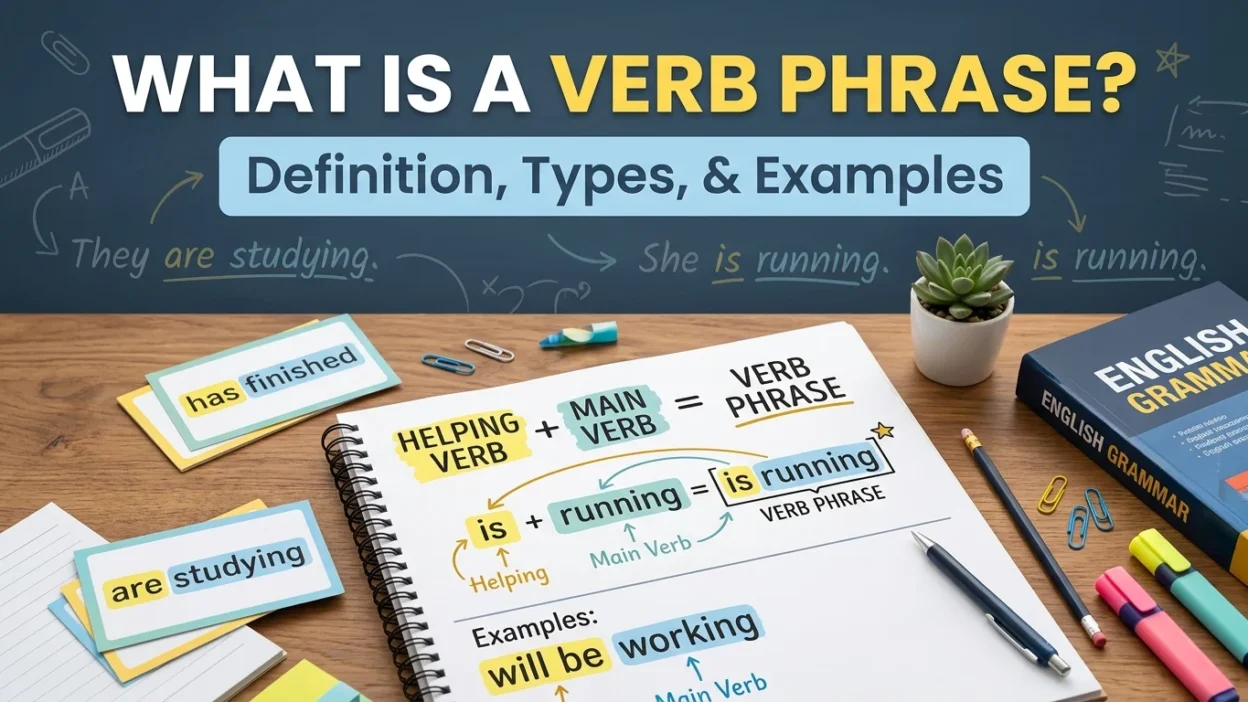
A verb phrase is a group of words that works together to express an action, an occurrence, or a state of being. It contains a main verb and may include one or more helping verbs (also called auxiliary verbs). For example, in the sentence “She is reading a book,” the verb phrase is “is reading.” It tells us what the subject is doing.
Understanding verb phrases is important for students, English learners, and anyone who wants to improve their grammar and sentence structure. Verb phrases help communicate when something happens, if an action is continuing, completed, or expected to happen in the future. They also help express possibility, necessity, ability, and other meanings. In this guide, you will learn the meaning of a verb phrase, its different types, how to identify one, and how to use it correctly in everyday English.
Quick Answer: What Is a Verb Phrase?
A verb phrase is a group of words containing a main verb and, when needed, one or more helping verbs. It expresses an action, event, or state of being. For example, “has finished,” “will be working,” and “is sleeping” are verb phrases because their words work together as a verb unit.
Why Do People Confuse Verb Phrases?
People often confuse verb phrases with single verbs because both perform similar grammatical functions in sentences. However, a verb phrase can contain several words that work together to express a complete verbal meaning.
For example:
- She writes every day. (Single verb)
- She is writing a letter. (Verb phrase)
- They have been waiting for an hour. (Verb phrase)
Another common source of confusion is the difference between a verb phrase and a complete sentence. A verb phrase does not usually express a complete thought by itself because it needs a subject and may need additional information.
Understanding the main verb, helping verbs, and their relationship makes this topic much easier.
What Is a Verb?
A verb is a word that expresses an action, an event, or a state of being. It is one of the most important parts of speech because it tells readers what happens in a sentence.
Examples of verbs include:
- Run
- Eat
- Write
- Sleep
- Think
- Become
- Seem
- Understand
Examples in sentences:
- Sarah runs every morning.
- The children play outside.
- He understands the lesson.
- They seem happy.
- My brother became a teacher.
In these sentences, the bolded action or state words function as verbs.
What Is a Verb Phrase?
A verb phrase is a grammatical unit built around a main verb. It may include helping verbs that provide additional information about tense, aspect, voice, mood, or possibility.
A verb phrase can contain:
- A main verb only.
- A main verb and one helping verb.
- A main verb and multiple helping verbs.
Examples:
- She is dancing.
- He has completed his homework.
- They will be traveling tomorrow.
- We have been studying English.
- The window was broken during the storm.
In these examples, the complete verb phrases communicate the actions or states described in the sentences.
Main Verb and Helping Verb
A main verb carries the central meaning of a verb phrase. A helping verb supports the main verb by adding grammatical information.
Common helping verbs include:
- Be: am, is, are, was, were, being, been
- Have: has, have, had
- Do: do, does, did
- Modal verbs: can, could, may, might, must, shall, should, will, and would
For example:
In “She has been working,” the main verb is “working,” while “has” and “been” are helping verbs.
Verb Phrase Comparison Table
| Feature | Main Verb | Helping Verb | Complete Verb Phrase |
|---|---|---|---|
| Meaning | Carries the main action | Supports the main verb | Expresses the complete verbal meaning |
| Example | Eating | Is | Is eating |
| Example | Finished | Has | Has finished |
| Example | Studying | Will be | Will be studying |
| Function | Describes an action or state | Adds grammatical information | Forms the verb unit |
When Should You Use a Verb Phrase?
Use a verb phrase when you need to communicate more than the basic action or state expressed by a main verb.
Here are some common situations:
1. To Express an Ongoing Action
Use a form of “be” with an -ing verb to describe an action in progress.
Example: She is cooking dinner.
2. To Describe a Completed Action
Use a form of “have” with a past participle to express a completed action.
Example: They have finished the project.
3. To Talk About the Future
Use “will” with a main verb to express a future action.
Example: I will visit my grandmother tomorrow.
4. To Express Ability
Use “can” or “could” with a main verb.
Example: He can speak three languages.
5. To Express Necessity
Use “must” or “have to” to communicate obligation or necessity.
Example: You must follow the instructions.
6. To Form Passive Sentences
Use a form of “be” with a past participle.
Example: The cake was baked by my mother.
15 Examples of Verb Phrases in Sentences
The following examples show how verb phrases work in everyday English.
- She is reading a novel.
- They have completed their assignments.
- I will call you tomorrow.
- He was sleeping when I arrived.
- We are learning English.
- The students have been preparing for their exams.
- My father can drive a car.
- You should respect your elders.
- She has written three letters.
- The children were playing in the garden.
- I am going to the market.
- They might visit us next week.
- The work will be completed soon.
- He had been waiting for an hour.
- We must finish this task today.
Each bolded group is a verb phrase. Notice how helping verbs change the meaning and grammatical function of the main verb.
Common Mistakes When Using Verb Phrases
English learners sometimes make mistakes when combining main verbs and helping verbs. Here are some common errors and their corrections.
Mistake 1: Using the Wrong Verb Form
Incorrect: She is write a letter.
Correct: She is writing a letter.
Explanation: After the helping verb “is” in the present progressive tense, use the -ing form of the main verb.
Mistake 2: Forgetting the Helping Verb
Incorrect: They going to school.
Correct: They are going to school.
Explanation: The present progressive construction requires a form of “be” before the -ing verb.
Mistake 3: Using the Wrong Past Participle
Incorrect: He has went home.
Correct: He has gone home.
Explanation: The present perfect construction uses “has” or “have” followed by the past participle.
Mistake 4: Using Two Main Verbs Incorrectly
Incorrect: She can sings beautifully.
Correct: She can sing beautifully.
Explanation: A modal helping verb such as “can” is followed by the base form of the main verb.
Mistake 5: Confusing a Verb Phrase With a Complete Sentence
Incorrect: Has been working all day.
Correct: She has been working all day.
Explanation: The first example is a verb phrase without an expressed subject. It can be appropriate in certain contexts, but it is not a complete standard sentence on its own.
How to Remember a Verb Phrase
An easy way to remember a verb phrase is to think of it as a team of words working together to express an action or state.
Remember this simple formula:
Helping Verb(s) + Main Verb = Verb Phrase
Examples:
- Is + running = Is running
- Has + finished = Has finished
- Will + travel = Will travel
- Have + been + waiting = Have been waiting
Keep in mind that a verb phrase does not always need a helping verb. A single main verb can also function as a verb phrase in traditional grammar.
Verb Phrases in American vs. British English
Verb phrases follow mostly the same grammatical rules in American and British English. The basic structures involving helping verbs, main verbs, tenses, and modal verbs are shared.
However, there are some differences in how certain verb phrases are commonly used.
| Situation | American English | British English |
|---|---|---|
| Recent completed action | I just ate. | I’ve just eaten. |
| Have something | Do you have a car? | Have you got a car? |
| Future arrangement | I’m going to meet him. | I’m going to meet him. |
| Obligation | I have to leave. | I have to leave. |
These are tendencies rather than strict rules. Both varieties use perfect constructions, and both accept many of the same verb phrase structures.
Similar Words and Related Grammar Terms
Understanding related grammar terms can help you recognize verb phrases more easily.
1. Verb
A verb expresses an action, occurrence, or state.
Example: She sings beautifully.
2. Auxiliary Verb
An auxiliary verb is a helping verb that works with a main verb.
Example: They are playing football.
3. Modal Verb
A modal verb expresses ability, possibility, permission, advice, or necessity.
Example: You should study harder.
4. Phrasal Verb
A phrasal verb consists of a verb and one or more particles, such as an adverb or preposition, that create a particular meaning.
Example: Please turn off the lights.
5. Verb Clause
A clause contains a subject and a verb phrase.
Example: She is reading a book.
6. Predicate
The predicate is the part of a sentence that says something about the subject. It includes the verb phrase and may contain additional information.
Example: The children are playing in the park.
Final Verdict: What Does Verb Phrase Mean?
A verb phrase is a group of words that functions as the verb in a sentence. It contains a main verb and may include helping verbs to express tense, aspect, voice, mood, or other grammatical meanings.
For example, “is running,” “has completed,” and “will be working” are all verb phrases. Learning to identify them helps you understand sentence structure, improve your grammar, and communicate more naturally in English.
FAQs:
1. What is a verb phrase in simple words?
A verb phrase is a word or group of words that works as the verb in a sentence. It includes a main verb and may have helping verbs. For example, “is sleeping” and “has finished” are verb phrases.
2. What are 5 examples of verb phrases?
Five examples of verb phrases are:
- Is running
- Have eaten
- Will travel
- Was sleeping
- Has been working
Each example contains a main verb, sometimes supported by one or more helping verbs.
3. What are the three parts of a verb phrase?
A verb phrase does not always have three parts. It can contain a main verb alone or a main verb with helping verbs. For example, “will have finished” contains two helping verbs (will and have) and one main verb (finished).
4. What is the difference between a verb and a verb phrase?
A verb is an individual word that expresses an action or state, while a verb phrase is the grammatical verb unit in a sentence. A verb phrase can consist of one verb or several verbs working together.
5. Can a verb phrase be one word?
Yes. In traditional grammar, a single main verb can function as a verb phrase. For example, “She sings” contains the one-word verb phrase “sings.”
6. How do you identify a verb phrase in a sentence?
First, find the main verb that expresses the action or state. Then identify any helping verbs connected to it. Together, these words form the verb phrase.
Example: In “They have been waiting,” the verb phrase is “have been waiting.”
7. What is the difference between a verb phrase and a phrasal verb?
A verb phrase is a grammatical unit containing a main verb and possibly helping verbs. A phrasal verb is a combination of a verb and a particle that creates a particular meaning. For example, “is looking” is a verb phrase, while “look after” is a phrasal verb.
8. Why are verb phrases important in English grammar?
Verb phrases help express actions, time, possibility, ability, necessity, and other meanings. They make sentences more informative and help speakers communicate ideas accurately.
Remember This
- A verb phrase functions as the verb unit in a sentence.
- It always contains a main verb.
- It may contain one or more helping verbs.
- Helping verbs add grammatical information.
- A single main verb can also function as a verb phrase.
- Verb phrases are important for forming different tenses and sentence structures.
Conclusion
A verb phrase is an essential part of English grammar because it helps express actions, events, and states of being. It can contain a single main verb or a combination of helping verbs and a main verb. Examples such as “is studying,” “has completed,” and “will be traveling” show how different verb phrases communicate different meanings.
By learning how to identify and use verb phrases, you can build better sentences, avoid common grammatical mistakes, and improve your English communication skills. Practice finding verb phrases in everyday sentences, and you will become more confident in using them correctly.