English spelling can sometimes be confusing, especially when two words look almost identical but have different meanings. One common example is envelop or envelope. These words differ by only one letter at the end, but they are not interchangeable.
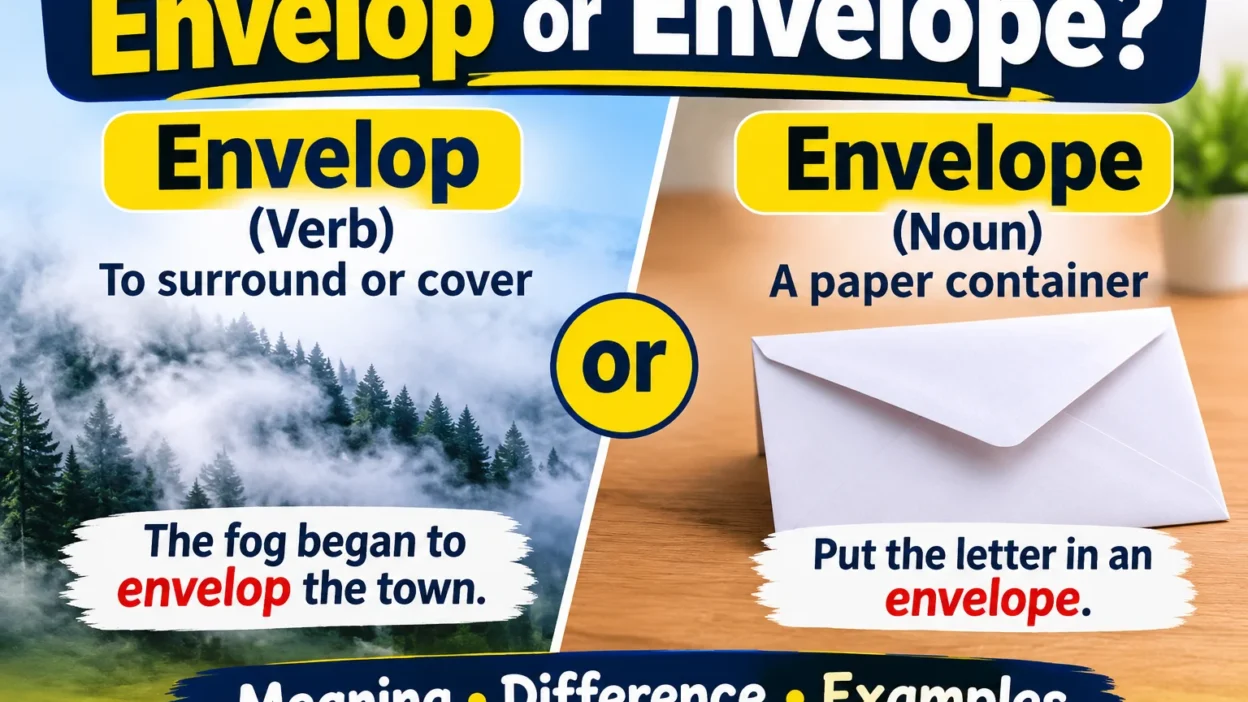
The correct choice depends on what you want to express. Envelop is a verb that means to surround, cover, or wrap something completely. Envelope is a noun that refers to a flat paper container used for holding letters, documents, or cards. Although both words are related to the idea of covering or surrounding something, they have different grammatical functions.
Understanding the difference between envelop and envelope will help you avoid spelling mistakes in emails, school assignments, business writing, and everyday conversations. In this guide, you will learn their meanings, pronunciation, differences, and practical examples so you can use each word correctly.
Quick Answer: Envelop or Envelope?
Envelop and envelope are both correct English words, but they have different meanings. Envelop is a verb meaning to surround or cover completely, while envelope is a noun meaning a paper container used for letters or documents. Use envelop for an action and envelope for a physical object.
Why Do People Confuse Envelop and Envelope?
People often confuse these words because their spellings are almost identical. Both begin with the same six letters, and their meanings are historically connected to the idea of wrapping or covering something.
Another reason for the confusion is pronunciation. Both words sound similar, particularly when spoken quickly. However, their grammatical roles make the difference clear.
Here are the main reasons for the confusion:
- Similar spelling: Both words share the same first six letters.
- Related meanings: Both are associated with covering or wrapping.
- Different word forms: One is a verb, while the other is a noun.
- Pronunciation similarities: Their sounds can be difficult for English learners to distinguish.
The easiest way to remember the difference is to focus on if you are describing an action or an object.
What Does Envelop Mean?
Envelop is a verb that means to surround, cover, wrap, or completely enclose something.
It describes an action in which something is covered or surrounded by another thing. It is commonly used in descriptive, literary, and everyday English.
Meaning of Envelop
According to its standard English meaning, to envelop something is to surround it completely or cover it from all sides.
For example:
- Thick smoke began to envelop the building.
- Darkness seemed to envelop the entire forest.
- A warm blanket can envelop your body.
- Clouds slowly enveloped the mountain.
In these examples, envelop describes something surrounding or covering another object.
Envelop as a Verb
Envelop is the base form of a verb. It can be used in different tenses.
| Verb form | Example |
|---|---|
| Present | The fog envelops the town. |
| Past | The smoke enveloped the house. |
| Present participle | Mist is enveloping the valley. |
| Past participle | The village was enveloped in darkness. |
Synonyms of Envelop
Some useful synonyms include:
- Surround
- Enclose
- Cover
- Wrap
- Shroud
- Engulf
- Immerse
- Blanket
The best synonym depends on the context. For example, smoke can envelop a building, while darkness can shroud a landscape.
What Does Envelope Mean?
Envelope is a noun that refers to a flat paper container used to hold letters, documents, invitations, greeting cards, or other written materials.
It usually has a flap that can be sealed to keep its contents secure.
Meaning of Envelope
An envelope is something you put a letter or document inside before mailing or presenting it to someone.
For example:
- I put the invitation inside an envelope.
- Please write your address on the envelope.
- She received an envelope in the mail.
- He sealed the envelope before sending the letter.
In these sentences, envelope refers to a physical object rather than an action.
Envelope as a Noun
Envelope is a countable noun. It can be singular or plural.
| Form | Example |
|---|---|
| Singular | I need an envelope. |
| Plural | She bought five envelopes. |
| With an adjective | He used a white envelope. |
| With a possessive | This is my envelope. |
Types of Envelopes
Different types of envelopes are used for different purposes.
- Business envelope: Commonly used for professional letters.
- Window envelope: Contains a transparent section that displays an address.
- Padded envelope: Provides extra protection for items.
- Greeting card envelope: Designed to hold greeting cards.
- Document envelope: Used for larger papers and important documents.
Envelop vs Envelope: Key Differences
Although these words look similar, their meanings and grammatical functions are different.
| Feature | Envelop | Envelope |
|---|---|---|
| Part of speech | Verb | Noun |
| Meaning | To surround or cover | A paper container |
| Main purpose | Describes an action | Names an object |
| Example | Smoke enveloped the house. | I opened the envelope. |
| Related forms | Envelops, enveloped, enveloping | Envelopes |
| Usage | Descriptive writing | Everyday and business writing |
The main difference: Envelop describes the action of surrounding something, whereas envelope names the object used to carry letters or documents.
When Should You Use Envelop or Envelope?
Choosing between these words becomes easier when you understand the context.
When to Use Envelop
Use envelop when you want to describe something surrounding, covering, or completely enclosing another thing.
Examples:
- Fog began to envelop the city.
- The darkness enveloped the room.
- A sense of calm enveloped her.
- Flames quickly enveloped the wooden structure.
- The thick clouds enveloped the mountain.
Remember that envelop is an action word.
When to Use Envelope
Use envelope when you are talking about a paper container for letters, cards, or documents.
Examples:
- Put the letter in an envelope.
- She received a birthday card in an envelope.
- I forgot to seal the envelope.
- Please address the envelope correctly.
- He placed the documents inside a large envelope.
Remember that envelope is the name of an object.
15 Examples of Envelop and Envelope in Sentences
The following examples will help you understand how both words work in everyday English.
Examples of Envelop
- Thick fog began to envelop the small village.
- Darkness slowly enveloped the empty streets.
- The smoke continued to envelop the entire building.
- Warm sunlight seemed to envelop the garden.
- A mysterious silence enveloped the room.
- The clouds started to envelop the mountain peaks.
- Flames quickly enveloped the wooden house.
- A feeling of happiness enveloped her after the good news.
Examples of Envelope
- I placed the invitation inside an envelope.
- She wrote her name on the envelope.
- Please put the documents in a sealed envelope.
- He received an envelope from his university.
- I bought a pack of white envelopes.
- The envelope contained an important letter.
- She opened the envelope carefully.
Common Mistakes When Using Envelop and Envelope
Even experienced English writers sometimes mix up these words. Here are some common mistakes and their corrections.
Mistake 1: Using Envelope Instead of Envelop
Incorrect: The smoke began to envelope the building.
Correct: The smoke began to envelop the building.
Explanation: The sentence describes an action. Therefore, the verb envelop is appropriate.
Mistake 2: Using Envelop Instead of Envelope
Incorrect: Please put the letter inside an envelop.
Correct: Please put the letter inside an envelope.
Explanation: A paper container is called an envelope, so the noun form is required.
Mistake 3: Confusing Their Parts of Speech
Incorrect: I need an envelop for this document.
Correct: I need an envelope for this document.
Explanation: The article “an” is followed by the noun envelope in this sentence.
Mistake 4: Forgetting the Final E
Incorrect: She purchased several envelops.
Correct: She purchased several envelopes.
Explanation: The plural form of envelope is envelopes, not envelops.
Easy Memory Trick: How to Remember Envelop vs Envelope
A simple memory trick can help you remember these words without checking a dictionary every time.
- Envelop = Verb: Think of the action of surrounding something.
- Envelope = Noun: Think of the paper object that holds a letter.
You can also remember the final E in envelope by connecting it with the word letter. An envelope holds a letter, and both words contain the letter E.
Quick memory sentence:
“The fog will envelop the house, and I will put my letter in an envelope.”
This sentence uses both words correctly and makes their difference easy to remember.
Envelop vs Envelope in American and British English
There is no major difference in the spelling or meaning of envelop and envelope between American and British English.
Both varieties use:
- Envelop as a verb meaning to surround or cover.
- Envelope as a noun referring to a paper container.
However, the pronunciation of envelope can vary slightly between speakers.
In American English, envelope is commonly pronounced as either:
- EN-vuh-lohp
- AHN-vuh-lohp
In British English, a common pronunciation is:
– EN-vuh-lohp
Pronunciation can vary by region and individual speaker. The spelling and grammatical distinction remain the same in both varieties.
Similar Words to Envelop and Envelope
Several English words are related to the meanings of envelop and envelope. Learning them can improve your vocabulary.
| Word | Part of speech | Meaning |
|---|---|---|
| Enclose | Verb | To put something inside or surround it |
| Surround | Verb | To be or move around something |
| Encapsulate | Verb | To contain or express something in a compact form |
| Wrap | Verb | To cover something with material |
| Engulf | Verb | To surround or swallow completely |
| Enclosure | Noun | Something that surrounds or contains an area |
| Packaging | Noun | Material used to protect or contain products |
These words are not always interchangeable. Choose the one that best expresses your intended meaning.
Final Verdict: Envelop or Envelope?
Both envelop and envelope are correct spellings, but they serve different purposes.
- Use envelop when describing the action of surrounding, covering, or enclosing something.
- Use envelope when referring to a paper container used for letters, cards, or documents.
For example, “The fog will envelop the town” is correct, while “Put the letter inside an envelope” is also correct.
The most important thing to remember is that envelop is a verb and envelope is a noun.
FAQs:
1. Is it envelop or envelope?
Both are correct words, but they have different meanings. Envelop is a verb meaning to surround or cover something, while envelope is a noun referring to a paper container used for letters and documents.
2. What is the difference between envelop and envelope?
The main difference is their grammatical function. Envelop describes an action, such as smoke surrounding a building. Envelope names an object, such as the paper container used to hold a letter.
3. Is envelop a real English word?
Yes, envelop is a real English word. It is a verb meaning to surround, cover, or completely enclose something. For example, “Darkness began to envelop the forest.”
4. Is envelope a noun or a verb?
Envelope is a noun. It refers to a paper container used for holding letters, cards, or documents. Its plural form is envelopes.
5. How do you spell the paper container for a letter?
The correct spelling is envelope, with an E at the end. For example, “Please put the letter in an envelope before mailing it.”
6. What is the plural of envelope?
The plural of envelope is envelopes. For example, “I bought ten envelopes for my office.”
7. How do you pronounce envelop and envelope?
Envelop is commonly pronounced EN-vuh-lohp, while envelope is commonly pronounced EN-vuh-lohp or AHN-vuh-lohp, depending on the speaker and regional accent.
8. Can envelop and envelope be used interchangeably?
No. They cannot be used interchangeably because they have different grammatical functions and meanings. Envelop is a verb, while envelope is a noun.
Remember This
- Envelop: A verb meaning to surround, cover, or wrap completely.
- Envelope: A noun meaning a paper container for letters or documents.
- Envelops: The present-tense form of the verb.
- Enveloped: The past-tense and past-participle form.
- Envelopes: The plural form of the noun.
Always remember that the final E in envelope helps identify the paper container.
Conclusion
Understanding the difference between envelop and envelope is simple once you recognize their meanings and grammatical roles. Although they look almost identical, envelop is a verb used to describe something being surrounded or covered, while envelope is a noun used for a paper container that holds letters, cards, or documents.
To avoid confusion, remember this simple rule: use envelop for an action and envelope for an object. With the examples and explanations in this guide, you can confidently use both words in your everyday conversations, emails, and writing.